

Election setback demands ruling party reflection
Election setback demands ruling party reflection
Posted June. 12, 2026 08:21,
Updated June. 12, 2026 08:21
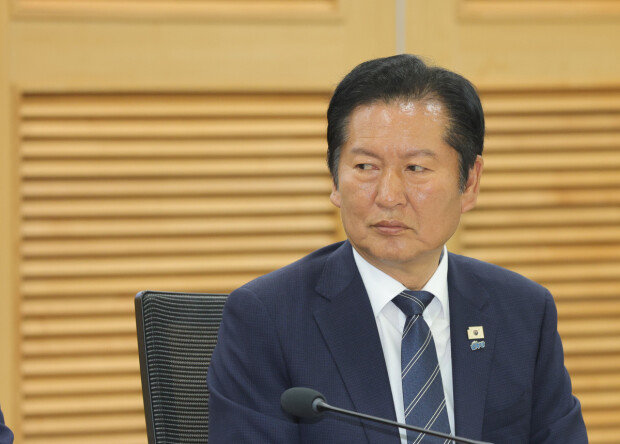
Thursday's closed-door meeting of ruling Democratic Party of Korea lawmakers erupted with frustration over the June 3 local election results. Several lawmakers called for party leader Chung Cheong-rae to resign, blaming him for the disappointing outcome. In his opening remarks, Chung emphasized unity, saying, “First, unity. Second, unity. Third, unity.” But his plea did little to defuse criticism of the party's handling of candidate selections, primary contests, and the campaign strategy. Some lawmakers directly told him that regaining public trust and ensuring the government's success required new leadership.
The dispute reflects more than a disagreement over election strategy. With the party convention just two months away, the debate over responsibility for an election that produced neither a clear victory nor a clear defeat is increasingly taking on the character of a leadership struggle. President Lee Jae-myung's assessment that losing races the party was expected to win could not be considered a success was widely interpreted as a rebuke of Chung. Chung's response that “the people endure, while political power is temporary” only added fuel to tensions between competing factions.
Signs of strain within the party became harder to ignore when Chung, usually present to see the president off on overseas trips, was absent as Lee departed for Europe. Instead, Prime Minister Kim Min-seok, widely viewed as a potential contender for the party leadership, appeared at the airport. The unease deepened further when a party spokesperson resigned after publicly wondering whether the president was now seeking to remove the party leader, despite the party's past criticism of former President Yoon Suk Yeol over similar allegations.
Responsibility for an election result that fell short of expectations may begin with the ruling party leadership, but it does not end there. It extends to the broader governing camp, including the president and the administration. Political strategists can offer endless explanations, but elections are ultimately judged by a simple standard: whether those in power understand what voters are saying and respond accordingly. In this election, voters delivered a clear warning to the Democratic Party of Korea. The party's losses in races it was expected to win reflected that message.
This is not the time for the ruling party to focus inward. Its immediate priority must be to address the serious lapses that undermined voters' rights during the election. At the same time, it cannot lose focus on an economy facing growing external pressures or on the daily struggles of ordinary citizens. After pledging a more humble approach following the election, the party must now deliver. Rebuilding trust, prioritizing people's livelihoods, and fostering national unity must take precedence over any internal power struggle. One year into its term, the government and ruling party have no more urgent task.

![[사설]“尹 계엄 하려 北 도발 유도”… 무지한 건지, 무모한 건지](https://dimg.donga.com/c/138/175/90/1/wps/NEWS/IMAGE/2026/06/12/134104085.1.jpg)
![국비 지원받아 무료로 중장비 면허 딴 60대 女농사꾼[은퇴 레시피]](https://dimg.donga.com/c/138/175/90/1/wps/NEWS/IMAGE/2026/06/13/134102134.5.jpg)



 About Dong-A Ilbo