

Court details plot to justify martial law
Court details plot to justify martial law
Posted June. 13, 2026 08:26,
Updated June. 13, 2026 08:26
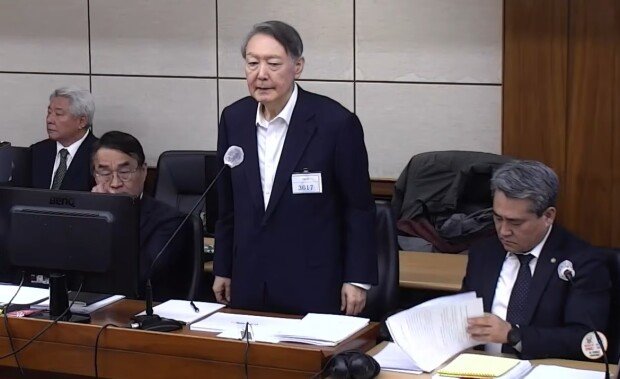
A South Korean court has ruled that former President Yoon Suk Yeol authorized drone operations over Pyongyang in October and November 2024 to create a pretext for declaring martial law. In its first-instance verdict, the court found that Yoon sought to provoke a military response from North Korea and manufacture a national security crisis akin to a wartime emergency. He was sentenced to 30 years in prison, matching the term sought by special prosecutors. Former Defense Minister Kim Yong-hyun, who orchestrated the operation, also received a 30-year sentence, while former Defense Counterintelligence Commander Yeo In-hyung was sentenced to 15 years for his role in the scheme.
The court said the severe punishment reflected the potentially disastrous consequences of the defendants' actions, which could have led to significant casualties or even threatened the nation's stability. According to the ruling, Yoon, whose constitutional duty as commander in chief was to safeguard the country and its citizens, instead exercised military authority to advance personal political objectives unrelated to national security, despite the risk of triggering an armed clash between the two Koreas. After South Korean drones entered Pyongyang, North Korea threatened retaliation and ordered artillery units near the border into a heightened state of readiness.
Yoon argued that he did not learn of the drone operation until after the trial had begun, but the court dismissed that claim. The ruling noted that beginning in March 2024, Yoon met with Kim Yong-hyun, Yeo In-hyung and others at a secure government facility in Samcheong-dong, where he discussed the need for emergency powers and related measures. Given those discussions, the court found no credible reason why Kim would have concealed the operation from him. It also cited notes left by Yeo containing phrases such as "an unstable situation must be created" and "targeting that would inevitably provoke a response because prestige had been damaged." The court viewed those notes as key evidence linking the drone operation to preparations for martial law.
The Pyongyang drone operation was marked by irregularities from the outset. The Drone Operations Command bypassed the normal military chain of command and submitted its operational plan directly to the presidential office under the title "Report for V," referring to the president. Even after the drone incursions became public and officials at the Joint Chiefs of Staff warned that the missions could unnecessarily provoke North Korea, additional drones were reportedly dispatched several times through November, just before martial law was declared.
Martial law is an extraordinary power reserved for the most severe crises, when the nation's security and survival are genuinely at stake. Yet the court found that Yoon sought to invert that principle by creating conditions that could later be used to justify an unlawful declaration of martial law. In doing so, he was prepared to risk military confrontation and place the lives of South Korean citizens in danger. The court's findings paint a troubling picture of a leader entrusted with protecting the nation who, it concluded, lost sight of the most basic responsibilities of the office.

![[속보]日규슈 규모 7.1 지진…부산서도 “건물 흔들렸다”](https://dimg.donga.com/c/138/175/90/1/wps/NEWS/IMAGE/2026/07/28/134380685.2.jpg)
![[속보]日규슈 규모 7.1 지진…쓰나미 경보 발령](https://dimg.donga.com/c/138/175/90/1/wps/NEWS/IMAGE/2026/07/28/134380539.1.jpg)



 About Dong-A Ilbo