

BOK signals rate hikes to curb inflation
BOK signals rate hikes to curb inflation
Posted June. 13, 2026 08:26,
Updated June. 13, 2026 08:26
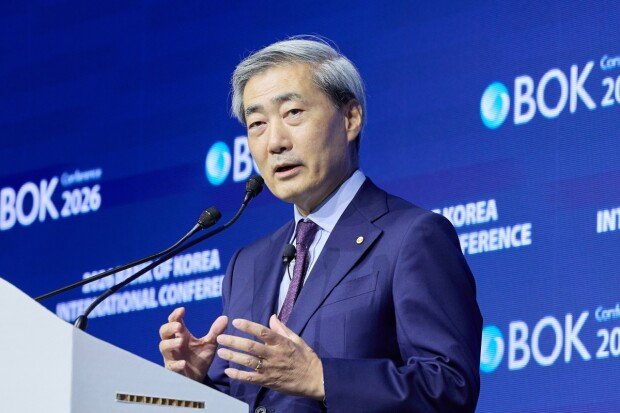
Bank of Korea Gov. Shin Hyun-song said Thursday that interest rates should be raised sooner rather than later, underscoring the central bank's commitment to keeping inflation in check.
The Bank of Korea's repeated signals of tighter monetary policy have fueled expectations of a rate hike at the Monetary Policy Board's July meeting. Because lending rates generally rise alongside the benchmark rate, borrowers are likely to face higher repayment costs in the months ahead.
Markets widely expect the central bank to raise rates twice this year. Some analysts have even raised the possibility of a 50-basis-point increase in July or back-to-back hikes in July and August. Still, any decision on the timing and size of future increases is expected to be made cautiously, given the heavier debt burden higher rates would impose on small business owners, the self-employed and other financially vulnerable groups.
Shin made the remarks at a ceremony marking the Bank of Korea's 76th anniversary at its headquarters in central Seoul. He said economic growth, inflation and financial stability indicators all pointed toward the need for tighter monetary policy. Thursday's comments marked the third time in two weeks that Shin has signaled support for a rate increase.
He added that data released since the Monetary Policy Board's May meeting had reinforced that assessment. The remarks appeared to reflect recent developments in inflation, economic growth, housing prices and exchange-rate movements.
Consumer prices rose 3.1% in May from a year earlier, climbing above the 3% mark for the first time since March 2024. Inflationary pressures have intensified amid the conflict in the Middle East, increasing the likelihood that price growth will exceed the Bank of Korea's second-quarter forecast of 2.9%. Shin also said inflation is expected to remain above the central bank's target for a considerable period.
Addressing concerns that higher rates could increase repayment burdens for households and businesses, Shin said targeted support would be more effective if delivered through fiscal policy. His comments suggested that government spending, rather than monetary policy, should be used to assist those most affected by rising borrowing costs.
In its June economic assessment, known as the Green Book, the Ministry of Economy and Finance said South Korea's economic recovery remains on track. At the same time, it warned that uncertainty linked to the conflict in the Middle East, along with rising prices and slower job growth, continues to weigh on household finances.
Other major economies are also moving toward tighter monetary policy. On June 11, the European Central Bank raised all three of its key policy rates by 0.25 percentage point, its first rate increase in two years and nine months. It became the first central bank among the Group of Seven economies to tighten policy since the outbreak of the Middle East conflict. Expectations are also growing that the Bank of Japan will raise its policy rate at its monetary policy meeting on June 15-16.
세종=김수연 syeon@donga.com


![[오늘의 운세/6월 14일]](https://dimg.donga.com/c/138/175/90/1/wps/NEWS/IMAGE/2026/06/13/134104335.1.jpg)



 About Dong-A Ilbo