

Korean firms target overseas markets in self-driving push
Korean firms target overseas markets in self-driving push
Posted May. 21, 2026 08:25,
Updated May. 21, 2026 08:25
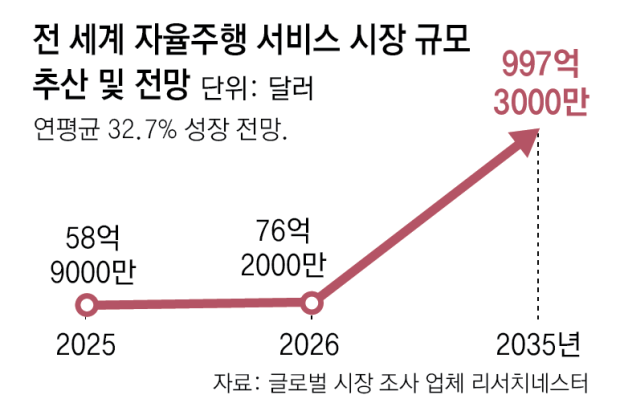
Global autonomous driving is still largely dominated by U.S. and Chinese tech giants, but a growing number of South Korean startups are beginning to carve out space abroad by targeting niche markets where competition from big tech is less intense.
Rather than taking on capital- and data-heavy industry leaders head-on, these firms are focusing on segments that are opening earlier overseas, including public transportation in the Middle East and Southeast Asia, as well as long-haul freight corridors in the United States.
Autonomous A2Z, ranked seventh globally in Guidehouse’s 2025 Autonomous Driving Leaderboard, is leading the push. In November, the company formed a joint venture with UAE-based AI firm Space42 and jointly invested $4 million to win an $8 million autonomous driving project in Abu Dhabi.
In February, A2Z became the first South Korean firm to receive government approval to export “national core technology,” clearing a key hurdle for overseas expansion. With that approval in place, the company plans to deploy its Level 4 driverless platform “ROii” and is targeting additional UAE contracts worth about $7.6 million this year.
The United Arab Emirates is emerging as a key early market. Dubai aims to have autonomous vehicles account for 25% of public transport by 2030, while Abu Dhabi is targeting full autonomy by 2040.
A2Z is also expanding into Southeast Asia and Japan. In Singapore, it has secured an autonomous driving license and is operating urban shuttle services in partnership with Grab, the country’s dominant super-app operator. During President Lee Jae-myung’s state visit to Singapore in March, A2Z signed memorandums of understanding with three organizations, including IT firm NCS, to broaden its local partnerships.
In Japan, the company is assessing commercial opportunities following an autonomous taxi pilot program in Naruto, Tokushima Prefecture, carried out in February and March.
Other Korean startups are also moving into logistics and specialized transport. Mars Auto, a self-driving truck developer, began freight operations in March along a 3,379-kilometer fixed route between the Port of Long Beach in California and Georgia, one of the longest autonomous freight test corridors in the world.
The route targets long-haul trucking segments where driver fatigue remains a major safety risk.
Mars Auto has also been selected for a Korea Institute for Advancement of Technology (KIAT) program supporting new industries and will receive about 2 billion won in R&D funding over two years.
RideFlux is preparing for commercial rollout in 2027, with expansion plans aimed at Japan and Southeast Asia. ThorDrive has begun operating autonomous cargo tugs at airports in Saudi Arabia. By focusing on regions and sectors largely untouched by global tech giants, these companies are positioning themselves early in fast-growing segments of the autonomous driving industry.
Jae-Hyeng Kim monami@donga.com




![“한동훈이 부산 국힘후보 지지 호소땐…당권파, 박민식 사퇴 설득하겠다고 해”[법정모독 UP & DOWN]](https://dimg.donga.com/c/138/175/90/1/wps/NEWS/IMAGE/2026/05/21/133970657.1.jpg)



 About Dong-A Ilbo