

Quiet isolation defines Hopper’s shared-room scene
Quiet isolation defines Hopper’s shared-room scene
Posted May. 21, 2026 08:25,
Updated May. 21, 2026 08:25
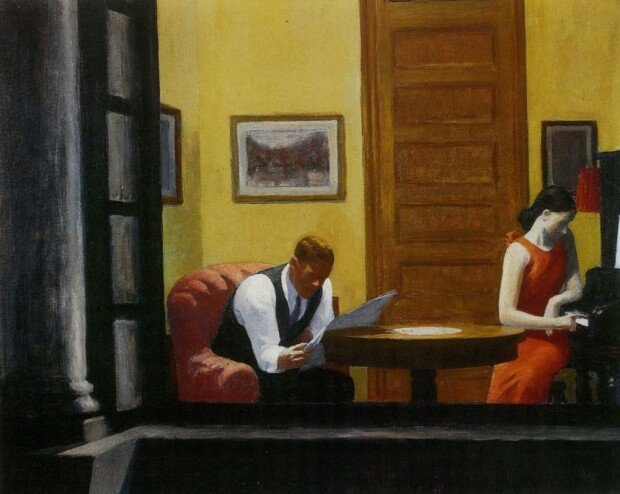
A man and a woman occupy the same brightly lit room, yet appear emotionally miles apart. He sits on a sofa behind a round table, absorbed in a newspaper. She sits at a piano with her back turned, lightly pressing the keys. There is no conversation, no exchange of glances. The scene invites a quiet question: what has come between them to create such a still, chilling sense of distance?
Edward Hopper is widely regarded as an artist who portrayed modern urban loneliness with remarkable precision. His paintings often depict ordinary New York interiors, including hotels, diners, theaters and apartments, populated by figures caught in moments of isolation.
His 1932 work New York Interior reflects this sensibility, depicting the inside of a modest New York home. The models were Hopper himself and his wife, Josephine. A painter in her own right, Josephine also served as his model, recorder and closest companion. But their marriage was anything but calm. They loved each other, yet their relationship was marked by frequent conflict and emotional strain.
In the painting, the woman is not simply seated at the piano. Her posture suggests a subdued, withdrawn state as she idly touches the keys, a gesture that feels less like playing and more like a tentative attempt to reach her husband. He, meanwhile, remains fixed on his newspaper, seemingly unaware of her presence.
Marital tension does not always erupt in open confrontation. More often, it builds in silence, through emotional distance and neglect. Those closest to one another can also become the source of the deepest loneliness. Still, the couple has not fully drifted apart. They remain in the same room, sharing the same evening. The faint sound of piano keys cutting through the silence feels like a muted attempt at communication.
Perhaps marriage is not defined by complete understanding of another person, but by the ability to endure a loneliness that even intimacy cannot erase. At times, love may simply mean staying present in silence, side by side.



![[사설]“김수현 녹취는 AI 조작”… 엄벌 없인 ‘악마적 범죄’ 더 판칠 것](https://dimg.donga.com/c/138/175/90/1/wps/NEWS/IMAGE/2026/05/22/133979690.1.jpg)
![[단독]조부 살해 20대女 “피 엄청 많이…빨리 와주세요” 119 신고](https://dimg.donga.com/c/138/175/90/1/wps/NEWS/IMAGE/2026/05/22/133978390.1.jpg)



 About Dong-A Ilbo