

Trump takes top CEOs to Beijing talks
Trump takes top CEOs to Beijing talks
Posted May. 13, 2026 08:20,
Updated May. 13, 2026 08:20
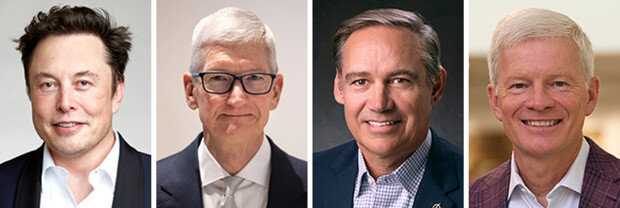
Sixteen leading U.S. executives from the technology and finance sectors, including Elon Musk and Tim Cook, will accompany President Donald Trump on his May 13-15 visit to China. Musk’s inclusion has drawn particular attention, given his previously strained relationship with Trump after once being dubbed the president’s “first buddy.”
Notably absent from the delegation is Jensen Huang, whose company has become a focal point in the escalating dispute over AI semiconductor exports to China.
Bloomberg News and other outlets, citing White House officials, reported Monday that Trump will travel with a large group of corporate leaders representing industries including technology, finance, aviation and agriculture. The delegation includes executives from major financial firms such as BlackRock, Blackstone, Citigroup, Goldman Sachs, Mastercard and Visa.
The aviation sector will be represented by Boeing and GE Aerospace, while agribusiness giant Cargill is expected to participate in talks over Chinese purchases of American farm products. Executives from major tech companies including Meta, Micron Technology and Qualcomm are also expected to join the trip.
A Trump administration official told Bloomberg that the president hopes to use the visit to secure business agreements and purchasing deals with China. Trump is also seeking to finalize details for a bilateral trade commission with Beijing, the official said.
The most closely watched potential agreement involves Chinese purchases of Boeing aircraft. Bloomberg and other media outlets reported that Boeing is nearing what could become its largest-ever order from China, with Beijing expected to purchase 500 Boeing 737 Max jets.
Brian Sikes, Cargill’s chief executive, is also expected to take part in negotiations tied to Chinese imports of U.S. agricultural products.
Bloomberg described Musk’s participation as a sign that relations between Trump and the world’s richest man have improved despite their earlier tensions. Tesla is currently seeking Chinese regulatory approval for its autonomous driving system. Tesla’s Shanghai factory recorded a 36 percent increase in sales last month from a year earlier despite growing competition from Chinese electric vehicle makers such as BYD.
Apple is also expected to closely monitor the trip, as roughly 20 percent of its revenue comes from China and major suppliers including Foxconn maintain large operations there.
Huang’s absence has fueled speculation across the industry, particularly because he has been one of the most vocal advocates for easing U.S. restrictions on AI chip exports to China. In a recent interview with CNBC, Huang said he would join the delegation if invited by the White House.
Henrietta Levin, a senior fellow at the Center for Strategic and International Studies who previously served as the National Security Council’s director for China under former President Joe Biden, said hard-line officials within the White House may have worried Huang would pressure Trump to further open the Chinese market during the trip.
Bloomberg reported that Huang’s exclusion could complicate NVIDIA’s efforts to expand AI chip exports to China. The Trump administration previously approved exports of NVIDIA’s H200 AI chips to China, but Chinese authorities reportedly did not allow domestic companies to purchase them.
Yahoo Finance reported that the size of the business delegation is smaller than during Trump’s 2017 China visit in his first term, when 29 executives joined the trip, and far below the 60 business leaders who accompanied him on last year’s Middle East tour.
Woo-Sun Lim imsun@donga.com




 About Dong-A Ilbo