

Excessive labor demands risk future competitiveness
Excessive labor demands risk future competitiveness
Posted May. 11, 2026 07:47,
Updated May. 11, 2026 07:47
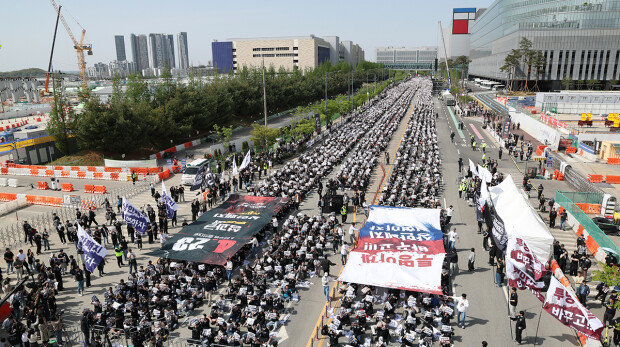
A last-ditch effort to avert a strike at Samsung Electronics is set for May 11 and 12, as labor and management enter government-mediated post-dispute talks. With a general strike scheduled for May 21, the negotiations are widely seen as the final realistic chance to avoid a damaging confrontation. But with both sides still deeply divided, a breakthrough remains far from certain.
Labor tensions are also deepening at Samsung Biologics, where talks involving labor, management and the government have failed to produce meaningful progress. As the standoff drags on, concerns are growing over the possibility of a second general strike.
The possibility of simultaneous disruptions in the semiconductor and biotechnology sectors, two pillars of the South Korean economy, is deepening concerns over the broader economic fallout. At the heart of the dispute at Samsung Electronics is a standoff over the structure of performance-based pay. Management has promised industry-leading compensation for employees in the memory chip division through special incentive packages. The union, however, is standing firm on its demands that 15 percent of operating profit be distributed as bonuses and that the current cap limiting bonuses to 50 percent of annual salary be abolished.
As negotiations have increasingly centered on demands from semiconductor employees, tensions among labor groups inside the company have also intensified. A broader concern is that demands for guaranteed profit-sharing are spreading across major industries. After SK hynix introduced a system allocating 10 percent of operating profit to employee bonuses, Samsung Electronics’ union raised its own demand to 15 percent. Labor groups at other conglomerates have since begun seeking payouts of 20 percent or even 30 percent. Critics argue that pushing for excessive bonus payouts before companies secure investment resources for future growth risks weakening long-term competitiveness. This is hardly a moment for companies to be consumed by battles over profit distribution.
Global technology companies are expected to increase investment in artificial intelligence infrastructure to as much as $1 trillion next year. For South Korean chipmakers, which have emerged as critical players in global supply chains, maintaining aggressive investment and stable production capacity will be essential to seize the opportunity. If excessive payouts reduce investment capacity and strikes disrupt production lines, that opportunity could quickly disappear. Shin Je-yoon, chairman of Samsung Electronics’ board, warned that labor unrest could seriously damage not only corporate competitiveness but also customer trust, shareholder value and the broader economy.
South Korea’s economy is currently benefiting from a long-awaited rebound in the semiconductor sector. The benchmark KOSPI, which hovered in the 2,000 range just a year ago, has repeatedly climbed to new highs on the strength of semiconductor stocks, easing concerns over the long-standing “Korea discount.” But if recurring labor disputes begin to erode corporate fundamentals, those gains could prove temporary. Rather than focusing solely on short-term interests, labor and management need to pursue a reasonable and sustainable solution.






 About Dong-A Ilbo