

Applied Intuition pushes open self-driving platform
Applied Intuition pushes open self-driving platform
Posted May. 11, 2026 07:47,
Updated May. 11, 2026 07:47
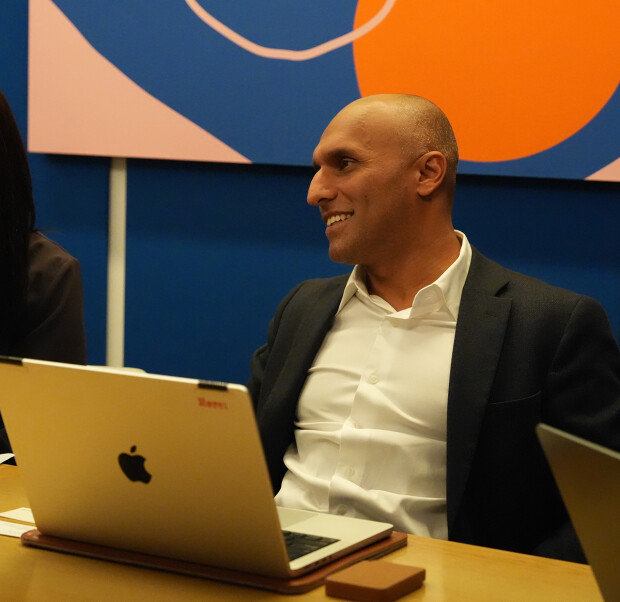
“Unlike Tesla’s strategy of building chips and vehicles entirely in-house, an open platform built through partnerships with global technology companies holds a clear cost advantage.”
Speaking in an interview in Seoul’s Gangnam district on April 29, Qasar Younis, chief executive of Applied Intuition, highlighted the growing importance of an “open ecosystem” in the autonomous driving industry. Instead of a single automaker developing every technology independently, the open-platform model is built around collaboration among carmakers, semiconductor companies and software operators that share technologies and infrastructure.
Founded in Silicon Valley in 2017, Applied Intuition has become a major player in autonomous driving software, specializing in virtual testing systems and vehicle operating systems. Eighteen of the world’s top 20 automakers are among its customers, and the company is valued at about $15 billion.
While Tesla relies on a vertically integrated model that controls everything from chip design to vehicle production, companies in the open-platform ecosystem combine technologies from multiple partners, including NVIDIA automotive chips and AI models, lidar sensors, cameras and vehicle assembly systems. Applied Intuition sits at the center of that network, using virtual simulations to test and refine components before they are integrated into mass-produced vehicles. The structure functions much like a modular system, with outside technologies fitted together like Lego blocks.
In March, Applied Intuition was named a recommended software partner for NVIDIA’s Level 2+ autonomous driving platform. During the same month, the company formed a strategic partnership with LG Innotek, marking the first integration of LG Innotek’s camera, lidar and radar technologies into the platform as a complete package. The two companies expanded their partnership on April 29 to include physical AI technologies such as drones and robotics.
Applied Intuition has also strengthened ties with global automakers. Porsche became the company’s first investor from the automotive sector in 2024, while customers include Toyota, Volkswagen, Nissan and General Motors.
Younis said the collaborative model ultimately lowers costs. “If sensor placement is optimized early through virtual testing, automakers can reduce the number of additional sensors required and cut vehicle component costs,” he said.
Explaining how the company tailors simulation data to different regulatory and driving environments, Younis said Applied Intuition recreates a wide range of real-world conditions in virtual testing systems, from India’s chaotic roads to Seoul’s crowded city streets. “For factors that cannot be fully captured through data alone, such as local traffic flow, regulations and driving habits, we work closely with regional partners to fill in those gaps,” he said.
Industry analysts say the open division-of-labor model could speed up the commercialization of autonomous driving technologies both in South Korea and overseas. As automakers increasingly combine semiconductors, AI models, sensors and validation software in modular form, South Korean parts suppliers and software developers are expected to gain broader access to global automotive supply chains.
“The more mature an industry becomes, the more cost-efficient a horizontal structure spanning hundreds of manufacturers becomes,” Younis said. “Society itself runs on specialization and interdependence. The automotive industry will ultimately follow the same path.”
전혜진 기자 sunrise@donga.com

![[단독]“아내 때렸는데 죽을것 같다” 70대, 신고뒤 투신](https://dimg.donga.com/c/138/175/90/1/wps/NEWS/IMAGE/2026/06/25/134181505.1.jpg)




 About Dong-A Ilbo