

Korea launches flagship fund for offshore wind
Korea launches flagship fund for offshore wind
Posted April. 06, 2026 09:07,
Updated April. 06, 2026 09:07
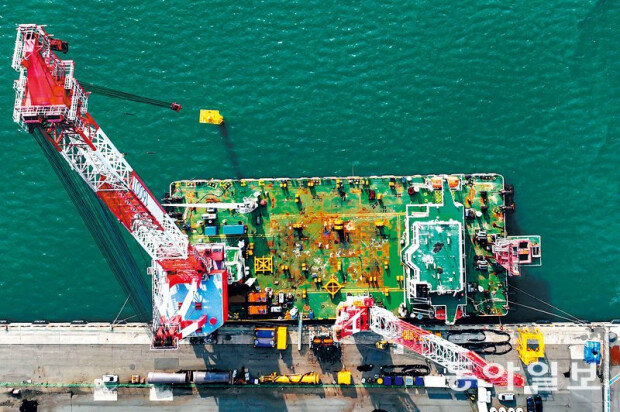
At Mokpo New Port in South Jeolla Province on March 26, a 1,600-ton vessel, the Nuri Baram, was docked at the pier, preparing for departure. The ship is set to sail in early April for the construction site of the Shinan Ui offshore wind farm in Shinan County. The project marks the first investment under a government-led 150 trillion won national growth fund designed to mobilize capital from both corporations and the public.
On deck, beneath a towering crane, crew members were loading substructures required for the wind farm’s construction. Kim Jung-hoon, an executive at CGO, said 76 crew members will remain near Ui Island for about eight months to carry out the work. The vessel will depart in April in line with the project timeline, he added.
The Nuri Baram is a specialized vessel used to transport and install substructures that form the foundation of offshore wind turbines. It is the first of its kind secured by a South Korean company, underscoring the country’s early stage in renewable energy development. According to the Organization for Economic Cooperation and Development, South Korea’s renewable energy share stood at 10.54 percent in 2024, ranking 37th among 38 member countries.
Rising tensions involving the United States, Israel and Iran have heightened concerns over disruptions to oil and liquefied natural gas supplies. For South Korea, which relies heavily on energy imports, the situation has reinforced the urgency of strengthening energy security through renewable sources.
The domestic renewable energy sector has lagged behind advanced economies, with limited technological competitiveness and uncertain returns constraining investment. However, “innovative finance,” which embraces higher risk in pursuit of long-term value, is beginning to take root in offshore wind. It is increasingly seen as a potential catalyst for improving South Korea’s energy self-sufficiency.
There are also growing calls for such financing to play a broader role, supporting strategic industries like renewable energy while helping diversify exports and revitalize regional economies.
Lee Hang-yong, president of the Korea Institute of Finance, said capital should be directed toward more productive sectors and industries capable of generating higher added value to drive future growth.

![“고혈압 치료? 요즘 세계는 더 빨리, 더 엄격하게 하라고 권장”[베스트 닥터의 베스트 건강법]](https://dimg.donga.com/c/138/175/90/1/wps/NEWS/IMAGE/2026/05/22/133976548.4.jpg)




 About Dong-A Ilbo