

Panmnesia Expands into Global Market Through Strategic Collaborations with SK Telecom and Openchip
Panmnesia Expands into Global Market Through Strategic Collaborations with SK Telecom and Openchip
Posted March. 13, 2026 14:42,
Updated March. 13, 2026 15:56
- Through its partnership with SK Telecom, Panmnesia aims to validate and deploy its PCIe 6.4/CXL 3.2 switching solutions in large-scale AI data centers, improving GPU utilization, latency, and overall infrastructure efficiency.
- Its collaboration with Openchip extends Panmnesia’s reach into the European RISC-V and supercomputing ecosystem, where its port-based switching technology could help address interoperability and scalability challenges.
The world’s largest information and communications technology exhibition, Mobile World Congress Barcelona 2026 (MWC 2026), officially opened on March 2. While CES, held each January, focuses primarily on consumer electronics, MWC serves as a global stage for information and communications technology companies. This year’s event brings together approximately 2,800 companies from 205 countries, with 182 Korean companies participating, making Korea the fourth-largest participating country.
Major Korean telecom operators including KT, SK Telecom, and LG Uplus, along with global smartphone manufacturer Samsung Electronics, are attending the event. In addition, 97 small and medium-sized enterprises and around 90 startups are showcasing their technologies.

Vivek Badrinath, Secretary General of the GSMA (Global System for Mobile Communications Association), delivers a keynote speech at MWC26 Barcelona / source=GSMA
MWC was once considered primarily a showcase for telecom operators. However, since the COVID-19 pandemic, the rapid advancement of network technologies, autonomous driving, and artificial intelligence has transformed the event into a major venue where semiconductor companies such as Qualcomm, Arm, and Intel unveil new technologies.
From 2024 to 2025, the rise of generative AI significantly increased the importance of infrastructure and chips. This year’s theme, “The IQ Era—short for the era of Intelligent Connectivity,” reflects an expanded focus beyond chip design to include semiconductor materials, glass substrates, and next-generation packaging technologies. As CES faces limitations in covering highly specialized infrastructure technologies, MWC has benefited from this shift, further establishing itself as a key platform for these innovations.
Among Korea’s AI semiconductor companies, FuriosaAI, Rebellions, DeepX, and Mobilint have set up their own exhibition booths, while MangoBoost CEO Kim Jang-woo and Rebellions CTO Oh Jin-wook delivered presentations during the event. However, one of the most notable companies gaining attention in the ecosystem is AI infrastructure link solution company Panmnesia.
Panmnesia Collaborates with Data Centers and Global AI Semiconductor Companies
Today’s AI data centers connect tens of thousands of GPUs through parallel computing, allowing them to operate as a single massive computer. NVIDIA refers to this architecture as “accelerated computing.”
While NVIDIA GPUs are interconnected using the company’s proprietary NVLink technology, other components—such as CPUs, memory, and storage—are typically connected via the PCIe standard, often routed through network switches. As data passes through these network switches, latency increases and throughput becomes limited by communication bandwidth, creating structural bottlenecks that can constrain overall system performance despite high computational capability.

In November last year, Panmnesia announced the industry’s first PCIe 6.4/CXL 3.2 fabric switch silicon supporting port-based routing / source=Panmnesia
The PCIe 6.4 / CXL 3.2 switch and controller, released by Panmnesia in January, offer a potential solution to latency issues in server-to-server connectivity. Panmnesia, the company founded in August 2022, develops interconnect technologies that physically link CPUs, GPUs, NPUs, and other processing units at the hardware level.
Unlike conventional network switch-based connections, Panmnesia utilizes CXL-based port-based switching, enabling heterogeneous devices from different vendors to be connected and operate as if they were a single system.

From left: Jason Lee, Head of Global Business Development at SKT; Yong-jin Cho, CPO of Panmnesia; Myoung-soo Jung, CEO of Panmnesia; Suk-Geun Chung, Head of AI CIC at SKT; Min-young Jeong, Head of AIDC Solutions at SKT. / source=Panmnesia
Panmnesia is leveraging this technology to collaborate with SK Telecom on data center architecture development.
In August last year, SK Telecom held the groundbreaking ceremony for the SK AI Data Center Ulsan, a hyperscale facility scheduled to deploy 40 MW in its first phase by 2027, with a total investment exceeding KRW 7 trillion to expand to 103 MW by 2029. The data center will house approximately 60,000 GPUs, making it the largest AI-dedicated data center in Korea. SK Telecom plans to pursue the adoption of Panmnesia’s CXL-based solutions for device interconnects in such AI data centers.

Overview of the CXL-based AI rack to be built by SK Telecom and Panmnesia / source=Panmnesia
This collaboration offers significant advantages for both companies. For SK Telecom, it enables improved AI data center utilization and infrastructure efficiency, both of which are critical in an industry where faster and more efficient processing determines competitiveness. As a result, SK Telecom’s AI data center could emerge as a globally recognized benchmark.
For Panmnesia, the partnership represents an important real-world deployment of its technology in a large-scale data center, establishing a strong reference case that could support future contracts with other AI data center operators.
Across nearly all industries, including IT, companies prefer proven and quantifiably validated solutions rather than untested technologies. For emerging technology companies like Panmnesia, launching a business without successful reference cases can be extremely challenging. SK Telecom’s full commitment to collaboration therefore carries considerable significance.
The two companies plan to validate GPU and memory utilization, latency, and throughput in server environments, and unveil a next-generation AI data center architecture within this year. The completed architecture will undergo pilot deployments in large AI data centers before entering commercial operation.
Engagement Not Only with AI DC but Also with Next-Generation Semiconductor Markets Such as RISC-V
On March 5, Panmnesia also signed a strategic partnership with Openchip, a European company specializing in high-performance computing accelerator chip design.
Openchip is a startup established as a joint venture between European system design and integration company GTD and the Barcelona Supercomputing Center (BSC). The company is developing full-stack processors based on RISC-V, an open hardware architecture that allows anyone to design and sell processors without licensing fees.
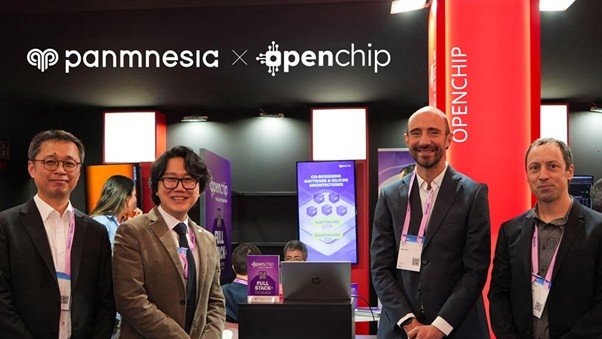
From left: Yong-jin Cho, CPO of Panmnesia; Myoung-soo Jung, CEO of Panmnesia; Cesc Guim, CEO of Openchip; and Gaspar Mora, CTO of Openchip / source=Panmnesia
Unlike traditional architectures such as x86 and Arm, which require licensing from companies like Intel or Arm, RISC-V can be used freely, allowing customized processor design and flexible modification or resale. Another advantage is that software does not need to know the vector length in advance and can automatically optimize for the hardware.
However, RISC-V also has challenges: the limited number of design engineers and high technical complexity, which can make development costly.
Openchip is expanding its operations across Europe. In addition to its headquarters in Spain, the company employs more than 300 staff across Italy, Poland, Belgium, France, Germany, and Ireland. Its projects have been recognized by the European Commission as Important Projects of Common European Interest (IPCEI) and align with Europe’s broader goal of achieving sovereign AI and semiconductor independence.
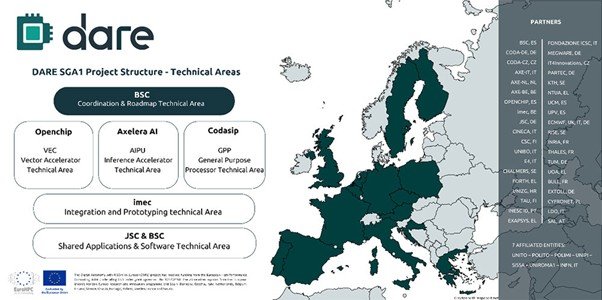
Europe’s DARE (Digital Autonomy with RISC-V in Europe) is a large-scale project in which 38 technology companies and research institutions jointly develop high-performance chips for European supercomputers and AI / source=Jülich Supercomputing Centre
Openchip also participates in DARE (Digital Autonomy with RISC-V in Europe), a major initiative involving 38 technology companies and research institutions working to develop high-performance chips for supercomputers and AI systems. Within the project, Openchip is responsible for developing vector accelerators (VEC), a key computational component based on RISC-V.
Because Openchip originated from the Barcelona Supercomputing Center, the collaboration also opens up potential opportunities for integration with supercomputing environments. In effect, partnering with Openchip positions Panmnesia alongside a core organization in Europe’s emerging supercomputing ecosystem.
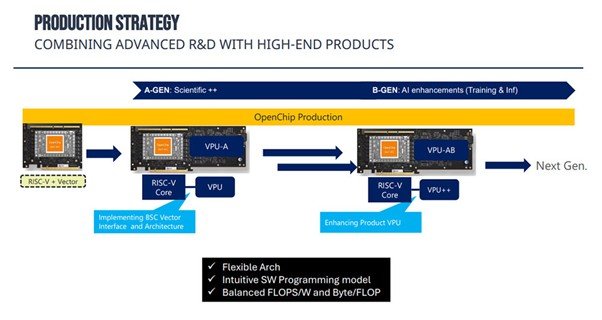
Openchip’s RISC-V-based product roadmap / source=Openchip
Openchip is also developing a PCIe-based vector processing accelerator (VPU) with Japan’s NEC, designed to enhance vector computing performance when installed in existing servers. Because the accelerator is based on RISC-V, compatibility with traditional x86-based systems may be limited. Panmnesia’s technology could potentially address these scalability challenges.
Although RISC-V offers design flexibility, the ecosystem is often criticized for software fragmentation and limited interoperability. In this context, Panmnesia’s port-based switching technology could become a key enabling solution for improving scalability and integration.
Strong Momentum at MWC Draws Global Attention to Panmnesia
One of the major challenges in the AI semiconductor industry today is securing reference deployments. As the industry evolves rapidly, minimizing risk has become essential, making proven infrastructure solutions highly desirable. This is one reason why many hyperscalers and supercomputing centers prioritize NVIDIA products, which have been extensively validated over time.
To establish initial reference cases, governments around the world—including Korea—are increasingly investing public funding or national infrastructure to support validation of domestically developed technologies.
At MWC 2026, Panmnesia achieved two major milestones: securing a collaboration with a major Korean telecom company and establishing a strategic partnership with Openchip, a key player in Europe’s technological sovereignty initiatives.
These developments signal that Panmnesia’s technology and products are beginning to be recognized globally as strategic technologies worth securing early.
The company’s next challenge will be to successfully execute these deployments and build additional reference cases, paving the way for broader adoption in the global AI infrastructure market.
By Si-hyeon Nam (sh@itdonga.com)




![[횡설수설/우경임]고1 男 173cm, 女 161cm… 미국만큼 큰 키](https://dimg.donga.com/c/138/175/90/1/wps/NEWS/IMAGE/2026/04/30/133845047.2.jpg)



 About Dong-A Ilbo