

Korea-U.S. trade talks continue amid tariff tensions
Korea-U.S. trade talks continue amid tariff tensions
Posted January. 31, 2026 09:08,
Updated January. 31, 2026 09:08
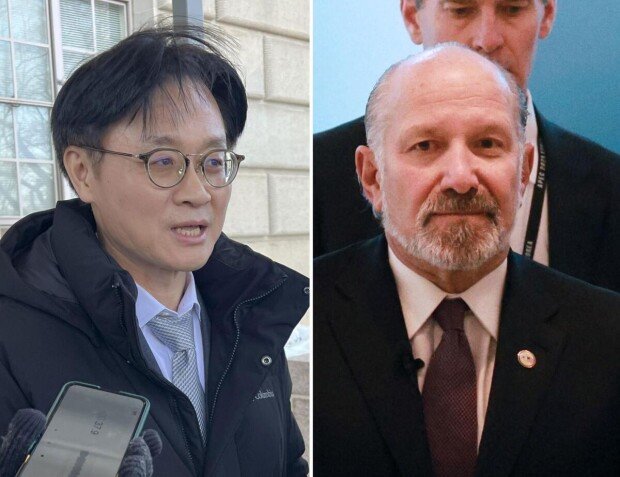
U.S. President Donald Trump announced plans to raise tariffs on South Korea from 15 percent to 25 percent, and South Korea-U.S. commerce ministers held their first talks on Jan. 29 but failed to reach an agreement. Seoul indicated it may begin preliminary consultations on U.S.-bound investment projects even before the National Assembly passes the delayed Special Act on U.S. Investment, while Washington reportedly called for a prompt implementation timeline.
South Korea’s Trade Minister Kim Jung-kwan met with U.S. Commerce Secretary Howard Lutnick at the Commerce Department in Washington. The high-level, face-to-face talks took place three days after Trump said he would reimpose higher tariffs on South Korea.
After the roughly one-hour meeting, Kim told reporters, “No conclusions have been reached yet. We discussed a wide range of issues and agreed to meet again tomorrow morning.” Asked whether they discussed the timetable for publication in the Federal Register, he said, “That topic was not addressed.”
Earlier, U.S. officials reportedly said procedural steps, including publication in the Federal Register, were already under way to reimpose the tariffs. At a Cabinet meeting on Jan. 29, Trump said the tariffs previously imposed on South Korea were “actually very generous” and could be “much steeper.”
Seoul has proposed holding preliminary consultations on U.S.-bound investment projects even before the special law is passed, in an effort to persuade Washington to reconsider the tariff increase. Because the government cannot guarantee when the National Assembly will approve the legislation, advance consultations could allow investment projects to move forward more quickly once it is enacted. Later on Jan. 29, South Korea’s Trade Negotiations Director Yeo Han-gu arrived in Washington and is expected to meet soon with U.S. Trade Representative Jamieson Greer.
Meanwhile, the U.S. Treasury Department redesignated South Korea as a currency watchlist country the same day. South Korea was removed from the list in November 2023 but was added again in November 2024, just before the Trump administration took office. Placement on the watchlist does not automatically trigger sanctions, but it can be used as leverage in future trade negotiations. The presidential office said the redesignation was determined “somewhat mechanically” under Treasury evaluation criteria.
Kyu-Jin Shin newjin@donga.com

![[단독]韓정부, 하메네이 장례식 불참…“이란측에서 난색 표해”](https://dimg.donga.com/c/138/175/90/1/wps/NEWS/IMAGE/2026/07/05/134237981.1.jpg)




 About Dong-A Ilbo