

Iran unrest grows amid economic collapse
Iran unrest grows amid economic collapse
Posted January. 13, 2026 09:33,
Updated January. 13, 2026 09:33
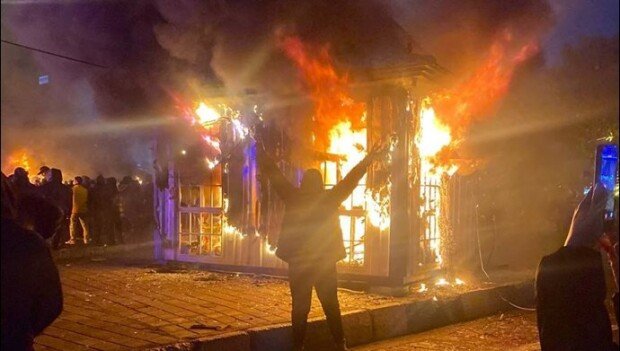
Anti-government protests in Iran that began on Dec. 28 have intensified, with foreign media and human rights groups reporting at least 500 deaths and estimates as high as 2,000 as of Jan. 11 local time. Images have emerged showing bodies piled up and left unattended across major cities, including Tehran.
Analysts say the bloodshed escalated after the Iranian government deployed the Islamic Revolutionary Guard Corps, an elite force directly under Supreme Leader Ali Khamenei whose primary mission is to protect the country’s theocratic system. Amid the violence, U.S. President Donald Trump again suggested the possibility of military intervention, saying he is considering “several strong options.”
● 'Snipers aiming at protesters’ faces, streets filled with blood'
The U.S.-based Human Rights Activists News Agency reported at least 544 deaths in the unrest, including 496 civilians and 48 security personnel, a nearly fivefold increase from 116 reported the previous day. Norway-based group Iran Human Rights confirmed at least 192 deaths and said the actual toll could exceed 2,000. Analysts say casualties have risen rapidly as the Revolutionary Guard has been fully deployed and begun targeting protesters directly.
Reports indicate the government intensified its crackdown after cutting off internet and international phone services on Jan. 8. The Guardian reported that Mahsa, a 28-year-old Iranian journalist, said security forces were firing directly at protesters’ faces, streets were covered in blood, and a large number of deaths had occurred before her phone line went dead.
The protests are widely seen as fueled by growing public anger over Iran’s worst economic crisis on record and longstanding dissatisfaction with the theocratic system led by Supreme Leader Ali Khamenei. Its currency rial has collapsed to a historic low, trading at 994,055 per U.S. dollar as of Jan. 9, roughly 31 times weaker than in 2015, when Iran signed the Joint Comprehensive Plan of Action with five Western powers and the rate was about 32,000 rials per dollar. Food prices have surged more than 60 percent from a year earlier, making it difficult even for the middle class to maintain a normal standard of living. Analysts estimate that more than 30 percent of Iranians are living in poverty. While previous protests were largely driven by university students and progressive intellectuals, merchants and middle-class citizens who once supported the regime are now joining demonstrations in significant numbers.
Another factor cited is the weakening of Khamenei’s authority following conflicts with Israel and the United States, despite Tehran’s claims of regional leadership. Iran suffered a decisive defeat last year in the so-called 12-day war against Israel and the United States. U.S. strikes on nuclear facilities and Israel’s targeted killings of Iranian military leaders and nuclear scientists exposed vulnerabilities in the regime.
During recent demonstrations, protesters reportedly chanted slogans openly rejecting the current system, including calls for the restoration of the monarchy, death to Khamenei, and an end to interference by neighboring countries.
● Trump: 'Military intervention is a strong option'
The United States is closely monitoring the situation and weighing the possibility of military action. Trump said aboard Air Force One on Jan. 11 that the administration receives hourly briefings on Iran and is considering several strong options, with a decision expected soon. He also said the United States would support satellite internet access through Starlink to counter Iran’s internet shutdown. The Wall Street Journal reported that Trump is scheduled to receive a detailed briefing on military strike options from U.S. security officials on Jan. 13.
Trump also raised the possibility of dialogue, saying Iran has proposed negotiations with the United States. He added that Iran appeared fatigued from repeated U.S. strikes, and while Washington could act first, it is also prepared to engage in talks.
Still, opposition to U.S. military intervention has surfaced within American politics. Republican Sen. Rand Paul said on ABC that bombing is not a solution and that the Constitution does not allow the president to launch airstrikes at will.
Many analysts say it remains uncertain whether the protests will lead to the collapse of the Khamenei regime. The military, centered on the Revolutionary Guard, continues to prop up the system, and no clear political alternative has emerged to channel public anger. Iran experienced mass protests over alleged election fraud in 2009 and demonstrations against mandatory hijab rules in 2022, yet the Khamenei regime endured. Jang Ji-hyang, head of the Center for Regional Studies at the Asan Institute for Policy Studies, said the regime’s future will depend on whether external forces such as U.S. military intervention come into play and how Iran’s elites and the Revolutionary Guard respond.
Keun-Hyung Yoo noel@donga.com



![“코 스프레이 2번 뿌렸더니 기억력 쑥”…치매 치료 가능성 [노화설계]](https://dimg.donga.com/c/138/175/90/1/wps/NEWS/IMAGE/2026/05/29/134018314.3.jpg)



 About Dong-A Ilbo