

Hyundai’s Motional tests robotaxi in Las Vegas
Hyundai’s Motional tests robotaxi in Las Vegas
Posted January. 13, 2026 09:32,
Updated January. 13, 2026 09:32
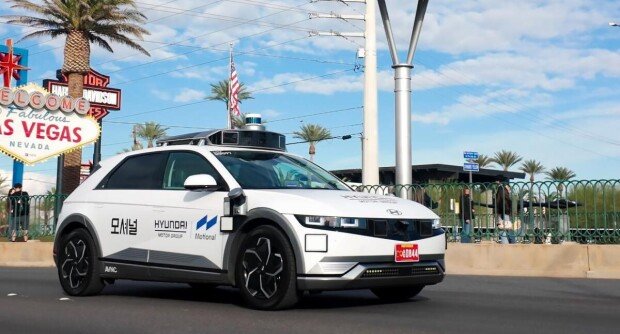
On Jan. 8 local time, Motional, a joint venture between Hyundai Motor Group and U.S. autonomous driving company Aptiv, showcased its autonomous driving technology during a test ride event in Las Vegas for journalists attending CES 2026, the world’s largest information technology and consumer electronics exhibition. The demonstration came ahead of full-scale robotaxi test operations scheduled to begin in the area later this year.
Passengers entered the rear seat of a Hyundai electric vehicle Ioniq 5 bearing the word “Motional” prominently written in Korean on its exterior. Inside the vehicle, multiple cameras, radar and lidar sensors made it immediately clear that the car was operating as an autonomous robotaxi. Following instructions displayed on a screen in front of the seat, passengers fastened their seat belts and pressed the “START” button. The vehicle then set off smoothly. The front display showed the planned route along with real-time graphic information on nearby vehicles and pedestrians.
During the roughly 30-minute drive covering about 14 kilometers, the Motional vehicle adjusted its speed in response to traffic conditions, much like a human driver. As it left a wide roadway and entered Town Square, an outdoor shopping complex where lanes suddenly narrow, the vehicle’s movements became noticeably more cautious. Icons representing pedestrians or bicycles passing close to the car repeatedly appeared and disappeared on the screen.
Particularly striking was the system’s apparent ability to anticipate pedestrian intent and adjust its driving accordingly. When a pedestrian’s upper body and gaze were directed toward the roadway, the system determined that the person intended to cross and automatically stopped or sharply reduced speed. When that was not the case, it concluded the pedestrian was continuing along the sidewalk and maintained a slow pace.
The vehicle also accurately recognized road signs. At intersections, it consistently came to a complete stop at red, inverted triangular stop signs with white lettering, then detected vehicles to the left, right and ahead before proceeding.
Lane changes were also smooth. After passing through Town Square and entering Las Vegas Boulevard, where the airport and major highways intersect, the vehicle assessed the speed of surrounding traffic, activated its turn signal autonomously and changed lanes efficiently. At locations with two left-turn lanes, it even shifted into the lane with fewer waiting vehicles.
Hyundai Motor Group plans to conduct test operations of Motional robotaxis in Las Vegas through the end of this year, with commercial service scheduled to begin later this year. During the test phase, an employee will sit in the driver’s seat to ensure safety. Once commercial operations begin, the vehicles are expected to operate at Level 4 autonomy, which does not require a human driver on board.
Motional’s autonomous driving system uses an end-to-end approach, in which the vehicle makes its own driving decisions by integrating data from multiple sensors. Tesla’s Full Self-Driving system also uses this method. While the approach offers greater versatility because it can be applied to a wide range of roads rather than fixed routes, it also carries a higher risk of unexpected incidents.
Laura Major, CEO of Motional, said the company is using artificial intelligence training to address rare but critical situations, such as suddenly opening vehicle doors or responding to emergency vehicles, and to refine performance down to what she described as the final 1 percent.
Motional is still widely seen as lagging behind Tesla and Chinese competitors in the accumulation of driving data. Motional’s autonomous vehicles have logged about 160 million kilometers, compared with roughly 11.2 billion kilometers for Tesla and an estimated 240 million kilometers for Baidu’s Apollo in China.
Hyundai Motor Group aims to narrow that gap through the commercialization of Motional’s Level 4 autonomous driving technology. A Hyundai Motor Group official said Motional’s top priority is the successful launch of its planned commercial service later this year. The official added that once the technology and overall competitiveness are further strengthened, the company may consider expanding deployment to other regions, including South Korea.
라스베이거스=박종민기자 blick@donga.com








 About Dong-A Ilbo