

Korean AI teams highlight 3D, omnimodal technology
Korean AI teams highlight 3D, omnimodal technology
Posted December. 31, 2025 09:28,
Updated December. 31, 2025 09:28
“Create a small white rabbit.”
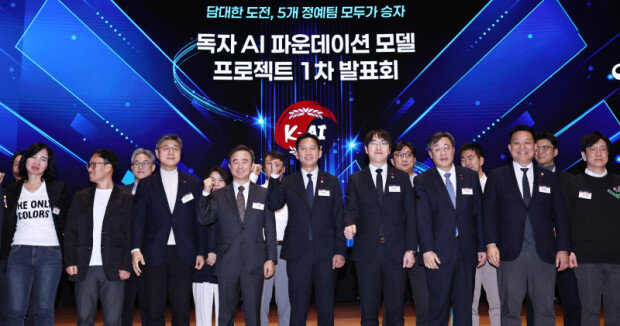
On the afternoon of Dec. 30, during the opening presentation of the Domestic AI Foundation Model Project at COEX in Gangnam, Seoul, the sentence was typed into a monitor at NC’s artificial intelligence demonstration booth. Within seconds, four slightly different rabbit images appeared on the screen. After one was selected and the prompt “Change to T-pose” was entered, the rabbit reappeared standing upright with its arms extended. About a minute later, a fully rendered three-dimensional rabbit emerged at the center of the display, allowing viewers to examine it from every angle, including the back of its head and tail. In the “Animation” tab, users could specify joints such as the jaw, shoulders, elbows and spine and select “Dance,” prompting the rabbit to move fluidly and perform a dance across the screen.
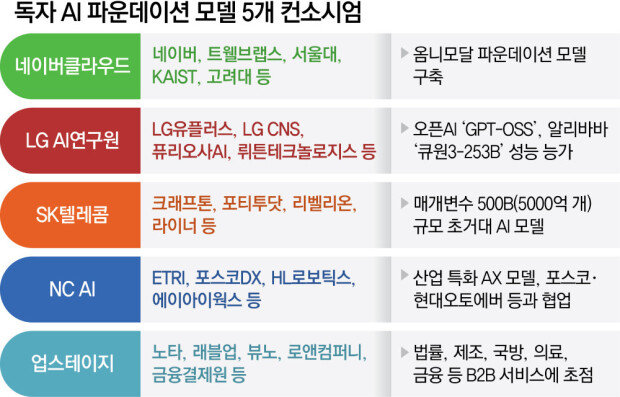
The Domestic AI Foundation Model Project was launched by the Ministry of Science and ICT with the goal of developing a globally competitive, Korean-style artificial intelligence. In August, five teams, Naver Cloud, LG AI Research, SK Telecom, NC AI and Upstage, were selected following expert evaluations. On Dec. 30, the teams presented and demonstrated the AI technologies they have developed to date. The venue was filled with spectators eager to witness the competition to identify a so-called national representative AI. Vice Prime Minister and Minister of Science and ICT Bae Kyung-hoon said, “The first step toward becoming one of the world’s top three AI powers is elevating domestic AI foundation models to world-class standards.”
The first presentation was delivered by Naver Cloud, which has consistently emphasized what it calls “omnimodal AI.” Its HyperCLOVA Seed 8B Omni model learns text, images, and video simultaneously and produces outputs across multiple modalities. The company likened this process to the way the human brain integrates different forms of information. Naver also unveiled its high-performance inference model, HyperCLOVA 32B Think, which earned top grades across all major subjects, including Korean, mathematics, English, and Korean history, on this year’s College Scholastic Ability Test. Naver’s CEO said the results were made possible by the model’s ability to interpret charts and images alongside text.
NC AI followed with a demonstration of its strategy to apply AI to industrial transformation by leveraging three-dimensional graphics and visual data derived from its gaming assets. The company said AI used in fields such as smart manufacturing requires advanced 3D graphics capabilities. NC AI CEO Lee Yeon-su said, “Our goal is to give strategic industries wings through AI so they can compete on the global stage.”
SK Telecom then showcased its ultra-large AI model, A.X.K1, which has 500 billion parameters, making it the largest model developed in South Korea to date. For comparison, OpenAI’s ChatGPT-5, released in August, is estimated to have approximately 2.5 trillion parameters.
LG AI Research emphasized that its K-ExaOne model is designed to strike a balance between performance and cost efficiency. The company said it set performance benchmarks comparable to leading frontier AI models in the United States and China, citing K-ExaOne with 236 billion parameters and Alibaba’s Q-1 3 235B. Upstage, the only startup participating in the project, presented its Sola Open 100B model, which it said was built to better understand Korean culture and linguistic nuance.
The government plans to announce the results of the first evaluation before Jan. 15. One of the five teams will be eliminated in the initial round, with one team removed every six months thereafter. The process will narrow the field to two finalists by the first half of 2027. The teams ultimately selected will receive annual support of approximately 3 billion won to 5 billion won, covering computing resources such as graphics processing units as well as data construction and processing costs to further advance their AI models.
전혜진기자 sunrise@donga.com


![[김순덕 칼럼]이 대통령은 왜 ‘탄핵 가능성’을 언급했을까](https://dimg.donga.com/c/138/175/90/1/wps/NEWS/IMAGE/2026/06/17/134133459.1.jpg)
![[단독]선관위, 결재없이 55억 써도 고작 견책…‘자체 징계’ 솜방망이](https://dimg.donga.com/c/138/175/90/1/wps/NEWS/IMAGE/2026/06/19/134138827.4.jpg)


 About Dong-A Ilbo