

Latin America moves right as pink tide fades
Latin America moves right as pink tide fades
Posted December. 29, 2025 08:30,
Updated December. 29, 2025 08:30
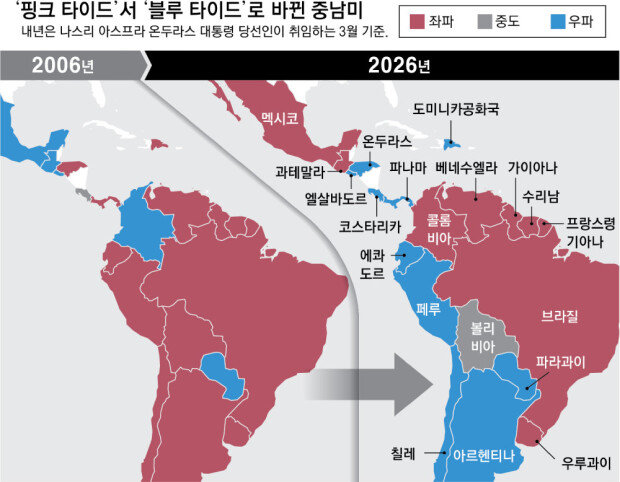
2025 marked a year of upheaval in Latin America’s political landscape, representing the region’s most dramatic shift in nearly three decades. Analysts say the era of the moderate left’s sequential rise to power, known as the pink tide, which began with Hugo Chavez’s election in Venezuela in 1998, is now waning. The opposing trend, a wave of right-wing governments often referred to as the blue tide, is expected to extend into next year.
Across four presidential elections held in Latin America in 2025, left-wing candidates were defeated in every contest. As a result, right-leaning governments now govern 10 of the region’s 20 countries, while centrist administrations hold power in one, giving the right and center a combined majority. Bolstered by the backing of U.S. President Donald Trump, these leaders staged a robust comeback, securing office on promises to ease economic strain and intensify efforts against crime and drug trafficking.
● Right-wing surge: 'We will fix the economy and public safety'
In Honduras, where vote counting concluded on Dec. 24, conservative candidate Nasry Asfura won the presidency, sealing a clean sweep of defeats for the Latin American left in the 2025 election cycle. President-elect Asfura, who is set to take office in January, is a right-leaning politician who stresses cooperation with the United States and pro-business policies. Beyond Honduras, right-wing or centrist candidates also prevailed this year in Chile, Bolivia and Ecuador.
The retreat of the Latin American left is widely attributed to rising public frustration as violent crime and illegal immigration increased and inflation accelerated. Son Hye-hyun, an adjunct professor at the Graduate School of International and Area Studies at Hankuk University of Foreign Studies, said the pink tide was driven by ideology, while the blue tide reflects voter assessments of governing performance, particularly on public safety and food security. She added that as stalled industrialization and the spread of criminal groups have begun to threaten basic survival, public opinion across Latin America is steadily shifting to the right.
In Chile, where public security deteriorated sharply under a left-wing government, hard-line conservative Jose Antonio Kast won the presidency after vowing to deport undocumented immigrants and deploy the military to high-crime areas. Bolivia, governed by leftist administrations for two decades, saw the inauguration last month of centrist, free-market advocate President Rodrigo Paz. In his inaugural address, Paz said ideology does not fill the dinner table, while emphasizing the need to overcome economic hardship, eradicate corruption and improve relations with the United States. In Honduras, voters also signaled support for a tough approach earlier this year by backing President Daniel Noboa’s iron-fisted campaign, which included deploying the military to suppress gangs.
A common thread across these countries is President Donald Trump’s active backing of pro-American forces, despite controversy over U.S. involvement in domestic politics. Ahead of Argentina’s midterm elections in October, the Trump administration pledged $40 billion in investment along with a currency swap to support President Javier Milei. Milei’s ruling party went on to secure a landslide victory in the midterms.
Right-wing leaders across Latin America have also embraced the image of being their country’s own version of Trump, adopting policies such as restrictive immigration measures, hard-line responses to crime and a pro-market stance. Milei visited the United States more than 10 times this year to showcase close ties, while El Salvador President Nayib Bukele deepened cooperation by accepting illegal immigrants deported by the Trump administration into his country’s correctional facilities.
● Blue tide likely to consolidate next year
The blue tide in Latin America is expected to move into a phase of consolidation in 2026. Brazil, Colombia, Peru and Costa Rica are all scheduled to hold presidential elections that year, and analysts forecast tightly contested races. Two of the contests are seen as leaning right and two left, with most observers predicting that none will result in a change in the governing party.
In Costa Rica and Peru, where elections are set for February and April next year, candidates from the conservative ruling parties are widely expected to prevail. In Colombia, despite deep political instability following the fatal shooting of right-leaning Sen. Miguel Uribe Turbay during a campaign rally in June, Sen. Ivan Cepeda of the ruling party currently leads opinion polls. In Brazil, President Luiz Inacio Lula da Silva, who has prioritized closer cooperation with China, is favored to win reelection. Former President Jair Bolsonaro’s son, Sen. Flavio Bolsonaro, who is close to U.S. President Donald Trump, has entered the race. According to a Bloomberg News poll released on Dec. 18 ahead of the October election, Lula held 47.9 percent support, far ahead of Bolsonaro at 21.3 percent.
이지윤기자 asap@donga.com








 About Dong-A Ilbo