

Special insurrection court bill passes amid constitutional concerns
Special insurrection court bill passes amid constitutional concerns
Posted December. 24, 2025 09:50,
Updated December. 24, 2025 09:50
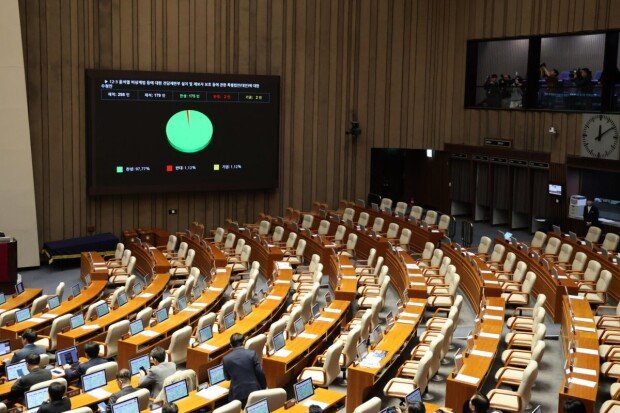
A bill to establish a special court dedicated to handling cases related to the Dec. 3 emergency martial law was passed by the National Assembly on Dec. 23, led by the Democratic Party of Korea. The bill, which was revised repeatedly amid controversy over its constitutionality, now largely mirrors regulations prepared by the Supreme Court to operate such a court. Critics say, however, that the Democratic Party’s insistence on pushing the legislation through may instead provide grounds for delaying insurrection trials involving former President Yoon Suk Yeol and others.
At a plenary session that day, the National Assembly approved the Act on Special Criminal Procedures for Crimes of Insurrection, Foreign Aggression and Rebellion, commonly referred to as the special insurrection court bill, with 175 votes in favor, two against and two abstentions. Jang Dong-hyeok of the People Power Party began a filibuster the previous day, delivering what became the longest speech in constitutional history at 24 hours in an attempt to block the bill. The Democratic Party ended the filibuster in accordance with the National Assembly Act and passed the bill by vote. The People Power Party did not participate in the vote.
The Democratic Party initially drafted the bill to allow a recommendation committee led by external figures, including the justice minister and the secretary general of the Constitutional Court, to select judges for the special court. After the proposal became mired in constitutional controversy, the party shifted to a revised version that called for a recommendation committee formed within the judiciary, including through a meeting of judges’ representatives. Criticism persisted, however, that the selection of judges through any recommendation committee would itself be unconstitutional. In the final version, the party eliminated the recommendation committee altogether and instead allowed judges’ meetings and case assignment committees at the Seoul Central District Court and the Seoul High Court to form the special court.
During this process, the Supreme Court prepared its own regulations to operate a special insurrection court through judges’ meetings and case assignment committees. Under those regulations, panels determined through random case assignment would handle insurrection cases exclusively, a move that appeared to accommodate the Democratic Party’s demands while steering clear of constitutional concerns.
By passing legislation in the National Assembly that closely resembles the Supreme Court’s regulations, however, the Democratic Party may have increased the likelihood of further delays in trials involving former President Yoon Suk Yeol and others connected to the Dec. 3 emergency martial law. A presiding judge at a high court in the Seoul metropolitan area said defendants in insurrection cases could argue that their right to a fair trial has been violated, since a court was effectively created after the fact by the Democratic Party for specific cases, potentially giving them grounds to seek a constitutional review of the law.
Choi Bo-yoon, senior spokesperson for the People Power Party, said in a statement that the Democratic Party had ultimately chosen to make itself “a sinner in the judgment of history.” She criticized the move as an attempt to shape trial outcomes through legislative power, calling it a decision that directly violates the constitutional order. He added that repeatedly changing the form of the bill does not erase what he described as its unconstitutional nature, characterizing the Democratic Party’s incremental revisions as little more than an acknowledgment that the legislation was fundamentally flawed.
김자현 zion37@donga.com






 About Dong-A Ilbo