

UNIST physicist proposes new space-time quantum theory
UNIST physicist proposes new space-time quantum theory
Posted December. 23, 2025 08:59,
Updated December. 23, 2025 08:59
“God does not play dice.”
Albert Einstein, the physicist who developed the theory of relativity, made the remark while criticizing the uncertainty principle of quantum mechanics. For decades, physicists have attempted to bridge the gap between quantum mechanics and relativity, yet those efforts have largely failed to narrow the divide. One fundamental challenge lies in the way the two theories conceptualize reality. Relativity treats space and time as a unified framework known as spacetime, while quantum mechanics has traditionally defined quantum states separately in spatial and temporal terms. Recently, however, a South Korean research team proposed a new theoretical framework that seeks to resolve this long-standing incompatibility.
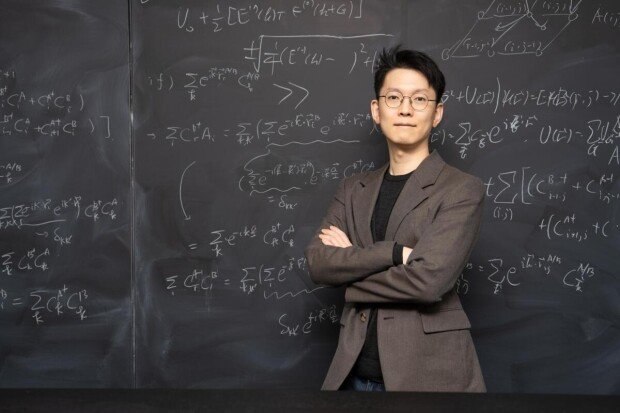
The Ulsan National Institute of Science and Technology, or UNIST, said on Dec. 22 that Lee Seok-hyung, a 32-year-old professor in its Department of Physics, published a new theory describing quantum states that vary simultaneously across space and time in the international journal Physical Review Letters, widely known as PRL. The paper was released just two years after Lee joined the faculty. Until now, quantum states have largely been treated as separate entities depending on whether they were defined spatially or temporally. For example, events occurring at the same moment in the United States and South Korea, which represent spatial states, and events occurring in South Korea on different days, which represent temporal states, have traditionally been defined and analyzed independently.
The theory proposed by Lee, titled “multi-quantum states over time,” allows quantum states to be expressed within a single mathematical structure that unifies space and time. “This work describes spatial quantum states and temporal quantum processes, which have been written in different languages, using a single, unified mathematical language,” Lee said. “The theory makes it possible to narrow the gap with relativity, which has long treated spacetime through a single mathematical framework.” UNIST described PRL as an exceptionally influential journal, noting that while publication in Nature or Science often draws public attention, publication in PRL is widely regarded as influential enough to change physics textbooks.
최지원 기자 jwchoi@donga.com







 About Dong-A Ilbo