

High exchange rate intensifies pressure on Korean firms
High exchange rate intensifies pressure on Korean firms
Posted December. 23, 2025 08:59,
Updated December. 23, 2025 08:59
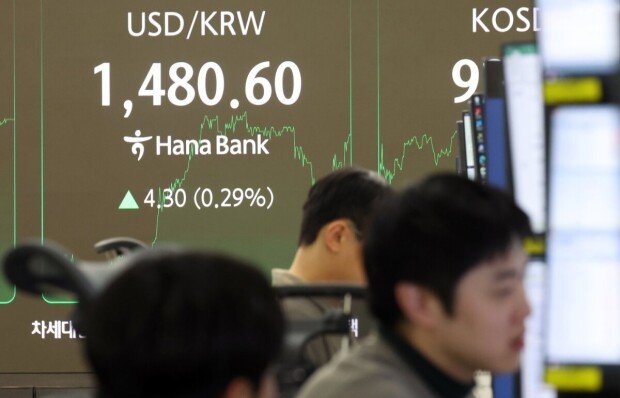
As the won-dollar exchange rate has surged to nearly 1,500 won per dollar, concerns are mounting across South Korea’s industrial sector. Fears over damage from the elevated exchange rate are spreading beyond currency-sensitive industries such as aviation and steel to small and midsize enterprises that lack the capacity to manage foreign exchange risk. With weak domestic demand compounded by adverse currency conditions, more than half of companies say they expect business conditions next year to be difficult.
● Airlines, steelmakers and small firms fear direct impact from exchange rate surge
According to industry and financial sector sources on Dec. 22, the won-dollar exchange rate, which remained in the 1,300-won range through mid-September, entered the 1,400-won range on Sept. 24 and has continued to climb. As of Dec. 22, it stood at 1,480.1 won based on the weekly trading close, surpassing the 1,480-won mark. This level exceeds the average exchange rate of 1,394.97 won recorded during the 1998 foreign exchange crisis.
The aviation industry has been particularly hard hit. Fuel costs, which account for about 30 percent of total operating expenses, as well as aircraft leasing fees, are all settled in dollars. For full-service carriers, even a 10-won increase in the exchange rate is known to raise costs by at least 20 billion won and by as much as 40 billion won. An official at a low-cost carrier said fees for overseas ground handling services have risen sharply in recent years, and with the exchange rate continuing to climb, airlines are being forced to shoulder even heavier financial burdens.
The steel industry is also closely monitoring currency movements, as a higher exchange rate pushes up the cost of imported iron ore, which accounts for the largest share of raw material expenses. POSCO consumes about 50 million tons of iron ore each year, all of it imported. The sector has found some relief as iron ore prices fell to roughly $100 per ton from about $120 per ton in the first half of last year. However, that advantage could vanish if the exchange rate rises further. A steel industry official said fierce price competition with Chinese producers leaves little room to pass rising raw material costs on to product prices.
Small and midsize enterprises are the most exposed to high exchange rate risks. A survey conducted by the Korea Federation of SMEs from Dec. 1 to Dec. 19 involving 635 companies found that 40.7 percent of firms engaged in both exports and imports suffered losses due to the sharp rise in the exchange rate. That far exceeded the 13.9 percent who said they benefited from the currency movement. An executive at a fashion-related small business that imports fabric from Southeast Asia said raw material prices have risen about 10 percent because of the exchange rate, but it is realistically difficult to raise supply prices by the same amount. The executive added that the company is ultimately absorbing the increase itself.
● More than half of companies say next year will be difficult
With the high exchange rate persisting toward the end of the year, corporate outlooks are growing increasingly uncertain. According to the Korea Enterprises Federation’s “2026 Corporate Business Environment Survey,” conducted among the country’s top 1,000 companies by sales, 52.0 percent of respondents said business conditions next year would be difficult. Among them, 34.0 percent described conditions as somewhat difficult, while 18.0 percent said they would be very difficult. The relatively high share of “very difficult” responses suggests companies are feeling a substantial economic burden. Only 44.7 percent of respondents said business conditions would be favorable.
Companies cited heightened volatility in foreign exchange markets, including exchange rates, as the top global business risk at 26.7 percent, reflecting recent sharp currency swings. That was followed by the expansion of protectionism and export barriers at 24.9 percent, a slowdown in the global economy and delayed recovery at 19.8 percent, and instability in import prices for energy and raw materials at 15.3 percent.
Won-Joo Lee takeoff@donga.com








 About Dong-A Ilbo