

Democratic Party accepts special prosecutor in Unification Church probe
Democratic Party accepts special prosecutor in Unification Church probe
Posted December. 23, 2025 08:58,
Updated December. 23, 2025 08:58
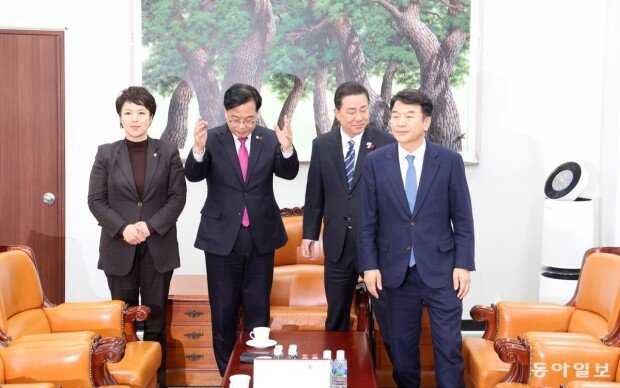
The Democratic Party of Korea on Dec. 22 abruptly accepted a call for a special prosecutor to investigate allegations that the Unification Church provided money and other benefits to politicians. The party reversed its previous stance, in which it had called the demand “not worth considering,” after the People Power Party and the minor New Reform Party agreed to propose a special prosecutor bill, intensifying pressure over allegations involving figures from the ruling camp. The presidential office welcomed the move, saying a thorough investigation should be conducted regardless of rank or party affiliation. As a result, a full-scale probe is expected into allegations that the Unification Church lobbied politicians across multiple administrations, including the Moon Jae-in and Yoon Suk Yeol administrations.
Democratic Party of Korea leader Jeong Cheong-rae said at a meeting of the party’s supreme council that day that he saw no reason to reject a special prosecutor for the Unification Church case. He added that including all those linked to the People Power Party to fully uncover the truth would align with public sentiment. Floor leader Kim Byung-kee also called for a special prosecutor investigation with no exceptions for politicians from either party and urged a review of how the Unification Church intervened in politics during the last presidential election.
The People Power Party and the New Reform Party both issued statements welcoming the ruling party’s acceptance of a special prosecutor. Floor leaders from the ruling and opposition parties began negotiations later that day to reach an agreement on a special prosecutor bill for the Unification Church case.
The Democratic Party of Korea’s shift toward accepting a special prosecutor appears to reflect a judgment that it would be difficult to maintain a defensive stance as pressure mounts over allegations that figures from the ruling camp received money or favors from the Unification Church. With Rep. Jeon Jae-soo having stepped down as oceans and fisheries minister, and with testimony, recordings and reports from Yoon Young-ho, the former global headquarters chief of the Unification Church and a key figure in the lobbying case, also naming several prominent opposition figures, the party is believed to see limited political risk in a broad investigation. Party officials also said strong support among Democratic Party of Korea backers for introducing a special prosecutor made continued resistance risky, as it could be viewed as obstructing state affairs.
The presidential office said it hopes the Democratic Party of Korea’s acceptance of a special prosecutor will provide momentum for a comprehensive investigation. It added that the full truth behind allegations of collusion between politics and religion must be uncovered and those responsible held accountable. Reports said that after a high-level ruling party and government meeting the previous day, presidential office officials met with Democratic Party of Korea leaders to express support for a special prosecutor. A presidential office official said confidence that no figures close to President Lee Jae-myung are implicated also factored into the decision to accept the probe.
Meanwhile, the ruling party on the same day introduced legislation for a “second comprehensive special prosecutor,” which would allow investigations to last up to 140 days. The party said that once the investigation periods for the three major special prosecutors, including the Kim Keon Hee special prosecutor led by Min Joong-ki, end on Dec. 28, it will immediately move to launch the second comprehensive special prosecutor.
Dong-Jun Heo hungry@donga.com

![[속보]호르무즈서 교전…이란 “유조선 공격하는 미군 격퇴”](https://dimg.donga.com/c/138/175/90/1/wps/NEWS/IMAGE/2026/05/08/133883338.3.jpg)


 About Dong-A Ilbo