

Hwang Sok-yong returns with epic historical novel
Hwang Sok-yong returns with epic historical novel
Posted December. 10, 2025 08:12,
Updated December. 10, 2025 08:12
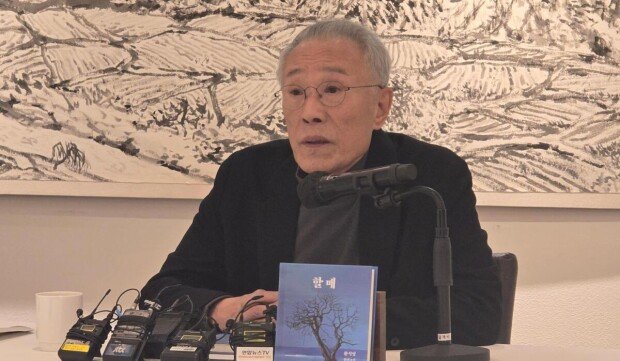
“All things in this world eventually come full circle. That realization is what I wanted to capture in this novel.”
Novelist Hwang Sok-yong, 82, held a press conference in Seoul’s Jung District on Dec. 9 to mark the release of his new book, “Grandma” (original Korean title: Halmae). The novel is Hwang’s first full-length work in five years, following "The Old Railroad Workers" (2020), which drew international attention after being shortlisted for the International Booker Prize last year.
Hwang emphasized that the passage of time surrounding the tree reveals “not a linear history, but a cycle of relationships and interconnected destinies.”
The story spans 600 years of Korean history, told through the life of an ancient hackberry tree known as the matriarch tree, which has withstood the turbulence of time. The narrative unfolds from the early 14th century, shortly after the founding of the Joseon Dynasty, to the modern era, shaped by waves of conflict and societal transformation. Hwang said he drew inspiration from a real 600-year-old hackberry tree in Haje Village, Gunsan, North Jeolla Province.
Hwang emphasized that the years surrounding the tree reveal not a linear history, but a cycle of relationships and interconnected destinies. “During the pandemic, I reflected deeply on life and death," he said. "I came to feel that every relationship is cyclical and that karma is constantly transmitted and transformed.”
The novel features characters with deep personal histories who discover the enduring value of hope and solidarity amid despair. “My aim was to portray the hackberry tree, destined to disappear because of a development project, and to bring to life the 600 years of ordinary people who lived alongside it,” Hwang said.
이지윤 leemail@donga.com

![“李대통령 만들어줬는데 말 안 듣는다는 게 문조털래유 생각”[정치를 부탁해]](https://dimg.donga.com/c/138/175/90/1/wps/NEWS/IMAGE/2026/06/24/134175928.1.jpg)
![[속보]손흥민 빼고 오현규 원톱…홍명보, 남아공전 ‘승부수’](https://dimg.donga.com/c/138/175/90/1/wps/NEWS/IMAGE/2026/06/25/134178970.2.jpg)



 About Dong-A Ilbo