

Japan warns of powerful quake threat after Aomori shock
Japan warns of powerful quake threat after Aomori shock
Posted December. 10, 2025 08:13,
Updated December. 10, 2025 08:13
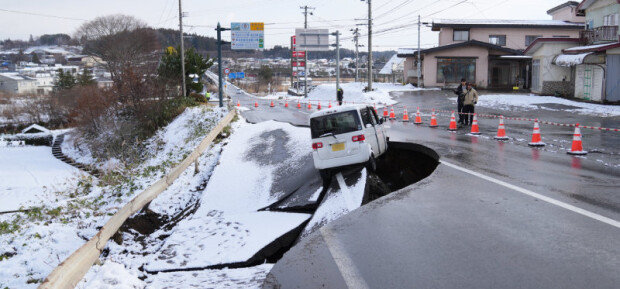
A magnitude 7.5 earthquake struck off the coast of Aomori Prefecture in northeastern Honshu on Dec. 8, injuring more than 30 people. Anxiety has continued to rise as strong aftershocks followed, including a magnitude 6.4 quake in a nearby area the next morning. The Japanese government issued its first “Hokkaido–Sanriku Offshore Secondary Earthquake Advisory,” warning that a massive quake could strike surrounding regions. Authorities urged residents to prepare for emergency evacuation because the likelihood of a magnitude 8.0 or stronger earthquake within the next week is higher than usual.
The Japan Meteorological Agency said the magnitude 7.5 earthquake struck at 11:15 p.m. on Dec. 8 off the northern tip of Honshu near Aomori Prefecture, with a focus depth of 54 kilometers. In Hachinohe, Aomori Prefecture, close to the epicenter, the quake registered a seismic intensity of level 6 strong. Japan’s seismic intensity scale measures how people and objects respond to shaking in the affected area. At level 6, it is nearly impossible for a person to remain standing, and unsecured furniture typically moves or topples. The Asahi Shimbun reported that such strong shaking had never been recorded in Aomori Prefecture since seismometers were installed in October 1996.
The powerful earthquake was also felt in Tokyo, where seismic intensity level 3 shaking was recorded. Residents reported furniture and walls rattling and colliding during the tremors. Following the quake, the Japan Meteorological Agency issued a tsunami warning of up to 3 meters for Aomori and surrounding areas. At 1 a.m. on Dec. 9, a tsunami reaching 70 centimeters was observed at Kuji Port in Iwate Prefecture. Later that morning, at 6:52 a.m., another estimated magnitude 6.4 earthquake struck off the coast of Aomori, followed by continued aftershocks.
According to Kyodo News, 34 people were injured in Aomori, Iwate, and Hokkaido, the regions nearest the epicenter. No deaths have been reported. Several roads were closed, and water supplies were disrupted. A total of 187 schools in Aomori and Hokkaido suspended classes following the earthquake.
Damage from the magnitude 7.5 earthquake is considered relatively limited compared with the magnitude 7.6 quake that struck the Noto Peninsula in central Honshu on Jan. 1 last year, which killed 691 people. Analysts said the latest earthquake caused less destruction because its epicenter was offshore and the focus depth of 54 kilometers was much deeper than the 16 kilometers recorded during last year’s Noto earthquake.
Even so, the Japanese government remains on high alert. Around 2 a.m. on Dec. 9, the Japan Meteorological Agency issued its first “Hokkaido–Sanriku Offshore Secondary Earthquake Advisory” in connection with the quake. This marked the first activation of the advisory system since it was introduced in December 2022.
The advisory applies to Pacific coastal regions stretching from Hokkaido to Chiba Prefecture. Authorities warned that a massive earthquake of magnitude 8.0 or greater is possible and said some seismologists do not rule out a scenario worse than the 2011 Great East Japan Earthquake. That disaster struck offshore from the Tohoku region on March 11, 2011, reached magnitude 9.0 and resulted in 22,228 deaths and missing persons as of March 1 this year. During a press briefing early on Dec. 9, the Japan Meteorological Agency said global earthquake statistics show that, historically, one out of 100 earthquakes of magnitude 7.0 or stronger is followed by a magnitude 8.0 or stronger earthquake within a week, meaning the likelihood has risen above normal levels.
Under the secondary earthquake advisory, residents in tsunami-prone areas are advised to sleep in clothing that allows for immediate evacuation and to keep emergency supplies within reach. Schools, commercial facilities, and public transportation will continue operating as usual. The advisory is set to remain in effect through Dec. 16.
Japanese Prime Minister Sanae Takaichi urged the public to take disaster preparedness seriously. She asked residents to protect themselves, review evacuation routes, and secure furniture, while staying alert to updates from the Japan Meteorological Agency and local governments over the next week.
In-Chan Hwang hic@donga.com

![[사설]당 대표의 ‘기괴한 알박기’에 꼼짝 못 하는 국민의힘](https://dimg.donga.com/c/138/175/90/1/wps/NEWS/IMAGE/2026/06/29/134205596.1.jpg)

![[횡설수설/장원재]日 월드컵 감독은 고졸 비주류](https://dimg.donga.com/c/138/175/90/1/wps/NEWS/IMAGE/2026/06/29/134205606.1.jpg)




 About Dong-A Ilbo