

Audit finds Yoon pushed 2,000 medical school seats
Audit finds Yoon pushed 2,000 medical school seats
Posted November. 28, 2025 07:13,
Updated November. 28, 2025 07:13
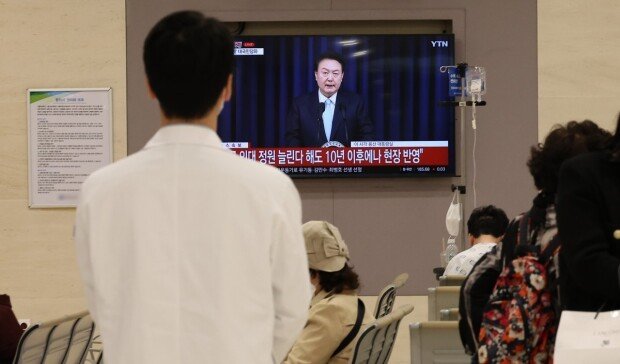
A government audit found that the Yoon Suk-yeol administration’s decision to increase medical school quotas by 2,000 students, which sparked legislative conflict, stemmed from former President Yoon repeatedly rejecting phased expansion reports from the Ministry of Health and Welfare and instructing officials to “increase the quota sufficiently.” As Yoon and the presidential office pushed for a large, one-time increase during his term, the ministry adjusted its calculations to justify the number of additional doctors.
According to the Board of Audit and Inspection’s report on the process of expanding medical school quotas, released Nov. 27, former Health and Welfare Minister Cho Kyu-hong reported in June 2023 that the ministry planned to add 500 students annually from 2025 to 2030. Former President Yoon returned the proposal, saying the increase should exceed 1,000 students per year. In response, the ministry submitted a revised plan in October 2023 to raise the quota by 1,000 students annually from 2025 to 2027 and by 2,000 in 2028. Although this increased the six-year total from 3,000 to 5,000 over four years, Yoon still said it was “not enough” and rejected the plan.
Following Yoon’s repeated demands, Cho instructed the relevant department to calculate the doctor shortage based on 2035. Without conducting a separate forecast, the ministry referred to three existing papers from the Korea Institute for Health and Social Affairs, the Korea Development Institute, and Seoul National University, which suggested a shortage of more than 10,000 doctors. The ministry then submitted a report to the presidential office stating that 10,000 additional doctors would be needed. According to the audit, Lee Gwan-seop, then chief secretary for national planning at the presidential office, was the first to propose dividing the 10,000 additional doctors over five years, with 2,000 students added annually, to complete the expansion within the president’s term.
Concerned about pushback from medical associations, the ministry presented both a phased plan starting with 900 students and a 2,000-student one-time plan to former President Yoon in December 2023. Yoon opposed the phased plan, saying, “There will be opposition anyway,” and instructed officials to explore ways to reduce resistance to the one-time increase.
In January 2024, Cho proposed a one-time increase of 1,700 students, but Lee, then chief secretary of the presidential office, recommended sticking with the original 2,000-student plan. The 2,000-student one-time increase was finalized in February 2024. The audit concluded that the Ministry of Health and Welfare did not initially calculate the need for 2,000 students. Rather, it created supporting calculations in response to the presidential office’s demand for a larger increase.
이윤태 oldsport@donga.com

![‘대포통장 공장’ 통째로 날린 英… 잔가지만 치는 韓[히어로콘텐츠/히든④-上]](https://dimg.donga.com/c/138/175/90/1/wps/NEWS/IMAGE/2026/06/25/134175409.1.jpg)
![[단독]SK, 광주-전남 반도체 단지에 신재생 투자도 검토](https://dimg.donga.com/c/138/175/90/1/wps/NEWS/IMAGE/2026/06/23/134162317.1.jpg)
![“李대통령 만들어줬는데 말 안 듣는다는 게 문조털래유 생각”[정치를 부탁해]](https://dimg.donga.com/c/138/175/90/1/wps/NEWS/IMAGE/2026/06/24/134175928.1.jpg)



 About Dong-A Ilbo