

U.S. approves South Korea nuclear submarines, cuts tariffs
U.S. approves South Korea nuclear submarines, cuts tariffs
Posted November. 15, 2025 07:20,
Updated November. 15, 2025 07:20
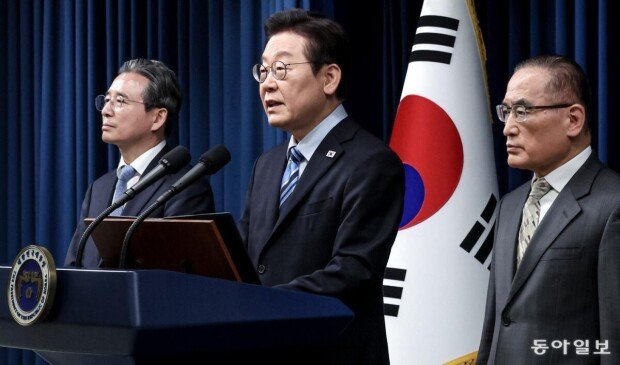
South Korea and the United States released a joint factsheet on tariffs and security on Nov. 14. The United States said it would approve South Korea’s construction of nuclear-powered submarines and support expanded authority for uranium enrichment and spent fuel reprocessing. In exchange for a $35 billion investment commitment in the United States, Washington also agreed to lower its tariff on South Korean automobiles to 15 percent and reduce semiconductor tariffs to a level comparable with those applied to Taiwan.
President Lee Jae-myung held a briefing the same day, saying, “One of the biggest variables for our economy and security, the South Korea-United States trade and security negotiations, has been finalized.” The announcement came 16 days after the South Korea-U.S. summit on Oct. 29.
The factsheet released by the two governments states that the United States has given its approval for South Korea to build nuclear-powered submarines and that Washington will work closely with South Korea to advance the construction project, including fuel supply. The document does not specify where or when the submarines will be built or how fuel will be supplied, indicating that further negotiations are likely.
On the expansion of enrichment and reprocessing authority, the factsheet states, “Within the scope consistent with the 123 Agreement and in compliance with U.S. legal requirements, the United States supports a process that would allow South Korea to pursue civilian uranium enrichment and spent fuel reprocessing.” The South Korean government has sought to secure authority comparable to Japan through a revision of the South Korea-U.S. nuclear energy agreement, but the factsheet does not explicitly reflect that goal.
After releasing the factsheet, the two sides also signed a memorandum of understanding on strategic investment in the United States. Both the factsheet and the MOU include a safeguard specifying that for the $200 billion in cash contributions within the $350 billion investment fund, South Korea will not be required to secure more than $20 billion per year. The investment commitment must be finalized by Jan. 19, 2029, the final day of U.S. President Donald Trump’s term. Investment returns will be split evenly until the principal is recovered, then shared on a one-to-nine basis between South Korea and the United States. In exchange, the U.S. auto tariff will be cut to 15 percent, and semiconductor tariffs will be guaranteed at the same level as those applied to Taiwan.
Jeong Cheong-rae, chair of the Democratic Party of Korea, welcomed the outcome, calling it a highly successful negotiation for the national interest. In contrast, Jang Dong-hyeok, leader of the People Power Party, criticized it as a blank sheet rather than a factsheet.
Kyu-Jin Shin newjin@donga.com




 About Dong-A Ilbo