

South Korea deploys AI robots in army operations
South Korea deploys AI robots in army operations
Posted November. 11, 2025 08:25,
Updated November. 11, 2025 08:25
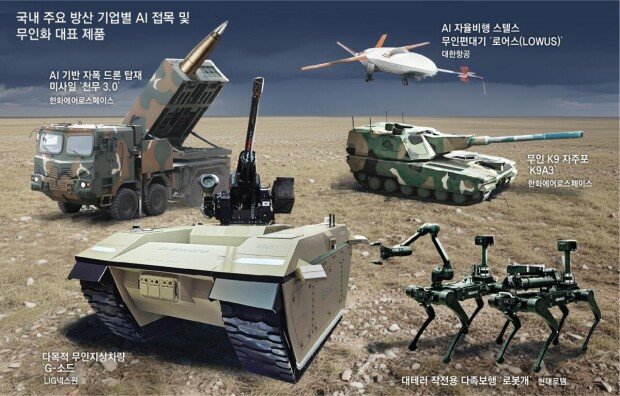
Robots are now tasked with detecting and removing landmines in the Demilitarized Zone on behalf of soldiers. In combat, locating wounded troops who fall behind the unit is also assigned to “robot dogs” instead of human reconnaissance teams. All of these technologies have either already been introduced by the South Korean military or are scheduled for deployment soon.
The real-world adoption of artificial intelligence and unmanned systems, once considered a distant prospect, is accelerating rapidly. On Nov. 10, the defense industry reported that the Defense Acquisition Program Administration signed a 270 billion won ($202 million) contract to mass-produce explosive detection and disposal robots at Hanwha Aerospace’s plant in Changwon, South Gyeongsang Province.
The robots could be deployed to frontline units as early as the end of this year, with full operational capability expected by 2027. Hyundai Rotem, in collaboration with Rainbow Robotics, has already conducted test deployments of its military AI robot dog, the “multiped combat robot,” in select Army units. The robot can travel at speeds of up to 4 kilometers per hour and conduct reconnaissance and search operations for approximately two hours.
The robots could be deployed to frontline units as early as the end of this year, with full operational capability expected by 2027. Hyundai Rotem, in collaboration with Rainbow Robotics, has already tested its military AI robot dog, the multiped combat robot, in select Army units. The robot can travel at speeds of up to 4 kilometers per hour and conduct reconnaissance and search operations for about two hours.
These shifts in the defense market are expected to create significant opportunities for K-Defense. South Korea’s technological capabilities are at the forefront of advanced defense sectors, particularly in artificial intelligence and unmanned systems. In the first half of this year alone, South Korean defense companies signed export contracts worth $6.9 billion, or roughly 10.03 trillion won, solidifying the country’s position as the world’s tenth-largest defense exporter. According to PBC Business Insights, the global digital battlefield market, valued at $53.4 billion, or about 77.72 trillion won, last year, is projected to reach $209.5 billion, or roughly 304.9 trillion won, by 2032.
Looking ahead, South Korea aims to become one of the world’s four leading defense powers. At the 2025 Seoul Aerospace and Defense Exhibition last month, President Lee Jae-myung said achieving top-four defense status is not an impossible dream and pledged to invest unprecedented budgets in defense and aerospace research and development through 2030. South Korean defense companies are concentrating their efforts on advancing next-generation core technologies, including artificial intelligence and unmanned systems, to reach this goal.
Won-Joo Lee takeoff@donga.com






 About Dong-A Ilbo