

South Korea, China summit boosts bilateral relations, talks
South Korea, China summit boosts bilateral relations, talks
Posted November. 03, 2025 08:04,
Updated November. 03, 2025 08:04
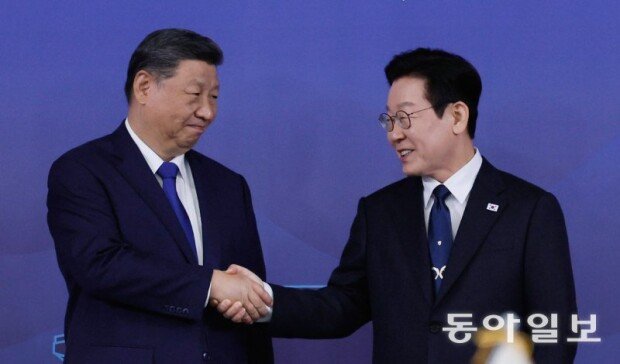
President Lee Jae-myung and Chinese President Xi Jinping agreed to strengthen strategic communication to improve bilateral relations during their first summit on Nov. 1. The two leaders also signed a 70 trillion won currency swap and agreed to accelerate the second phase of negotiations for the Korea-China Free Trade Agreement. Observers say relations between Seoul and Beijing, which had fallen to their lowest point amid U.S.-China strategic rivalry and rising anti-China sentiment, may now be on a path to recovery following Xi’s state visit to South Korea, his first in 11 years. Concerns raised by China over South Korea’s nuclear-powered submarine program were also discussed during the summit, with analysts warning the issue could become a new source of tension in bilateral relations.
At the start of the meeting, Xi said, “China and South Korea are important and close neighbors that cannot be separated and indispensable partners in cooperation.” According to China Central Television, Xi proposed strengthening strategic communication, deepening economic cooperation, promoting mutual interests, expanding people-to-people exchanges to improve public sentiment, and advancing peace and development through multilateral cooperation. In his public remarks that day, Xi repeated the word “cooperation” nine times. During his previous summit with then-President Yoon Suk Yeol in November 2022, Xi also called for stronger strategic communication, but regular high-level dialogue was suspended as relations sharply deteriorated afterward.
President Lee said, “As the structure of economic cooperation between South Korea and China shifts from a vertical to a horizontal model, our two countries must develop further toward a mutually beneficial partnership.” The two nations extended their currency swap agreement and signed memorandums of understanding to strengthen cooperation in services and trade, with the second phase of FTA talks in mind.
During the summit, President Lee explained that South Korea’s nuclear-powered submarines carry conventional rather than nuclear weapons and serve a defensive purpose, according to a government official. The issue, which has raised concern in Beijing, was among the agenda items discussed by the two leaders.
The two sides also showed differences over North Korea’s denuclearization. National Security Adviser Wi Sung-lac said, “President Lee asked President Xi to play a constructive role in promoting North Korea’s denuclearization.” He added, “China expressed its willingness to cooperate for peace and stability on the Korean Peninsula but said dialogue between the United States and North Korea is essential to resume talks.” Beijing has recently avoided making direct references to denuclearization.
The Asia-Pacific Economic Cooperation summit concluded on Nov. 1 with the adoption of the Gyeongju Declaration, the AI Initiative, and the Joint Framework for Responding to Demographic Change. It was the first time APEC adopted a document presenting a shared vision for artificial intelligence.
Kyu-Jin Shin newjin@donga.com






 About Dong-A Ilbo