

STYLEmate Uses Data-Driven Matching to Find Optimal Influencers for Marketing Efficiency.
STYLEmate Uses Data-Driven Matching to Find Optimal Influencers for Marketing Efficiency.
Posted October. 29, 2025 10:18,
Updated October. 29, 2025 10:19
- STYLEmate uses proprietary AI technology called LookTag to analyze influencer
content and match brands with the most suitable influencers based on
objective data, improving marketing efficiency.
- The company combines automated AI-driven matching with human expertise to
ensure both speed and creative quality, resulting in successful campaigns
and strong brand-influencer synergy.
- STYLEmate is expanding globally and aims to become an AI SaaS solution for
influencer marketing, supporting both short-term campaign performance
and long-term brand growth.
“Fashion and beauty brands constantly deliberate over which influencers to entrust with their marketing campaigns to maximize efficiency. A good influencer must be found not by ‘gut feeling,’ but by ‘data.’ With our proprietary AI-based LookTag technology, we match the optimal influencer to maximize marketing efficiency according to the brand's characteristics.”
This is the statement of Sang-hee Han, CEO of STYLEmate. STYLEmate is a company possessing AI data analysis technology that analyzes influencer images and content, converting unstructured data into structured data. Based on objective data, it helps brands easily find influencers who fit their target audience, facilitating fast and effective campaign execution. It also assists in matching influencers of various nationalities, enabling global marketing campaigns.
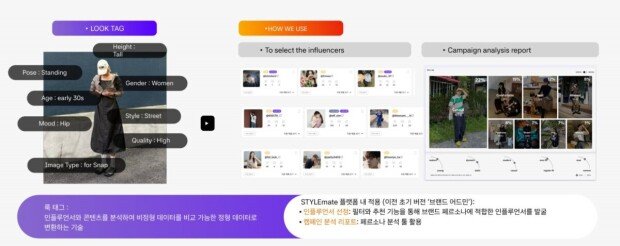
STYLEmate: Automating Brand-Perfect Influencer Matching Based on ‘LookTag’
Han explained, "STYLEmate focuses its capabilities on matching influencers perfectly suited to a brand based on our proprietary AI technology, LookTag, and presenting the results with objective indicators." She added, "We convert an influencer's content from unstructured data (photos, videos, hashtags, etc.) into structured data like 'style,' 'mood,' 'tone,' and 'consumer reaction.' We then analyze the marketing brand's history and past campaign data to automatically match the influencer who will yield the optimal efficiency."
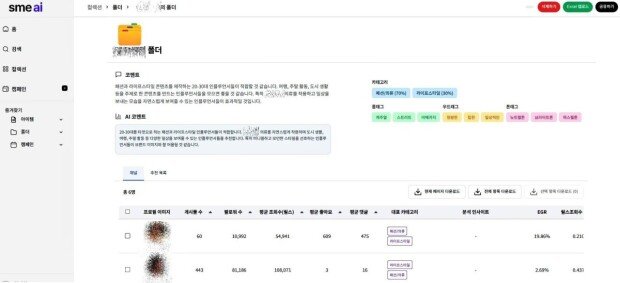
She continued, "Because the AI combines learned data with the brand persona to recommend the influencer with the most synergy, the brand can confirm with data 'why this influencer fits our brand.' Instead of simply matching influencers with a high follower count, we can accurately find those who fit the brand's mood based on qualitative factors like content style, tone, and consumer reaction patterns." Han stated, "Thanks to this, we reduce the time and cost
of executing marketing campaigns while increasing promotional efficiency, leading to results that mutually satisfy both the brand and the influencer."
Han shared a case study demonstrating STYLEmate's technological utility.
"A major conglomerate's fashion brand, 30 years on the market, wanted to shed its old image and launch a campaign bordering on a complete rebranding," she said. "Previously, they relied on their internal marketing team or external agencies to create influencer content, but satisfaction was low regarding both effectiveness and the content's creative quality. STYLEmate analyzed the persona the brand desired using LookTag, matched the influencers likely to create the most synergy, and proceeded with the campaign. As a result, exposure increased by about 300% compared to past content, and content shares and saves rose by about 190%."
"The highly satisfied brand went on to use the influencer content directly as Instagram ad creative. We were able to confirm a structural effect that not only reduced costs compared to existing methods but also improved both content efficiency and consumer response," Han emphasized.
Leveraging Two Strengths: ‘AI-based Automated Influencer Matching Platform + Aesthetically-Driven Content’
STYLEmate differentiates itself by utilizing both its AI-based automated matching platform and the human touch.
"I want to define STYLEmate as a midpoint between an agency and a solution," Han said. "This is because we adopted a structure where the AI-based automated matching platform ensures efficiency and speed, while humans handle creative content planning and brand care. Agencies produce high-aesthetic content but are slow, while platforms are fast but easily miss brand context. For example, even if a legacy jeans brand wants to run a marketing campaign to build a younger image, an AI relying on past data might match an influencer who emphasizes history. Therefore, STYLEmate has humans complement the technology, leveraging both strengths to create content optimized for the brand's KPIs."
She continued, "I recall a time when a fashion brand requested a marketing campaign while opening a pop-up store at a department store in Yeouido. At that time, we quickly matched influencers suitable for the brand based on LookTag and assisted with the campaign execution. The brand, on a limited budget, only requested influencer matching. But we didn't stop there; we personally contacted influencers suitable for the desired campaign and invited them to the offline site. As a result, about 50 influencers visited the location, creating a viral buzz centered on short-form content. This was a strategy that went beyond simple online seeding to connect influencers with an offline brand experience, and a case of leveraging the synergy between technology and people. The brand was moved by the unexpected influencer participation... and developed an ongoing relationship with STYLEmate. Thanks to this meticulousness, STYLEmate currently collaborates with over 200 brands and more than 6,000 influencers."
"We Will Build Market Trust by Securing More Precise Data"
STYLEmate identified data refinement and securing market trust as its growth tasks.
"For STYLEmate to grow further, we need data refinement and market trust," said Han. "Influencer marketing is still an area where brands find it difficult to execute budgets aggressively because of the perception that 'it's hard to prove the effects numerically.' We need an understanding that running one influencer campaign doesn't immediately improve ROAS (Return on Ad Spend). Rather, we intend to prove with data that it is helpful for long-term branding and securing a brand's own content assets. To this end, our R&D is focused on matching influencers based on LookTag, STYLEmate's unique data, and presenting those results as objective indicators."
"We are also pursuing service expansion into the global market. In Japan, we are already conducting cross-border campaigns linking Korean and Japanese brands and influencers. In the United States, we are preparing a Proof of Concept (PoC) by discovering local brands and partners. I believe marketing is all about references, so we aim to prove our technology and the problems we are solving in the actual market through good campaign cases, and then feed those results back into technology advancement," she conveyed.
STYLEmate was able to advance its technology with the help of various support organizations. Among them, Han recalls that the achievements made with Seoul National University of Science and Technology (SeoulTech) were a great help in technology development.
"While there are many support programs for startups, 'Jungle,' a global corporate collaboration program run by Seoul National University of Science and Technology (SeoulTech) and AWS, was extremely helpful as it provided insights immediately applicable in the actual industry," Han said. "I was particularly satisfied that it meticulously supports startups at various stages, from early to growth, and provides growth support from a partnership perspective, not just simple grants. Furthermore, we gained practical global market entry insights, including overseas expansion strategies, sales, and networking methods. We were also able to have substantive discussions with AWS during the process of materializing our AI technology. Consequently, the biggest achievement was being able to simultaneously advance our technological foundation and global expansion strategy thanks to the Jungle program."
Finally, we heard about STYLEmate's future plans.
"As of this year, over 200 cumulative brands are using STYLEmate. We started primarily in the fashion sector in our early days, but we have now expanded our categories to beauty and lifestyle. A memorable achievement this year is that as the content quality improved through data-based persona analysis and matching, the number of brands wanting to collaborate with STYLEmate's affiliated influencers increased," Han stated.
"Going forward, we plan to focus more on advancing our LookTag-based AI matching and expanding global/cross-border campaigns. In particular, through PoCs and partnerships in the Japanese and U.S. markets, we will push for advancement into an AI SaaS solution so that brands can easily collaborate with influencers and secure content in the global market. We will also continuously improve the solution's functions to establish ourselves as a marketing AI solution that can be efficiently used by everyone from early-stage startups to growth-stage companies," she said. "We ask for your interest as we will introduce an AI SaaS solution that supports not only short-term campaign performance but also long-term branding and content asset acquisition."
By Dong-jin Kim (kdj@itdonga.com)
* This article was written with support from Seoul National University of Science and Technology.
content and match brands with the most suitable influencers based on
objective data, improving marketing efficiency.
- The company combines automated AI-driven matching with human expertise to
ensure both speed and creative quality, resulting in successful campaigns
and strong brand-influencer synergy.
- STYLEmate is expanding globally and aims to become an AI SaaS solution for
influencer marketing, supporting both short-term campaign performance
and long-term brand growth.
“Fashion and beauty brands constantly deliberate over which influencers to entrust with their marketing campaigns to maximize efficiency. A good influencer must be found not by ‘gut feeling,’ but by ‘data.’ With our proprietary AI-based LookTag technology, we match the optimal influencer to maximize marketing efficiency according to the brand's characteristics.”
This is the statement of Sang-hee Han, CEO of STYLEmate. STYLEmate is a company possessing AI data analysis technology that analyzes influencer images and content, converting unstructured data into structured data. Based on objective data, it helps brands easily find influencers who fit their target audience, facilitating fast and effective campaign execution. It also assists in matching influencers of various nationalities, enabling global marketing campaigns.
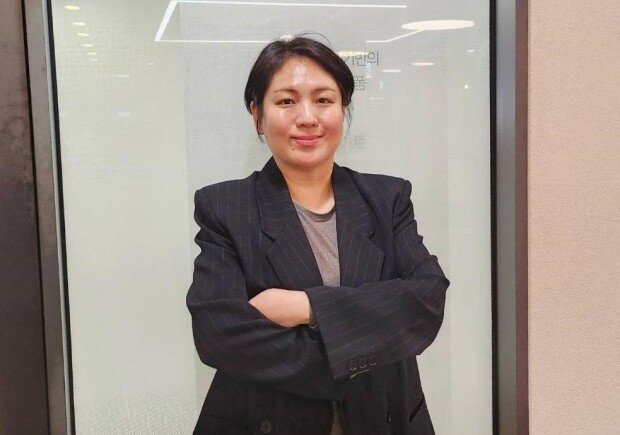
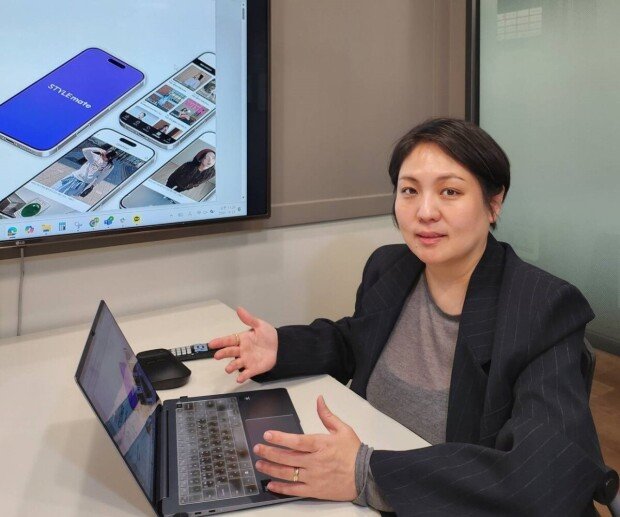
Sang-hee Han, CEO of STYLEmate / source=STYLEmate
STYLEmate: Automating Brand-Perfect Influencer Matching Based on ‘LookTag’
Han explained, "STYLEmate focuses its capabilities on matching influencers perfectly suited to a brand based on our proprietary AI technology, LookTag, and presenting the results with objective indicators." She added, "We convert an influencer's content from unstructured data (photos, videos, hashtags, etc.) into structured data like 'style,' 'mood,' 'tone,' and 'consumer reaction.' We then analyze the marketing brand's history and past campaign data to automatically match the influencer who will yield the optimal efficiency."
Providing a LookTag-based automated influencer matching service / source=STYLEmate
She continued, "Because the AI combines learned data with the brand persona to recommend the influencer with the most synergy, the brand can confirm with data 'why this influencer fits our brand.' Instead of simply matching influencers with a high follower count, we can accurately find those who fit the brand's mood based on qualitative factors like content style, tone, and consumer reaction patterns." Han stated, "Thanks to this, we reduce the time and cost
of executing marketing campaigns while increasing promotional efficiency, leading to results that mutually satisfy both the brand and the influencer."
STYLEmate’ AI explaining the reasoning for an influencer match / source=STYLEmate
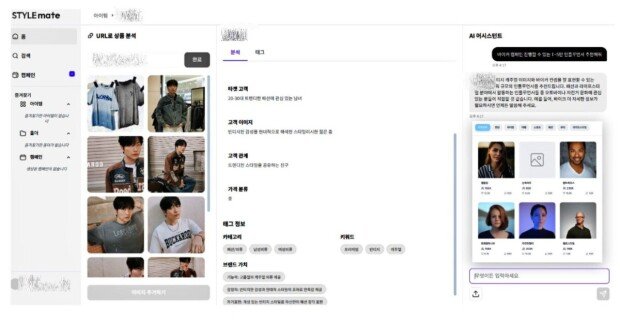
Analyzing brand characteristics to present suitable customer segments, images, and influencers / source=STYLEmate
Han shared a case study demonstrating STYLEmate's technological utility.
"A major conglomerate's fashion brand, 30 years on the market, wanted to shed its old image and launch a campaign bordering on a complete rebranding," she said. "Previously, they relied on their internal marketing team or external agencies to create influencer content, but satisfaction was low regarding both effectiveness and the content's creative quality. STYLEmate analyzed the persona the brand desired using LookTag, matched the influencers likely to create the most synergy, and proceeded with the campaign. As a result, exposure increased by about 300% compared to past content, and content shares and saves rose by about 190%."
"The highly satisfied brand went on to use the influencer content directly as Instagram ad creative. We were able to confirm a structural effect that not only reduced costs compared to existing methods but also improved both content efficiency and consumer response," Han emphasized.
Leveraging Two Strengths: ‘AI-based Automated Influencer Matching Platform + Aesthetically-Driven Content’
STYLEmate differentiates itself by utilizing both its AI-based automated matching platform and the human touch.
"I want to define STYLEmate as a midpoint between an agency and a solution," Han said. "This is because we adopted a structure where the AI-based automated matching platform ensures efficiency and speed, while humans handle creative content planning and brand care. Agencies produce high-aesthetic content but are slow, while platforms are fast but easily miss brand context. For example, even if a legacy jeans brand wants to run a marketing campaign to build a younger image, an AI relying on past data might match an influencer who emphasizes history. Therefore, STYLEmate has humans complement the technology, leveraging both strengths to create content optimized for the brand's KPIs."
She continued, "I recall a time when a fashion brand requested a marketing campaign while opening a pop-up store at a department store in Yeouido. At that time, we quickly matched influencers suitable for the brand based on LookTag and assisted with the campaign execution. The brand, on a limited budget, only requested influencer matching. But we didn't stop there; we personally contacted influencers suitable for the desired campaign and invited them to the offline site. As a result, about 50 influencers visited the location, creating a viral buzz centered on short-form content. This was a strategy that went beyond simple online seeding to connect influencers with an offline brand experience, and a case of leveraging the synergy between technology and people. The brand was moved by the unexpected influencer participation... and developed an ongoing relationship with STYLEmate. Thanks to this meticulousness, STYLEmate currently collaborates with over 200 brands and more than 6,000 influencers."
"We Will Build Market Trust by Securing More Precise Data"
STYLEmate identified data refinement and securing market trust as its growth tasks.
"For STYLEmate to grow further, we need data refinement and market trust," said Han. "Influencer marketing is still an area where brands find it difficult to execute budgets aggressively because of the perception that 'it's hard to prove the effects numerically.' We need an understanding that running one influencer campaign doesn't immediately improve ROAS (Return on Ad Spend). Rather, we intend to prove with data that it is helpful for long-term branding and securing a brand's own content assets. To this end, our R&D is focused on matching influencers based on LookTag, STYLEmate's unique data, and presenting those results as objective indicators."
"We are also pursuing service expansion into the global market. In Japan, we are already conducting cross-border campaigns linking Korean and Japanese brands and influencers. In the United States, we are preparing a Proof of Concept (PoC) by discovering local brands and partners. I believe marketing is all about references, so we aim to prove our technology and the problems we are solving in the actual market through good campaign cases, and then feed those results back into technology advancement," she conveyed.
Sang-hee Han, CEO of STYLEmate / source=STYLEmate
STYLEmate was able to advance its technology with the help of various support organizations. Among them, Han recalls that the achievements made with Seoul National University of Science and Technology (SeoulTech) were a great help in technology development.
"While there are many support programs for startups, 'Jungle,' a global corporate collaboration program run by Seoul National University of Science and Technology (SeoulTech) and AWS, was extremely helpful as it provided insights immediately applicable in the actual industry," Han said. "I was particularly satisfied that it meticulously supports startups at various stages, from early to growth, and provides growth support from a partnership perspective, not just simple grants. Furthermore, we gained practical global market entry insights, including overseas expansion strategies, sales, and networking methods. We were also able to have substantive discussions with AWS during the process of materializing our AI technology. Consequently, the biggest achievement was being able to simultaneously advance our technological foundation and global expansion strategy thanks to the Jungle program."
Finally, we heard about STYLEmate's future plans.
"As of this year, over 200 cumulative brands are using STYLEmate. We started primarily in the fashion sector in our early days, but we have now expanded our categories to beauty and lifestyle. A memorable achievement this year is that as the content quality improved through data-based persona analysis and matching, the number of brands wanting to collaborate with STYLEmate's affiliated influencers increased," Han stated.
"Going forward, we plan to focus more on advancing our LookTag-based AI matching and expanding global/cross-border campaigns. In particular, through PoCs and partnerships in the Japanese and U.S. markets, we will push for advancement into an AI SaaS solution so that brands can easily collaborate with influencers and secure content in the global market. We will also continuously improve the solution's functions to establish ourselves as a marketing AI solution that can be efficiently used by everyone from early-stage startups to growth-stage companies," she said. "We ask for your interest as we will introduce an AI SaaS solution that supports not only short-term campaign performance but also long-term branding and content asset acquisition."
By Dong-jin Kim (kdj@itdonga.com)
* This article was written with support from Seoul National University of Science and Technology.








 About Dong-A Ilbo