

North Korea prepares satellite launch after missile test
North Korea prepares satellite launch after missile test
Posted October. 23, 2025 07:52,
Updated October. 23, 2025 07:52
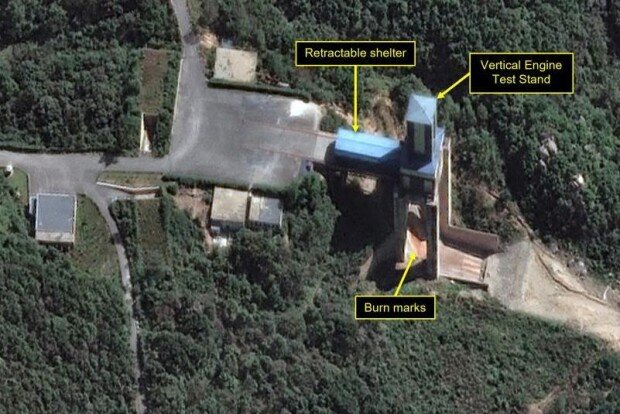
North Korea seems to be preparing further provocations, including a reconnaissance satellite launch, following its first ballistic missile test since President Lee Jae-myung took office and a recent engine test at the Sohae Satellite Launching Station in Cholsan County, North Pyongan Province.
The U.S.-based monitoring site 38 North reported on Oct. 21 that satellite imagery from late September and early October shows recent combustion tests of a small engine around the vertical engine test stand, or VETS. Images from Oct. 4 reveal orange residue and burn marks at the exhaust vent, likely from fuel and oxidizers such as nitric acid or nitrous oxide.
Analysis also noted movable cranes, loaded trucks, and carts carrying hoses and cables shifting positions around the VETS between Sept. 27, 29, and Oct. 4, indicating ongoing site activity.
Jang Yeong-geun, director of the Missile Center at South Korea’s National Strategy Institute, said the activity suggests North Korea is preparing a reconnaissance satellite launch, possibly before year-end. North Korea claimed it successfully launched its first military reconnaissance satellite, “Manrigyong-1,” in November 2023 and announced plans for three more, but no further launches have been observed since a failed attempt in May 2024.
Military analysts expect North Korea to stage shows of force during the APEC summit in Gyeongju, when South Korea is likely to hold meetings with the United States and China. Experts warn Pyongyang could escalate provocations after resuming ballistic missile launches for the first time in more than five months, seeking international recognition as a nuclear power.
A test launch of the Hwasong-20 intercontinental ballistic missile, unveiled during the Oct. 10 parade marking the 80th anniversary of the Workers’ Party of Korea, cannot be ruled out. A military official noted the Hwasong-18 was tested about two months after its parade debut, suggesting the Hwasong-20 could follow soon.
Observers say if North Korea fires a new ICBM capable of reaching the U.S. mainland during the Gyeongju APEC summit, it could secure de facto nuclear status with tacit approval from China and Russia and boost leverage in future nuclear talks with the U.S.
Sang-Ho Yun ysh1005@donga.com








 About Dong-A Ilbo