

YMJLAB Announces 'AI Marketer' for International Taekwondo Studios.
YMJLAB Announces 'AI Marketer' for International Taekwondo Studios.
Posted October. 17, 2025 14:14,
Updated October. 17, 2025 14:17
- YMJLAB, led by CEO Sung-gi Choi, has developed the STEP AI Manager,
an AI-powered marketing and management tool designed to help U.S.
Taekwondo studios focus on teaching by automating administrative and
promotional tasks.
- Unlike traditional systems that mainly handle member management,
this solution emphasizes new student recruitment and streamlines website
and social media updates, resulting in significant time savings and increased
trial class conversions.
- The company is leveraging global partnerships and aims to expand its services
to other self-employment sectors after establishing a strong presence in the
U.S. market.
For many small business owners, the daily grind often involves spending more time on ancillary tasks than on their actual craft. A Taekwondo master, for example, wants to focus on teaching students but instead finds themself bogged down by complex administrative duties like member management, marketing, and tax preparation. This is not just a domestic issue in South Korea; it’s a universal challenge faced by self-employed individuals worldwide.
YMJLAB (Yomangjin Research Lab), a startup led by CEO Sung-gi Choi, is tackling this very problem. With 28 years of diverse experience in the IT industry, Choi has developed a solution that leverages AI to help business owners concentrate on their core operations. He calls it the ‘AI Marketer.’ The company is now venturing into the global market, specifically targeting U.S. Taekwondo studios, known as ‘dojang’, with a unique service called ‘STEP AI Manager.’ We sat down with CEO Choi to discuss his vision for the digital transformation of small businesses.
You have extensive experience across various companies. After a long career in IT, what led you to start a business focused on Taekwondo studios?
I’ve been an entrepreneur since I was 19, working in the IT field for 28 years. I started as a programmer and moved through roles in design, server administration, and web development before focusing on project management (PM) and business strategy from my 30s.
I founded YMJLAB in December 2020, initially with a business model combining virtual reality (VR) and travel. I spent six months on Jeju Island conducting market research and validating the model. We had a smooth start, even being selected as a tourism venture by the Korea Tourism Organization. However, we realized there was a disconnect with our actual customer base. Our research was primarily based on feedback from acquaintances and tech enthusiasts, so we lacked contact with real end-users.
A new opportunity arose through an acquaintance who runs a Taekwondo studio in the United States. I learned that many American students take tours to Korea during their summer breaks. During the 2023 World Scout Jamboree, it was remarked that "more students would likely come to Korea for Taekwondo than for the Jamboree." This insight prompted me to spend 2024 traveling with these tour groups, allowing me to conduct in-depth research on the U.S. Taekwondo market. The STEP AI Manager service was developed specifically for these American studios.
How large is the U.S. Taekwondo market? Why did you choose the U.S. as your first market instead of Korea?
There are approximately 15,000 Taekwondo studios in the U.S., about twice the number in South Korea. What's more surprising is that 70-80% of them are operated by native-born Americans. While early studios were mainly run by Koreans or Korean-Americans, the majority of masters today are local.
It seems that after 50 years of brand-building, the respect and value for Taekwondo are even higher in the U.S. than in Korea. While this is somewhat humbling for a Korean, it also signifies a stable market with significant growth potential.
What are the core features of STEP AI Manager? How does it differ from existing studio management systems?
As a former small business owner myself, and through my work in smart tourism, I've met many self-employed people running restaurants and museums. They start businesses out of passion for their field, but reality forces them to spend most of their time on administration—PR, operations, taxes, and collecting fees. Taekwondo masters, who have dedicated their lives to the martial art, often find using complex digital systems challenging. While there are many ERP solutions and marketing websites on the market, the problem is they are too difficult to use and require extensive learning.
We simplified this with a conversational, ChatGPT-like interface. When a user logs in, the AI Manager proactively makes suggestions, saying, for instance, "You've received several inquiries and trial class requests. They require your review." The user simply needs to confirm and provide instructions, and the AI handles the rest.
That sounds like a clear differentiation from existing systems, which are typically focused on member management. Could you elaborate?
Most existing systems are centered on member management. Their business model is to facilitate tuition payments and take a commission, focusing on features like overdue payment tracking and automatic card payments.
However, in conversations with studio masters, I discovered a more significant pain point. Taekwondo studios have a natural attrition rate; about 3-5% of students leave each month after completing their training or for other reasons. For a dojang with 100 students, that's a loss of 3 to 5 members every month. If they can't recruit more new students than they lose, the business becomes unsustainable.
Therefore, we developed our service with the AI Marketer, which specializes in new member recruitment, as its core function. Websites are more heavily utilized in the U.S. than in Korea. STEP AI Manager revamps a studio's website and automatically updates its social media content to keep visitors engaged. It also includes an AI chatbot for automated consultations, a Q&A messaging system, and a trial class registration assistant.
As for member management, many studios are hesitant to switch from their current systems because it’s a complicated process that requires all members to re-register their payment methods. So, our strategy is to first enter the niche market of marketing solutions. Once we build trust with our clients, we plan to gradually expand into the existing market of member management and other administrative services.
I’m curious about your real-world implementation cases and results. What effects have you seen?
We launched our closed beta in June and expanded to an open beta with six additional studios in August. We were able to analyze data from a 3-4 month operational period at the two North Carolina studios run by our partner, Master Dae-ryung Kim.
Website traffic doubled compared to last year, and the conversion rate from inquiry to trial class increased by 18%. Most impressively, the manager's time spent on answering calls and emails dropped from an average of three hours a day to just 30 minutes—an 85% reduction. This saved time allows them to focus more on caring for their students.
For context, Master Kim is a Taekwondo gold medalist from the 2002 Asian Games. He is a true martial artist who has run studios in the U.S. for 20 years. Having someone of his stature believe in and partner with us speaks to the value of our solution.
Additionally, we've been given an opportunity to present and promote our product at an annual business seminar for Taekwondo school owners in Las Vegas. It's a major event with 200-400 masters attending. It’s scheduled for this month, and our expectations are very high.

I heard you participated in a global collaboration program with Seoul National University of Science and Technology. What kind of support did you receive?
Through the global collaboration program at Seoul National University of Science and Technology (SeoulTech), we joined the ‘MIRACLE’ project, a partnership with Oracle. This allowed us to build a fast and stable system using Oracle Cloud Infrastructure (OCI). A major advantage was that OCI provides an infrastructure that is highly optimized for AI development.
Recently, we were also invited to speak at the Oracle session of the Seoul Investor Forum 2025, where we had the chance to present to investors from Silicon Valley and other international hubs. An overseas accelerator we met there expressed interest in our business, and we have a follow-up meeting scheduled in Los Angeles next week.
Partnering with a global corporation like Oracle also adds a layer of credibility. It’s more compelling to say, "We built this using Oracle's technology and infrastructure," than for a small startup to say, "We built this all on our own."
Running a startup is always a challenge, and pioneering an overseas market is even more difficult. How are you navigating these obstacles?
The biggest difficulties are, of course, fundraising and staffing. Building a team with the necessary pioneering spirit and ability to adapt quickly to new technologies is not easy.
I have no choice but to lead by example. By showing our current and new team members my own dedication, I believe they will follow the vision.
Funding is a similar challenge. Receiving investment is ideal, but when that’s not possible, we take on System Integration (SI) service projects to secure operational funds that we then invest back into development. We also receive significant help from government-funded grants.
What are your plans for the future? Do you intend to expand beyond Taekwondo studios?
Our immediate goal is to achieve meaningful results in the U.S. Taekwondo market. Once we have a firm foothold there, we plan to expand into numerous other self-employment sectors.
I've heard the U.S. small business market is on the scale of a thousand trillion dollars—it's a market of unimaginable size. We want to establish ourselves as a partner to American small business owners.
For now, we are focused on the U.S., but we will eventually consider high-value markets like Europe, as well as markets in Southeast Asia and China. The business stage for Korean companies is global.
Having run many businesses, I know that people want to focus on what they love but are often held back by circumstances. Speaking with Taekwondo masters in the U.S., I realized they share the same struggle. Through STEP AI Manager, we hope to become their partner and help open up a brighter future for them.
By Young-woo Kim (pengo@itdonga.com)
* This article was written with support from Seoul National University of Science and Technology.
an AI-powered marketing and management tool designed to help U.S.
Taekwondo studios focus on teaching by automating administrative and
promotional tasks.
- Unlike traditional systems that mainly handle member management,
this solution emphasizes new student recruitment and streamlines website
and social media updates, resulting in significant time savings and increased
trial class conversions.
- The company is leveraging global partnerships and aims to expand its services
to other self-employment sectors after establishing a strong presence in the
U.S. market.
For many small business owners, the daily grind often involves spending more time on ancillary tasks than on their actual craft. A Taekwondo master, for example, wants to focus on teaching students but instead finds themself bogged down by complex administrative duties like member management, marketing, and tax preparation. This is not just a domestic issue in South Korea; it’s a universal challenge faced by self-employed individuals worldwide.
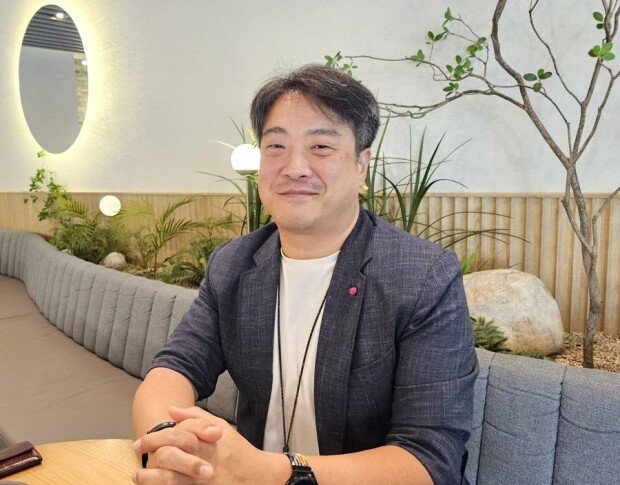
Sung-gi Choi, CEO of YMJLAB / source=IT dongA
YMJLAB (Yomangjin Research Lab), a startup led by CEO Sung-gi Choi, is tackling this very problem. With 28 years of diverse experience in the IT industry, Choi has developed a solution that leverages AI to help business owners concentrate on their core operations. He calls it the ‘AI Marketer.’ The company is now venturing into the global market, specifically targeting U.S. Taekwondo studios, known as ‘dojang’, with a unique service called ‘STEP AI Manager.’ We sat down with CEO Choi to discuss his vision for the digital transformation of small businesses.
You have extensive experience across various companies. After a long career in IT, what led you to start a business focused on Taekwondo studios?
I’ve been an entrepreneur since I was 19, working in the IT field for 28 years. I started as a programmer and moved through roles in design, server administration, and web development before focusing on project management (PM) and business strategy from my 30s.
I founded YMJLAB in December 2020, initially with a business model combining virtual reality (VR) and travel. I spent six months on Jeju Island conducting market research and validating the model. We had a smooth start, even being selected as a tourism venture by the Korea Tourism Organization. However, we realized there was a disconnect with our actual customer base. Our research was primarily based on feedback from acquaintances and tech enthusiasts, so we lacked contact with real end-users.
A new opportunity arose through an acquaintance who runs a Taekwondo studio in the United States. I learned that many American students take tours to Korea during their summer breaks. During the 2023 World Scout Jamboree, it was remarked that "more students would likely come to Korea for Taekwondo than for the Jamboree." This insight prompted me to spend 2024 traveling with these tour groups, allowing me to conduct in-depth research on the U.S. Taekwondo market. The STEP AI Manager service was developed specifically for these American studios.
How large is the U.S. Taekwondo market? Why did you choose the U.S. as your first market instead of Korea?
There are approximately 15,000 Taekwondo studios in the U.S., about twice the number in South Korea. What's more surprising is that 70-80% of them are operated by native-born Americans. While early studios were mainly run by Koreans or Korean-Americans, the majority of masters today are local.
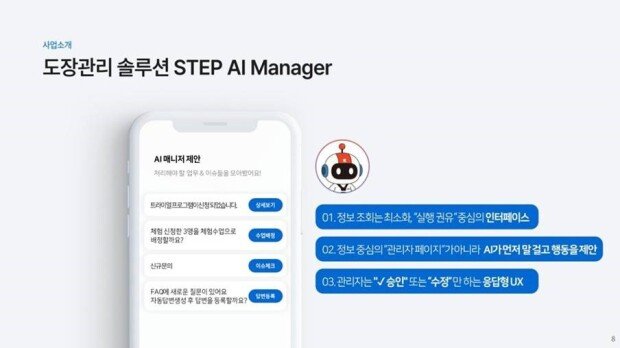
STEP AI Manager for Taekwondo studios in the U.S. / source=YMJLAB
It seems that after 50 years of brand-building, the respect and value for Taekwondo are even higher in the U.S. than in Korea. While this is somewhat humbling for a Korean, it also signifies a stable market with significant growth potential.
What are the core features of STEP AI Manager? How does it differ from existing studio management systems?
As a former small business owner myself, and through my work in smart tourism, I've met many self-employed people running restaurants and museums. They start businesses out of passion for their field, but reality forces them to spend most of their time on administration—PR, operations, taxes, and collecting fees. Taekwondo masters, who have dedicated their lives to the martial art, often find using complex digital systems challenging. While there are many ERP solutions and marketing websites on the market, the problem is they are too difficult to use and require extensive learning.
We simplified this with a conversational, ChatGPT-like interface. When a user logs in, the AI Manager proactively makes suggestions, saying, for instance, "You've received several inquiries and trial class requests. They require your review." The user simply needs to confirm and provide instructions, and the AI handles the rest.
That sounds like a clear differentiation from existing systems, which are typically focused on member management. Could you elaborate?
Most existing systems are centered on member management. Their business model is to facilitate tuition payments and take a commission, focusing on features like overdue payment tracking and automatic card payments.
However, in conversations with studio masters, I discovered a more significant pain point. Taekwondo studios have a natural attrition rate; about 3-5% of students leave each month after completing their training or for other reasons. For a dojang with 100 students, that's a loss of 3 to 5 members every month. If they can't recruit more new students than they lose, the business becomes unsustainable.
Therefore, we developed our service with the AI Marketer, which specializes in new member recruitment, as its core function. Websites are more heavily utilized in the U.S. than in Korea. STEP AI Manager revamps a studio's website and automatically updates its social media content to keep visitors engaged. It also includes an AI chatbot for automated consultations, a Q&A messaging system, and a trial class registration assistant.
As for member management, many studios are hesitant to switch from their current systems because it’s a complicated process that requires all members to re-register their payment methods. So, our strategy is to first enter the niche market of marketing solutions. Once we build trust with our clients, we plan to gradually expand into the existing market of member management and other administrative services.
I’m curious about your real-world implementation cases and results. What effects have you seen?
We launched our closed beta in June and expanded to an open beta with six additional studios in August. We were able to analyze data from a 3-4 month operational period at the two North Carolina studios run by our partner, Master Dae-ryung Kim.
Website traffic doubled compared to last year, and the conversion rate from inquiry to trial class increased by 18%. Most impressively, the manager's time spent on answering calls and emails dropped from an average of three hours a day to just 30 minutes—an 85% reduction. This saved time allows them to focus more on caring for their students.
For context, Master Kim is a Taekwondo gold medalist from the 2002 Asian Games. He is a true martial artist who has run studios in the U.S. for 20 years. Having someone of his stature believe in and partner with us speaks to the value of our solution.
Additionally, we've been given an opportunity to present and promote our product at an annual business seminar for Taekwondo school owners in Las Vegas. It's a major event with 200-400 masters attending. It’s scheduled for this month, and our expectations are very high.
Choi is communicating with local Taekwondo officials in the U.S. / source=YMJLAB
I heard you participated in a global collaboration program with Seoul National University of Science and Technology. What kind of support did you receive?
Through the global collaboration program at Seoul National University of Science and Technology (SeoulTech), we joined the ‘MIRACLE’ project, a partnership with Oracle. This allowed us to build a fast and stable system using Oracle Cloud Infrastructure (OCI). A major advantage was that OCI provides an infrastructure that is highly optimized for AI development.
Recently, we were also invited to speak at the Oracle session of the Seoul Investor Forum 2025, where we had the chance to present to investors from Silicon Valley and other international hubs. An overseas accelerator we met there expressed interest in our business, and we have a follow-up meeting scheduled in Los Angeles next week.
Partnering with a global corporation like Oracle also adds a layer of credibility. It’s more compelling to say, "We built this using Oracle's technology and infrastructure," than for a small startup to say, "We built this all on our own."
Running a startup is always a challenge, and pioneering an overseas market is even more difficult. How are you navigating these obstacles?
The biggest difficulties are, of course, fundraising and staffing. Building a team with the necessary pioneering spirit and ability to adapt quickly to new technologies is not easy.
I have no choice but to lead by example. By showing our current and new team members my own dedication, I believe they will follow the vision.
Funding is a similar challenge. Receiving investment is ideal, but when that’s not possible, we take on System Integration (SI) service projects to secure operational funds that we then invest back into development. We also receive significant help from government-funded grants.
What are your plans for the future? Do you intend to expand beyond Taekwondo studios?
Our immediate goal is to achieve meaningful results in the U.S. Taekwondo market. Once we have a firm foothold there, we plan to expand into numerous other self-employment sectors.
I've heard the U.S. small business market is on the scale of a thousand trillion dollars—it's a market of unimaginable size. We want to establish ourselves as a partner to American small business owners.
For now, we are focused on the U.S., but we will eventually consider high-value markets like Europe, as well as markets in Southeast Asia and China. The business stage for Korean companies is global.
Having run many businesses, I know that people want to focus on what they love but are often held back by circumstances. Speaking with Taekwondo masters in the U.S., I realized they share the same struggle. Through STEP AI Manager, we hope to become their partner and help open up a brighter future for them.
By Young-woo Kim (pengo@itdonga.com)
* This article was written with support from Seoul National University of Science and Technology.








 About Dong-A Ilbo