

Electric vehicles and K-beauty drive Korea exports growth
Electric vehicles and K-beauty drive Korea exports growth
Posted October. 01, 2025 07:52,
Updated October. 01, 2025 07:52
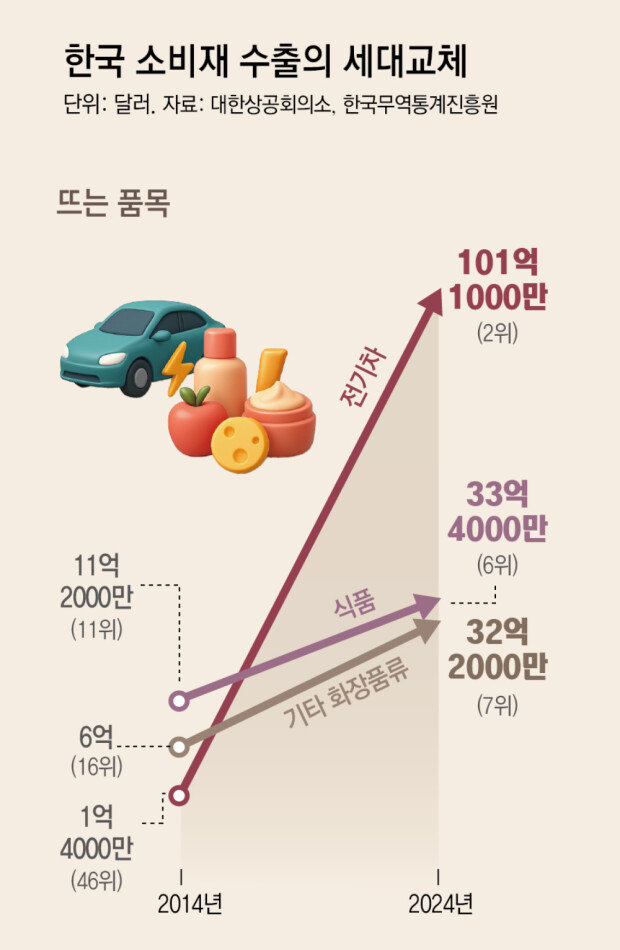
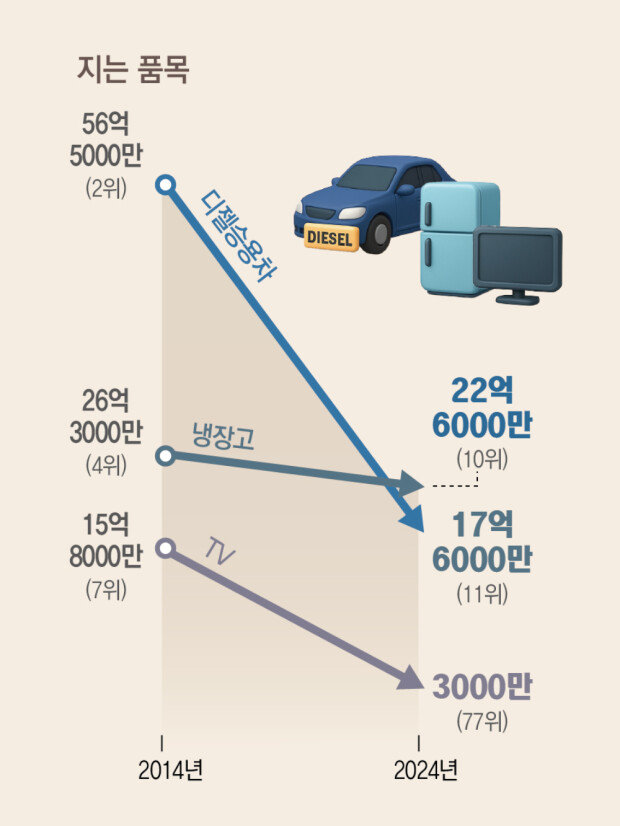
Analysis of South Korea’s consumer goods exports over the past decade shows food and cosmetics tied to K-content have become new growth drivers. Exports of electric vehicles have replaced declining diesel cars, reflecting a generational shift in the sector.
The Korea Chamber of Commerce and Industry released its “Recent Trends in Consumer Goods Exports” on September 30, based on analysis by the Korea Trade Statistics Promotion Institute. According to the report, products previously outside the top 10 in 2014—electric vehicles (46th), food (11th), and other cosmetics (16th)—entered the top 10 last year, ranking 2nd, 6th, and 7th, respectively. Diesel passenger cars (2nd to 11th), televisions (7th to 77th), and clothing accessories (9th to 20th) fell out of the top 10.
Electric vehicle exports jumped from $140 million in 2014 to $10.11 billion last year, a more than 70-fold increase. Cosmetics, 10th in 2014, grew fivefold to 3rd place, while other cosmetics including sheet masks, deodorants, and bath products rose nine spots to 7th, benefiting from global K-beauty popularity. Food, which ranked 11th in 2014, moved up to 6th, aided by strong demand for K-food products such as ramen and fermented sauces.
KCCI noted that automobiles remain the top consumer export, but global decarbonization trends and demand for eco-friendly vehicles have shifted sales from gasoline and diesel cars to electric vehicles. The organization also highlighted that strong preference for Korean brands has boosted demand for cosmetics and food.
Over the past decade, South Korea’s consumer goods exports have expanded rapidly, particularly to the United States. U.S. exports, already the largest at $20.31 billion in 2014, nearly doubled to $38.73 billion last year. China remained the second-largest market, but its export growth was modest, rising from $6.36 billion in 2014 to $6.69 billion last year.
Consumer goods exports grew at an average annual rate of 2.6 percent over the past decade, outpacing the 1.8 percent growth rate for overall merchandise exports. Seo Yong-gu, a business professor at Sookmyung Women’s University, said the sector is relatively insulated from economic cycles, and rising K-brand recognition has stabilized overseas market access.
박종민기자 blick@donga.com








 About Dong-A Ilbo