

Battery fire causes widespread outage in South Korea
Battery fire causes widespread outage in South Korea
Posted September. 29, 2025 07:34,
Updated September. 29, 2025 07:34
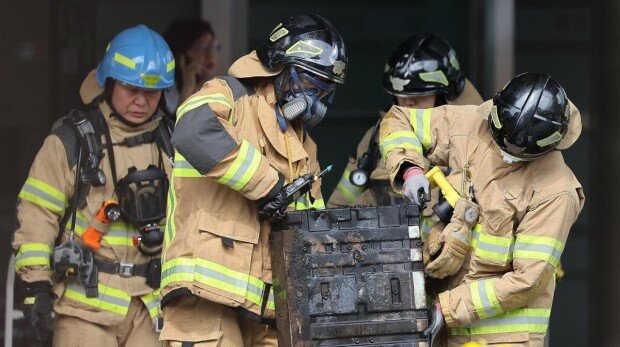
A battery fire at the National Information Resources Service’s Daejeon data center on Sept. 26 triggered a nationwide government network outage, halting key public systems. Online civil services, certificate issuance, postal operations, and banking services were disrupted, causing widespread inconvenience. Authorities warned that full restoration could take time, raising concerns about potential disruptions to public institutions and financial services on Monday, Sept. 29.
The fire broke out at 8:15 p.m. on Sept. 26 and was fully extinguished around 6 p.m. the following day. It reportedly started while lithium batteries in an uninterruptible power supply on the data center’s fifth floor were being relocated. The exact cause remains under investigation. Of the 647 government systems managed by the center, 96 were directly damaged, and 551 were temporarily suspended due to heat-related concerns.
As of Sept. 28, two days after the fire, major government websites, including the online civil service portal Government24 and the Anti-Corruption and Civil Rights Commission platform, remained offline. Postal and delivery services, along with banking and insurance operations, were also disrupted, inconveniencing citizens seeking cash withdrawals or deliveries ahead of the Chuseok holiday. The unprecedented situation prompted the government to issue public notices through private platforms such as Naver and Kakao.
The Ministry of the Interior and Safety began sequentially restoring the 551 systems that were not directly damaged starting the afternoon of Sept. 28, as communication and security infrastructure recovery progressed. By 2 a.m., more than half of the Daejeon network equipment was operational, and 763 of 767 core security devices (99%) were functioning normally. The 96 directly affected systems, however, require data recovery, equipment replacement, and safety verification, so full restoration is expected to take considerable time.
The incident exposed weaknesses in the government’s IT infrastructure. A redundancy system intended to allow other regional centers to take over operations during emergencies failed, amplifying the disruption. Although authorities have been developing a multi-region simultaneous operation system since a 2023 network outage, only a limited number of systems are currently in trial operation.
Experts are calling for a comprehensive review of disaster preparedness at major government information facilities. Lim Jong-in, a professor at Korea University’s Graduate School of Information Security, said the prolonged recovery highlights a critical national security vulnerability and emphasized the urgent need for a dual operation system capable of immediately taking over from other locations during incidents.
송진호 기자 jino@donga.com




![“앤트로픽 버렸다” 미국 개발자들이 중국 AI로 갈아타는 이유[딥다이브]](https://dimg.donga.com/c/138/175/90/1/wps/NEWS/IMAGE/2026/06/24/134171473.1.jpg)



 About Dong-A Ilbo