

South Korea faces tariff reversal, auto exports slump
South Korea faces tariff reversal, auto exports slump
Posted September. 17, 2025 07:41,
Updated September. 17, 2025 07:41
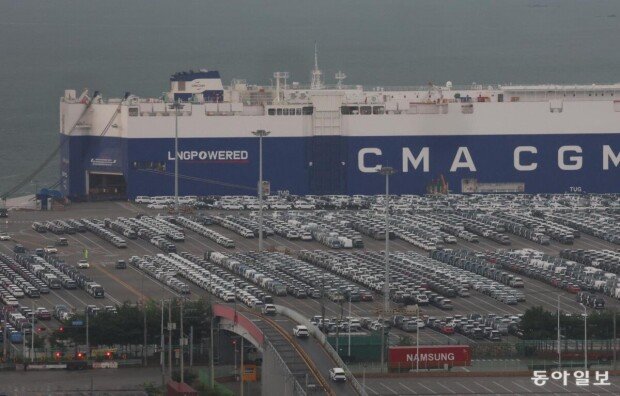
The Trump administration announced that, beginning Sept. 16 local time, it will impose a 15 percent tariff on Japanese automobiles and auto parts. The measure followed U.S. President Donald Trump’s signing of an executive order to implement the U.S.-Japan trade agreement. As a result, Japanese cars will be subject to a tariff rate 10 percentage points lower than South Korea’s, which remains at 25 percent. The change effectively ends the tariff advantage South Korean cars had enjoyed since the Korea-U.S. Free Trade Agreement took effect in 2012.
The South Korean government also reached an agreement on July 30 to set a 15 percent tariff on automobiles, but implementation has been delayed due to difficulties in follow-up negotiations. For South Korean carmakers, already burdened by the Trump administration’s 25 percent tariff, the reversal further undermines their position in price competition with Japanese firms.
Warning signs are already appearing in the U.S. market. According to the Ministry of Trade, Industry and Energy’s “Automobile Industry Trends in August 2025” report released the same day, automobile exports to the United States fell to $2.097 billion, down 15.2 percent from a year earlier. Exports have declined for six consecutive months since March. With the United States accounting for 42.6 percent of South Korea’s automobile exports, tariff impacts have left Korean automakers unable to avoid sluggish sales in their largest market.
As South Korea’s auto industry faces an unprecedented crisis from the combined impact of steep U.S. tariffs and a tariff reversal favoring Japan, the U.S. electric vehicle tax credit is also set to expire in October. The change is expected to deliver another blow to domestic automakers, which had been accelerating their push into the U.S. market with eco-friendly models. Compounding the challenge, a raid by U.S. immigration authorities on HL-GA, the Hyundai Motor Group–LG Energy Solution joint factory in Georgia, has further disrupted plans to expand local production.
For now, the industry is looking beyond the United States in search of a breakthrough. Exports to the European Union in August rose 54 percent to $792 million, while shipments to other parts of Europe jumped 73.2 percent to $547 million, signaling strong demand in the region.
Still, analysts warn that the increase in European exports cannot fully offset the slump in the United States, given the industry’s heavy reliance on the American market. “For the time being, automakers will be forced to sell at a loss as tariff burdens erode profitability," said Lee Hang-gu, a research fellow at the Korea Automotive Technology Institute. "Not only finished vehicle makers but the entire domestic auto parts ecosystem, which is heavily dependent on the North American market, has been put at risk.”
Woo-Sun Lim imsun@donga.com






 About Dong-A Ilbo