

SK and SoftBank expand cooperation in semiconductor technology
SK and SoftBank expand cooperation in semiconductor technology
Posted December. 06, 2025 07:16,
Updated December. 06, 2025 07:16
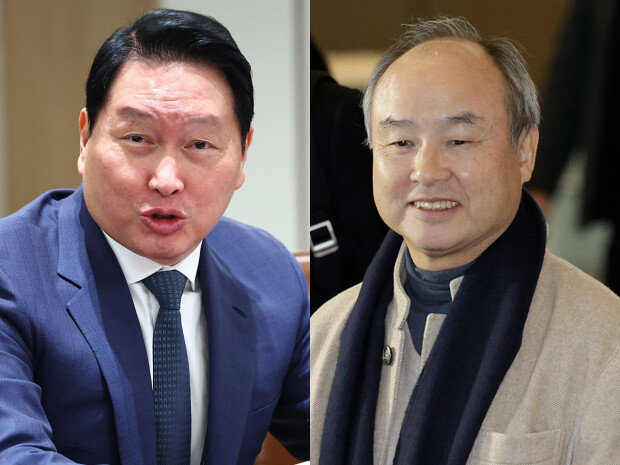
SK Group Chairman Chey Tae-won reportedly held a separate meeting with SoftBank Chairman Son Jeong-eui to discuss collaboration in artificial intelligence and semiconductors. With global competition for AI infrastructure intensifying and semiconductor shortages worsening, attention is focused on whether the two leaders also discussed potential investment in semiconductor facilities.
According to multiple investment banking sources on Dec. 5, Chey met Son for a private dinner at an undisclosed location in Seoul. Son was in South Korea for talks with President Lee Jae-myung, and the business leaders reportedly reconnected during the trip. Chey also attended an investment promotion event in October at Mar-a-Lago in Florida, the private resort of U.S. President Donald Trump, following an invitation from Son.
Industry officials view the latest meeting as preliminary coordination to expand cooperation in semiconductors and artificial intelligence. Earlier that morning, Son met with President Lee Jae-myung to discuss boosting South Korea’s AI competitiveness and deepening ties in the semiconductor sector. Within the industry, SoftBank is seen not merely as a financial investor but as a central player with influence across the semiconductor ecosystem. The company is the majority shareholder of global chip design firm Arm and a long-term investor in Nvidia, a leading AI chip manufacturer. More recently, SoftBank has partnered with OpenAI to advance the Stargate project, which aims to build about $500 billion worth of AI infrastructure in the United States.
SK Group is already participating in the Stargate initiative. On Oct. 1, Chey signed a letter of intent with OpenAI CEO Sam Altman to supply high-bandwidth memory and other memory semiconductors for AI applications. The semiconductor industry is closely watching to see if the recent meeting included discussions on joint investment. SK Group has already indicated plans for massive capital expenditures for AI data centers and the large-scale semiconductor cluster under construction in Yongin.
During a public-private meeting at the presidential office on Nov. 16 following the Korea-U.S. customs negotiations, Chey stated that building the Yongin semiconductor cluster could require more than 600 trillion won. The original estimate was about 120 trillion won, but the projected cost surged more than fivefold due to the strong dollar and sharp increases in raw material prices. This has led to speculation that SoftBank, which is aggressively expanding investment in AI and semiconductors, may have identified common ground with SK Group, which needs substantial capital.
Analysts note that even if the talks evolve into investment negotiations, significant challenges remain. Any participation by SoftBank, a major foreign private investor, in Korea’s strategic industries would require extensive policy and industrial review. Concerns could also surface about growing foreign influence in key national sectors.
이동훈 dhlee@donga.com





 About Dong-A Ilbo