

Korea opens ARM training school to strengthen AI talent
Korea opens ARM training school to strengthen AI talent
Posted December. 06, 2025 07:16,
Updated December. 06, 2025 07:16
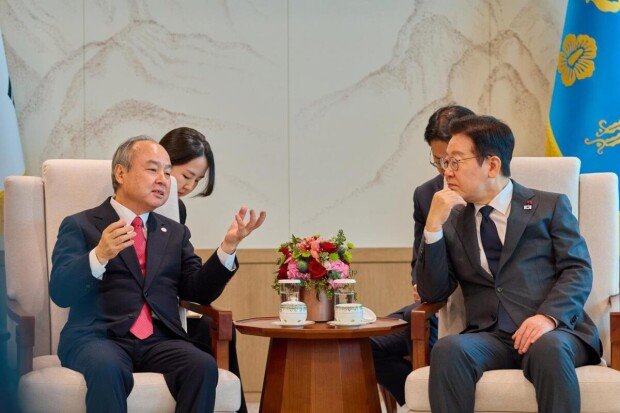
President Lee Jae-myung met with Son Jeong-eui, chairman of Japan’s SoftBank Group, on Dec. 5 and agreed to establish an “ARM School” in South Korea to train 1,400 specialists in semiconductor design. ARM, a subsidiary of SoftBank, is the world’s largest chipless semiconductor company. The initiative reflects South Korea’s push to strengthen system semiconductor design capabilities, which function as the core processing unit in artificial intelligence, through partnerships with leading global AI companies.
During a briefing on the meeting between President Lee and Chairman Son, Presidential Policy Office Director Kim Yong-beom said the Ministry of Trade, Industry and Energy and ARM had signed a memorandum of understanding to strengthen South Korea’s semiconductor and AI industries. He added that both sides would work together to develop plans for establishing the ARM School. Rene Haas, CEO of ARM, also attended the meeting.
President Lee said the initiative would be highly beneficial in nurturing AI talent in South Korea and emphasized that the government aims to build a society where every citizen, corporation and organization uses AI at a basic level, just as they rely on water supply systems, sewage systems and roads.
ARM is a semiconductor design company whose clients include major global tech firms such as Apple, Google and Microsoft, as well as leading semiconductor companies including Samsung, Nvidia and Qualcomm. The company effectively dominates the market for mobile semiconductor design. The ARM School aims to train 1,400 experts in system semiconductors and fabless design by 2030. The government is reportedly reviewing the Gwangju Institute of Science and Technology as the preferred candidate site for the school.
Experts say the ARM School will help cultivate top-tier talent amid growing concerns about the outflow of South Korea’s AI and semiconductor workforce. According to a report released the same day by the Bank of Korea titled “Status of AI Specialists and Supply-Demand Imbalances,” about 16 percent of South Korea’s AI professionals are working overseas, which is roughly 6 percentage points higher than the rate in other sectors. The number of Korean AI workers employed abroad rose sharply from about 4,000 in 2010 to 11,000 last year.
The report also found that the wage premium for AI talent in South Korea was significantly lower than in major global economies last year. The wage premium refers to the additional compensation earned by workers with AI expertise compared with other employees. South Korea’s AI wage premium stands at about 6 percent, just one quarter of the United States’ 25 percent. It is also far below Canada at 18 percent and the United Kingdom, France, and Australia at 15 percent.
윤다빈 empty@donga.com


![[김순덕 칼럼]이 대통령은 왜 ‘탄핵 가능성’을 언급했을까](https://dimg.donga.com/c/138/175/90/1/wps/NEWS/IMAGE/2026/06/17/134133459.1.jpg)
![[단독]선관위, 결재없이 55억 써도 고작 견책…‘자체 징계’ 솜방망이](https://dimg.donga.com/c/138/175/90/1/wps/NEWS/IMAGE/2026/06/19/134138827.4.jpg)


 About Dong-A Ilbo