

Anzaetek: “Revolutionizing Healthcare and Finance with Quantum AI”
Anzaetek: “Revolutionizing Healthcare and Finance with Quantum AI”
Posted September. 15, 2025 13:52,
Updated September. 15, 2025 13:53
- Anzaetek, founded by Renaud Michel Bechade, is revolutionizing healthcare and
finance with Quantum AI, which allows multiple entities to train AI without
sharing raw data.
- This technology addresses privacy, security, and ethical concerns, making AI
adoption easier in these fields.
- Anzaetek's main platforms, QFL Explorer and Sqetch, enable hospitals and
financial institutions to collaborate securely and effectively 1.
[IT Donga, Reporter Young-woo Kim] AI technology is expanding across industries. However, in fields such as healthcare and finance, issues like privacy protection, security, ethical concerns, and accountability have made AI adoption difficult.
For example, hospitals may want to collaborate to develop more accurate disease prediction AI. But because they cannot share sensitive patient information, joint research becomes nearly impossible. It is like asking chefs to cook together without revealing their secret recipes.
As a solution, “Quantum AI,” which applies quantum computing principles to AI, is attracting attention. This technology allows multiple entities to train AI without sharing raw data. Anzaetek, founded by Renaud Michel Bechade, is leading innovation in healthcare and finance with this approach.
A 20-Year Finance Veteran Establishes a “Quantum” Company
Bechade, a French national, has nearly 20 years of experience as a quantitative analyst in global finance. “Quants” use mathematics, statistics, and computer programming to analyze markets and build investment strategies.
He studied computational biomechanics at the University of Tokyo and applied mathematics at École Polytechnique. His career includes roles as Head Quant at Shinhan Investment and KB Securities, Head of Quantitative Analysis for Asia-Pacific at HSBC, Director of Quantitative Research at Standard Chartered Bank, and a credit hybrid specialist at J.P. Morgan. Drawing on this experience, he founded Anzaetek in July 2023.
On why he launched his startup in Korea, Bechade said: “Korea was my last workplace in finance, so I have a strong connection here. While attending quantum-related courses at the Seoul Quantum Campus, I was selected for a government-supported program managed by the Global Startup Center (GSC). That became the catalyst for entering this field.”
Quantum AI: Innovation through Quantum Computing Principles
To understand Quantum AI, one must first understand quantum computers. Unlike conventional computers that process information in binary (0s and 1s), quantum computers use the phenomenon of quantum superposition, which allows them to represent both 0 and 1 simultaneously. It’s like a coin spinning in the air, showing both heads and tails at the same time.
“Simply put, Quantum AI is an advanced mathematical method that helps AI learn better with less data,” Bechade explained. “It not only enhances AI’s learning ability but also strengthens data privacy.”
At the core of Anzaetek’s technology is Quantum Federated Learning (QFL), which allows institutions to jointly train AI models without directly sharing their raw data.
“Hospitals and financial institutions fundamentally cannot share raw data,” Bechade said. “Our goal is to develop a quantum federated AI model that enables joint learning without exposing raw data externally.”

Targeting Healthcare and Finance, Where Security Concerns Have Hindered AI Adoption,
Anzaetek’s main customers include hospitals, asset managers, banks, and insurers. Bechade pointed to rare diseases and micro-credit as areas where Quantum AI can be particularly impactful.
“In rare disease research, where data is scarce, we expect strong results. It can also bring breakthroughs in solving issues such as credit risk, financial fraud, and insurance modeling with limited data,” he emphasized.
The company is developing two main platforms. The first, scheduled for release in December, is QFL Explorer, software that enables hospitals to train AI together without sharing patient information. It combines quantum computing with privacy-preserving features.
The second is Sqetch, a next-generation platform capable of processing diverse data types—images, audio waveforms, and text—all fully encrypted. Like computing inside a sealed box, even the operator cannot see the raw data, only the output. Sqetch prioritizes information protection throughout the entire data pipeline.
“In the case of acute kidney injury, early prediction models are extremely valuable for treatment and prognosis,” Bechade explained. “Being able to predict the likelihood of acute kidney disease without transferring patient records between hospitals is highly meaningful.”
Anzaetek is currently collaborating with the AI Center at Seoul National University Bundang Hospital, one of Korea’s leading medical AI research institutions established in 2020 to apply AI technology across diagnosis, treatment, prevention, and healthcare services.
Partnering with IBM, a Leader in Quantum Computing
Anzaetek has also been selected for a global collaboration program run by Seoul National University of Science and Technology (SeoulTech), which enabled it to partner with IBM, a world leader in quantum computing. Through this program, Anzaetek gained access to IBM’s quantum computer system installed at Yonsei University.
“This program helped us refine how we explain our technology to the public, improve our compliance checklists for security and regulations, and shorten the time from prototype to pilot operations,” Bechade said.

Differentiating from Big Tech Giants
On differentiation from tech giants such as IBM, Google, and Microsoft, Bechade noted: “These big tech companies mainly act as platform providers, offering quantum hardware access, job schedulers, and cloud operating systems.”
“In contrast, Anzaetek develops industry-specific software for healthcare and finance. Our solutions, such as federated learning, confidential computing certification, and blind-style computing, enable collaboration without exposing raw data. While big tech builds large ecosystems, we focus on delivering practical tools within those ecosystems,” he explained.
“Practical Tools for the Quantum Era”
Looking ahead, Bechade said: “Our vision is to build trusted Quantum AI technologies for industries like healthcare and finance, where privacy protection is paramount.”
Specifically, the company will present research titled “Tailor-Made Embeddings for Quantum Machine Learning” at the upcoming QTML (Quantum Techniques in Machine Learning) conference in November. This presentation will demonstrate how large-scale image data can be efficiently processed on quantum computers.
Within the next 12 months, Anzaetek also plans to launch a Multimodal QML Pipeline based on Trusted Execution Environment (TEE) computer systems, further enhancing security for federated learning. “We hope our software will soon be applied across industries in the coming quantum era,” Bechade added.
Although quantum computing is still in its early stages, Anzaetek is taking a practical approach to solving healthcare and finance data privacy challenges. Drawing on broad market experience, the company is aiming for global leadership in Quantum AI innovation.
By Young-woo Kim (pengo@itdonga.com)
* This article was written with support from Seoul National University of Science and Technology.
finance with Quantum AI, which allows multiple entities to train AI without
sharing raw data.
- This technology addresses privacy, security, and ethical concerns, making AI
adoption easier in these fields.
- Anzaetek's main platforms, QFL Explorer and Sqetch, enable hospitals and
financial institutions to collaborate securely and effectively 1.
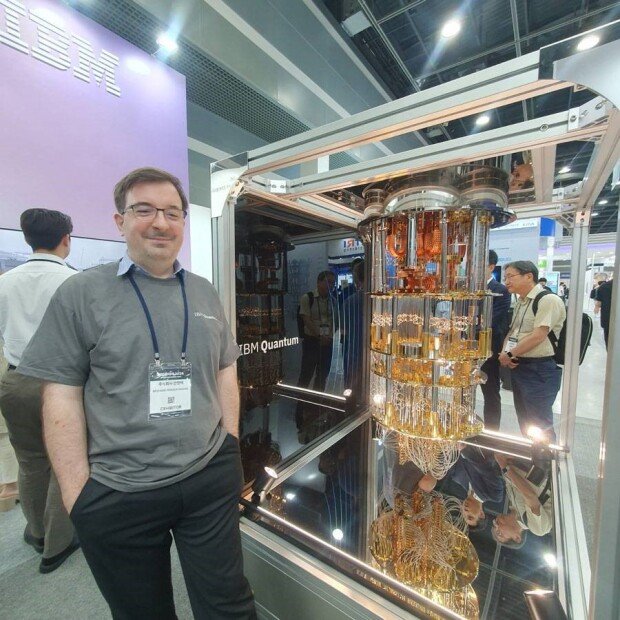
Renaud Michel Bechade, CEO of Anzaetek, in front of IBM’s quantum processor (QPU) exhibited at Quantum Korea 2025 / Source=Anzaetek
[IT Donga, Reporter Young-woo Kim] AI technology is expanding across industries. However, in fields such as healthcare and finance, issues like privacy protection, security, ethical concerns, and accountability have made AI adoption difficult.
For example, hospitals may want to collaborate to develop more accurate disease prediction AI. But because they cannot share sensitive patient information, joint research becomes nearly impossible. It is like asking chefs to cook together without revealing their secret recipes.
As a solution, “Quantum AI,” which applies quantum computing principles to AI, is attracting attention. This technology allows multiple entities to train AI without sharing raw data. Anzaetek, founded by Renaud Michel Bechade, is leading innovation in healthcare and finance with this approach.
A 20-Year Finance Veteran Establishes a “Quantum” Company
Bechade, a French national, has nearly 20 years of experience as a quantitative analyst in global finance. “Quants” use mathematics, statistics, and computer programming to analyze markets and build investment strategies.
He studied computational biomechanics at the University of Tokyo and applied mathematics at École Polytechnique. His career includes roles as Head Quant at Shinhan Investment and KB Securities, Head of Quantitative Analysis for Asia-Pacific at HSBC, Director of Quantitative Research at Standard Chartered Bank, and a credit hybrid specialist at J.P. Morgan. Drawing on this experience, he founded Anzaetek in July 2023.
On why he launched his startup in Korea, Bechade said: “Korea was my last workplace in finance, so I have a strong connection here. While attending quantum-related courses at the Seoul Quantum Campus, I was selected for a government-supported program managed by the Global Startup Center (GSC). That became the catalyst for entering this field.”
Quantum AI: Innovation through Quantum Computing Principles
To understand Quantum AI, one must first understand quantum computers. Unlike conventional computers that process information in binary (0s and 1s), quantum computers use the phenomenon of quantum superposition, which allows them to represent both 0 and 1 simultaneously. It’s like a coin spinning in the air, showing both heads and tails at the same time.
“Simply put, Quantum AI is an advanced mathematical method that helps AI learn better with less data,” Bechade explained. “It not only enhances AI’s learning ability but also strengthens data privacy.”
At the core of Anzaetek’s technology is Quantum Federated Learning (QFL), which allows institutions to jointly train AI models without directly sharing their raw data.
“Hospitals and financial institutions fundamentally cannot share raw data,” Bechade said. “Our goal is to develop a quantum federated AI model that enables joint learning without exposing raw data externally.”
Anzaetek is targeting innovation in healthcare through Quantum AI / Source=Anzaetek
Targeting Healthcare and Finance, Where Security Concerns Have Hindered AI Adoption,
Anzaetek’s main customers include hospitals, asset managers, banks, and insurers. Bechade pointed to rare diseases and micro-credit as areas where Quantum AI can be particularly impactful.
“In rare disease research, where data is scarce, we expect strong results. It can also bring breakthroughs in solving issues such as credit risk, financial fraud, and insurance modeling with limited data,” he emphasized.
The company is developing two main platforms. The first, scheduled for release in December, is QFL Explorer, software that enables hospitals to train AI together without sharing patient information. It combines quantum computing with privacy-preserving features.
The second is Sqetch, a next-generation platform capable of processing diverse data types—images, audio waveforms, and text—all fully encrypted. Like computing inside a sealed box, even the operator cannot see the raw data, only the output. Sqetch prioritizes information protection throughout the entire data pipeline.
“In the case of acute kidney injury, early prediction models are extremely valuable for treatment and prognosis,” Bechade explained. “Being able to predict the likelihood of acute kidney disease without transferring patient records between hospitals is highly meaningful.”
Anzaetek is currently collaborating with the AI Center at Seoul National University Bundang Hospital, one of Korea’s leading medical AI research institutions established in 2020 to apply AI technology across diagnosis, treatment, prevention, and healthcare services.
Partnering with IBM, a Leader in Quantum Computing
Anzaetek has also been selected for a global collaboration program run by Seoul National University of Science and Technology (SeoulTech), which enabled it to partner with IBM, a world leader in quantum computing. Through this program, Anzaetek gained access to IBM’s quantum computer system installed at Yonsei University.
“This program helped us refine how we explain our technology to the public, improve our compliance checklists for security and regulations, and shorten the time from prototype to pilot operations,” Bechade said.
Bechade promoting Anzaetek’s technology at Quantum Korea 2025 / Source=Anzaetek
Differentiating from Big Tech Giants
On differentiation from tech giants such as IBM, Google, and Microsoft, Bechade noted: “These big tech companies mainly act as platform providers, offering quantum hardware access, job schedulers, and cloud operating systems.”
“In contrast, Anzaetek develops industry-specific software for healthcare and finance. Our solutions, such as federated learning, confidential computing certification, and blind-style computing, enable collaboration without exposing raw data. While big tech builds large ecosystems, we focus on delivering practical tools within those ecosystems,” he explained.
“Practical Tools for the Quantum Era”
Looking ahead, Bechade said: “Our vision is to build trusted Quantum AI technologies for industries like healthcare and finance, where privacy protection is paramount.”
Specifically, the company will present research titled “Tailor-Made Embeddings for Quantum Machine Learning” at the upcoming QTML (Quantum Techniques in Machine Learning) conference in November. This presentation will demonstrate how large-scale image data can be efficiently processed on quantum computers.
Within the next 12 months, Anzaetek also plans to launch a Multimodal QML Pipeline based on Trusted Execution Environment (TEE) computer systems, further enhancing security for federated learning. “We hope our software will soon be applied across industries in the coming quantum era,” Bechade added.
Although quantum computing is still in its early stages, Anzaetek is taking a practical approach to solving healthcare and finance data privacy challenges. Drawing on broad market experience, the company is aiming for global leadership in Quantum AI innovation.
By Young-woo Kim (pengo@itdonga.com)
* This article was written with support from Seoul National University of Science and Technology.

![금태섭 “李정부 지탱한 ‘내란 프레임’ 이제 깨졌다”[황형준의 법정모독]](https://dimg.donga.com/c/138/175/90/1/wps/NEWS/IMAGE/2026/06/23/134167619.1.jpg)

![[오늘의 운세/6월 24일]](https://dimg.donga.com/c/138/175/90/1/wps/NEWS/IMAGE/2026/06/24/134170359.1.jpg)
![대포통장 신고했더니 되레 소송… 피해자 90%가 패소[히어로콘텐츠/히든③-上]](https://dimg.donga.com/c/138/175/90/1/wps/NEWS/IMAGE/2026/06/24/134170034.1.jpg)



 About Dong-A Ilbo