

Makeworks, “ ‘CAD View’, WebCAD for construction companies, will lead the smart construction digital transformation.
Makeworks, “ ‘CAD View’, WebCAD for construction companies, will lead the smart construction digital transformation.
Posted August. 26, 2025 10:08,
Updated August. 26, 2025 10:49
- Makeworks, a startup specializing in digital transformation, has developed a
web-based CAD solution called 'CADview' to address the challenges faced by
small and medium-sized construction companies in adopting Building
Information Modeling (BIM) due to high costs and technical barriers.
- CADview leverages existing 2D drawings to deliver effects comparable to a full-
fledged BIM solution, providing 80% of BIM's core functionality on the web.
- Makeworks aims to lead the digital transformation of construction markets not
only in Korea but also overseas, including India and Africa.
While rapid digital transformation (DX) is reshaping various industries, the construction sector remains largely dominated by analog methods, heavily relying on paper drawings and manual processes. Although Building Information Modeling (BIM)—a solution for 3D architectural design and integrated project information management—exists, its high costs and steep technical barriers make it inaccessible for the small and medium-sized construction companies.

‘Makeworks,’ a startup specializing in digital transformation, has emerged to tackle this challenge. Its web-based CAD solution, ‘CADview,’ leverages existing 2D drawings to deliver effects comparable to a full-fledged BIM solution. With its practical, field-oriented approach, Makeworks aims to lead the digital transformation of construction markets not only in Korea but also overseas, including India and Africa.
Solving Problems Found on the Job Site
Kyeong-jun Jeon, CEO of Makeworks who majored in software engineering, directly experienced the slow pace of digital adoption in the construction field during his time working on construction sites as a student. In construction, every phase—from design to quantity surveying—must be organically linked. BIM is the tool that integrates and manages this entire process using 3D data.
However, despite being an ideal program, BIM demands large storage capacities and high-performance hardware, making it expensive. The initial adoption cost can reach $7,500 per person, with an additional $3,400 in annual maintenance fees. Furthermore, a lack of specialized technical skills on actual job sites makes industry-wide implementation difficult. “The Korean government is pushing to mandate BIM, but this primarily applies to large corporations,” Jeon explained. “For the 99.9% of Korea’s 80,000 construction firms that are small to medium-sized businesses, adopting BIM is virtually impossible.”
This realization that the industry needed a digital transformation tailored to the realities of the construction site motivated Jeon to spin off from his role at CNT Tech, a Korean accelerator. He founded Makeworks in 2022 and launched ‘CADview’ last year.
Web-Based CADview: 80% of BIM's Functionality, Now on the Web
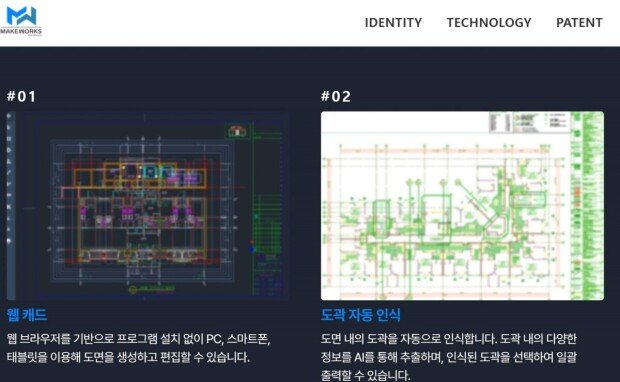
CADview is a SaaS-based web CAD solution that overcomes the limitations of fragile 2D paper drawings while providing 80% of BIM's core functionality. For instance, BIM can calculate material costs by rendering the entire construction process in 3D. CADview achieves a similar result by extracting area information from each layer of a 2D drawing and linking these layers to material prices to generate an automated estimate. It also allows users to create worker accounts directly on the drawings, enabling real-time collaboration and notifications among project participants.
CADview's most significant differentiator is that it is entirely web-based. “With CADview, you can view, create, and edit drawings from anywhere with an internet connection,” Jeon stated. “There is no platform dependency, as it requires no app installation on iOS or Android.” While installed programs like AutoCAD are tied to specific platforms, CADview runs on any standard web browser. It also consolidates features that were previously third-party add-ons in traditional CAD software, such as estimation and drawing sharing, into a single platform.
“Makeworks developed rendering optimization technology based on WebGL, a web-based 3D graphics technology that has matured since 2016,” Jeon said. “Additionally, we’ve incorporated an AI that utilizes the Oracle API to extract and classify text information within drawings, automatically sorting over 100 different types of blueprints.”
Beyond Technology: Targeting India and the Global Market
Since its establishment in 2022, Makeworks has been continuously improving its solution by conducting technology validation for CADview with 87 construction companies since last year, aiming for profitability within the year. While market-dominant incumbents maintain high-price policies and platform dependency, Makeworks’ strategy is to capture market share through affordability and platform independence. “CADview offers its core features to users for free, with a low monthly subscription of about $7 to $22 for additional convenience features,” Jeon noted. This gives it a significant price advantage compared to existing programs that cost thousands of dollars.
This pricing strategy is squarely aimed at global markets, including India. “India has over a million construction companies, most of which are small-scale. The industry employs over 70 million people,” he said. “In these developing nations, cost issues make BIM adoption even more challenging. Makeworks’ goal is to leverage our proprietary technology to enter and quickly establish a foothold in high-growth construction markets like India and Africa.”
Makeworks received support from the Miracle program, jointly run by the Seoul National University of Science and Technology (SeoulTech) and Oracle. “As a cloud-based SaaS solution, we had major concerns about infrastructure, but the program made it much easier to utilize Oracle Cloud Infrastructure (OCI),” Jeon said. “We also received business commercialization grants and various networking opportunities. Notably, Makeworks will be participating in the upcoming Global Seoul Investor Forum in September as an Oracle partner.”
Building on this foundation, Jeon plans to tackle the company’s biggest challenge: sales. “Our team is composed of developers, so we lack sales experience,” he added. “To solve this, we plan to use the practical support we’ve received to hire a sales expert.”
Finally, he emphasized his philosophy with an analogy: “A 3D version of Tetris was released once, but its difficulty spiked, and it ultimately failed in the market. Just as 2D Tetris remains popular because it’s easier for people to process, the demand for 2D drawings will remain steady,” he asserted. “Makeworks will help lead the construction industry’s digital transformation by optimizing 2D drawings for the web.”
By Ye-ji Kim (yj@itdonga.com)
* This article was written with support from Seoul National University of Science and Technology.
web-based CAD solution called 'CADview' to address the challenges faced by
small and medium-sized construction companies in adopting Building
Information Modeling (BIM) due to high costs and technical barriers.
- CADview leverages existing 2D drawings to deliver effects comparable to a full-
fledged BIM solution, providing 80% of BIM's core functionality on the web.
- Makeworks aims to lead the digital transformation of construction markets not
only in Korea but also overseas, including India and Africa.
While rapid digital transformation (DX) is reshaping various industries, the construction sector remains largely dominated by analog methods, heavily relying on paper drawings and manual processes. Although Building Information Modeling (BIM)—a solution for 3D architectural design and integrated project information management—exists, its high costs and steep technical barriers make it inaccessible for the small and medium-sized construction companies.
Kyeong-jun Jeon, CEO of Makeworks / source=IT dongA
‘Makeworks,’ a startup specializing in digital transformation, has emerged to tackle this challenge. Its web-based CAD solution, ‘CADview,’ leverages existing 2D drawings to deliver effects comparable to a full-fledged BIM solution. With its practical, field-oriented approach, Makeworks aims to lead the digital transformation of construction markets not only in Korea but also overseas, including India and Africa.
Solving Problems Found on the Job Site
Kyeong-jun Jeon, CEO of Makeworks who majored in software engineering, directly experienced the slow pace of digital adoption in the construction field during his time working on construction sites as a student. In construction, every phase—from design to quantity surveying—must be organically linked. BIM is the tool that integrates and manages this entire process using 3D data.
However, despite being an ideal program, BIM demands large storage capacities and high-performance hardware, making it expensive. The initial adoption cost can reach $7,500 per person, with an additional $3,400 in annual maintenance fees. Furthermore, a lack of specialized technical skills on actual job sites makes industry-wide implementation difficult. “The Korean government is pushing to mandate BIM, but this primarily applies to large corporations,” Jeon explained. “For the 99.9% of Korea’s 80,000 construction firms that are small to medium-sized businesses, adopting BIM is virtually impossible.”
CADView is a SaaS-based web CAD solution / source=Makeworks
This realization that the industry needed a digital transformation tailored to the realities of the construction site motivated Jeon to spin off from his role at CNT Tech, a Korean accelerator. He founded Makeworks in 2022 and launched ‘CADview’ last year.
Web-Based CADview: 80% of BIM's Functionality, Now on the Web
CADview is a SaaS-based web CAD solution that overcomes the limitations of fragile 2D paper drawings while providing 80% of BIM's core functionality. For instance, BIM can calculate material costs by rendering the entire construction process in 3D. CADview achieves a similar result by extracting area information from each layer of a 2D drawing and linking these layers to material prices to generate an automated estimate. It also allows users to create worker accounts directly on the drawings, enabling real-time collaboration and notifications among project participants.
CADview's most significant differentiator is that it is entirely web-based. “With CADview, you can view, create, and edit drawings from anywhere with an internet connection,” Jeon stated. “There is no platform dependency, as it requires no app installation on iOS or Android.” While installed programs like AutoCAD are tied to specific platforms, CADview runs on any standard web browser. It also consolidates features that were previously third-party add-ons in traditional CAD software, such as estimation and drawing sharing, into a single platform.
“Makeworks developed rendering optimization technology based on WebGL, a web-based 3D graphics technology that has matured since 2016,” Jeon said. “Additionally, we’ve incorporated an AI that utilizes the Oracle API to extract and classify text information within drawings, automatically sorting over 100 different types of blueprints.”
Beyond Technology: Targeting India and the Global Market
Since its establishment in 2022, Makeworks has been continuously improving its solution by conducting technology validation for CADview with 87 construction companies since last year, aiming for profitability within the year. While market-dominant incumbents maintain high-price policies and platform dependency, Makeworks’ strategy is to capture market share through affordability and platform independence. “CADview offers its core features to users for free, with a low monthly subscription of about $7 to $22 for additional convenience features,” Jeon noted. This gives it a significant price advantage compared to existing programs that cost thousands of dollars.
This pricing strategy is squarely aimed at global markets, including India. “India has over a million construction companies, most of which are small-scale. The industry employs over 70 million people,” he said. “In these developing nations, cost issues make BIM adoption even more challenging. Makeworks’ goal is to leverage our proprietary technology to enter and quickly establish a foothold in high-growth construction markets like India and Africa.”
Makeworks received support from the Miracle program, jointly run by the Seoul National University of Science and Technology (SeoulTech) and Oracle. “As a cloud-based SaaS solution, we had major concerns about infrastructure, but the program made it much easier to utilize Oracle Cloud Infrastructure (OCI),” Jeon said. “We also received business commercialization grants and various networking opportunities. Notably, Makeworks will be participating in the upcoming Global Seoul Investor Forum in September as an Oracle partner.”
Building on this foundation, Jeon plans to tackle the company’s biggest challenge: sales. “Our team is composed of developers, so we lack sales experience,” he added. “To solve this, we plan to use the practical support we’ve received to hire a sales expert.”
Finally, he emphasized his philosophy with an analogy: “A 3D version of Tetris was released once, but its difficulty spiked, and it ultimately failed in the market. Just as 2D Tetris remains popular because it’s easier for people to process, the demand for 2D drawings will remain steady,” he asserted. “Makeworks will help lead the construction industry’s digital transformation by optimizing 2D drawings for the web.”
By Ye-ji Kim (yj@itdonga.com)
* This article was written with support from Seoul National University of Science and Technology.




![[단독]‘사채지옥’ 갇힌 20대 여성… 3년간 1.5억 뜯기고 성착취 영상까지](https://dimg.donga.com/c/138/175/90/1/wps/NEWS/IMAGE/2026/06/26/134186010.1.jpg)



 About Dong-A Ilbo