

South Korea faces U.S. pressure ahead of summit talks
South Korea faces U.S. pressure ahead of summit talks
Posted August. 23, 2025 07:10,
Updated August. 23, 2025 07:10
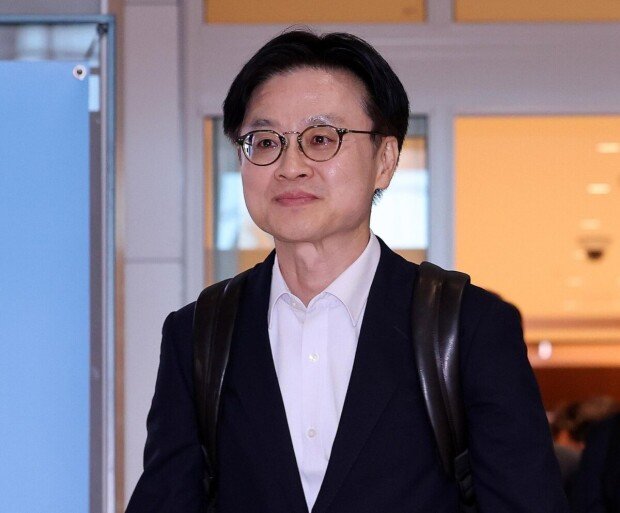
Ahead of the first summit between President Lee Jae-myung and U.S. President Donald Trump, South Korea’s top officials in diplomacy, industry, and trade made an unusually coordinated visit to the United States, sources said on Aug. 22, citing Washington’s additional demands on Korean investment and agricultural market access.
The United States is reportedly demanding a detailed plan for the $350 billion investment fund that South Korea agreed to establish under the tariff deal reached on July 31. With the Trump administration pressing for additional investment by citing subsidies under the CHIPS Act and making a series of unexpected proposals, critics say Washington is effectively changing the rules and increasing pressure as the summit approaches.
“We understand that the United States has demanded specific plans on when and how the $350 billion investment fund will be executed,” a diplomatic source said. "The issue is linked to the summit." A U.S. government official also said the visits by Foreign Minister Cho Hyun and Trade, Industry and Energy Minister Kim Jeong-gwan would include discussions on tariffs.
South Korea and the United States agreed in tariff negotiations concluded on July 31 to establish a $350 billion investment fund for the United States. Of that amount, $150 billion will go to the Maritime and Shipbuilding Growth Alliance (MASGA) project for shipbuilding cooperation, while the remaining $200 billion has been allocated to U.S.-bound investments in semiconductors, nuclear power, secondary batteries, and biotechnology.
However, the two sides have disagreed over the $200 billion portion of the investment fund. South Korea has said that most of it will take the form of loans and guarantees, while the United States maintains it represents actual investment.
“We will reach a written agreement with South Korea and Japan within weeks,” U.S. Commerce Secretary Howard Rutnick said in a CNBC interview on Aug. 19. “Real investment will take place.” The Japanese government has argued that its $550 billion investment fund agreed with the United States consists of loans and guarantees, but Rutnick countered that “their money will be put into actual investment.”
Observers say the United States is applying additional pressure by linking tariff reductions to the investment fund, even though no written agreement has been reached. The South Korean government is reportedly preparing to announce domestic companies’ investment plans totaling $150 billion, separate from the fund, while continuing negotiations with Washington on U.S.-bound investment.
“Talks between South Korea and the United States on investment and tariffs are narrowing little by little, though further consultations are still needed,” National Security Adviser Wi Sung-lac said. “According to President Trump’s remarks, investment issues will be discussed further at the summit. Additional plans are under consideration, which may take shape during the meeting."
Differences over agricultural market access are also expected to be a factor at the summit. On the day the deal was reached, President Trump wrote on his personal social media platform Truth Social that South Korea agreed to fully open trade with the United States and accept American products such as cars, trucks, and agricultural goods. However, South Korean Policy Chief Kim Yong-beom said in a briefing that rice and beef are not subject to further market opening. “It is true that the United States has raised agricultural issues, and we are responding in line with our existing position,” Wi said.
With the United States applying last-minute pressure on investment and agricultural market access, a joint statement may not be issued following the summit. While the U.S. released a joint declaration after its February summit with Japan, recent meetings with the Philippines and other countries have not included joint statements or press conferences. “It is true that we are consulting on the draft of a joint statement,” Wi said. “We cannot say for certain how the final draft will turn out.”
Na-Ri Shin journari@donga.com

![달걀 하루 몇 개까지 괜찮을까?…핵심은 ‘이것’[건강팩트체크]](https://dimg.donga.com/c/138/175/90/1/wps/NEWS/IMAGE/2026/04/27/133818891.3.jpg)
![[알립니다]만성폐쇄성폐질환과 폐고혈압](https://dimg.donga.com/c/138/175/90/1/wps/NEWS/IMAGE/2026/04/24/133800812.4.jpg)



 About Dong-A Ilbo