

Stone cross links Silla to Nestorian Christianity
Stone cross links Silla to Nestorian Christianity
Posted August. 06, 2025 08:14,
Updated August. 06, 2025 08:14
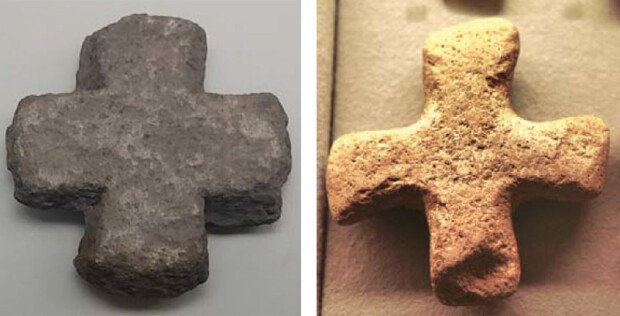
A recent, first-of-its-kind 3D analysis of a stone cross discovered at Bulguksa Temple in Gyeongju, North Gyeongsang Province, has revived theories linking the artifact to a minority Christian sect that reached the ancient Korean kingdom of Silla through the Silk Road. The findings have sparked renewed speculation that Nestorian Christianity, originating in the Roman Empire in the fifth century, might have arrived on the Korean Peninsula around the eighth or ninth century.
In his paper published in the international journal of the Silk Road Research Institute, titled "Secretly Yet Clearly: Tracing Archaeological Evidence of Nestorianism in Manchuria and the Korean Peninsula during the Silla-Balhae Period," Kang In-uk, a history professor at Kyung Hee University, concluded from the 3D survey that the Bulguksa stone cross clearly exhibits distinctive Nestorian characteristics.
According to Kang’s paper, the granite artifact measures approximately 24 centimeters in both height and width. It features the distinctively outward-flared design typical of Nestorian crosses, with visible rough chisel marks on the reverse side.
Nestorianism, also known as Jingjiao, developed from the theological teachings of Nestorius (386–451), the archbishop of Constantinople. Followers believed Christ possessed two distinct natures, divine and human, a doctrine leading them to be classified as heretics by early mainstream Christianity. Consequently, adherents gradually migrated toward East Asia over several centuries, often working as merchants or stonemasons. Professor Kang argues the Bulguksa cross was likely hidden inside a pagoda by a Nestorian stonemason who arrived in Silla via the Silk Road during the Unified Silla period.
Kang further argues that the stone cross appears intentionally carved into a shape suited for insertion into a structure. He proposes that Sogdian stonemasons, who were nomadic people of Scythian descent from the Sogdiana region of Central Asia, embedded the cross within the base of a pagoda. This served both as structural reinforcement and as a discreet expression of their faith.
Similar Nestorian artifacts have been unearthed from contemporary sites in Tang China and Balhae. A common trait among these finds is their discreet placement, hidden from the view of non-believers and outsiders. During the same period, Gyeongju thrived as a cosmopolitan hub, actively welcoming foreign cultures and residents. Kang noted that embedding subtle religious symbols within Buddhist structures was a typical method Nestorians employed to preserve their faith. However, he cautioned against interpreting such discoveries as evidence of active missionary work or the roots of contemporary Christianity.
However, some scholars argue that archaeological evidence is insufficient to support these claims, pointing to uncertainties regarding the artifact's discovery context and manufacturing methods. The stone cross was discovered among scattered stone materials following the destruction of Bulguksa Temple during the Korean War, lacking comprehensive archaeological documentation. According to Park Kyung-shin, curator at Soongsil University’s Korean Christian Museum, an early graduate from Soongsil University’s history department recalled that the cross was found while searching for stones to build a fire during lantern repairs, but precise details about its original location and stratigraphic layer remain unclear.
Jung Woo-taek, an emeritus professor specializing in Buddhist art at Dongguk University, also expressed skepticism. He suggested the artifact could simply be a structural joint carved into a cross shape to connect thick stone components. Jung emphasized the importance of confirming exactly which pagoda the artifact belonged to and whether its production date aligns with the pagoda’s original construction period.
Even if the artifact is confirmed as Nestorian, scholars caution it may not conclusively prove the religion itself spread to the Korean Peninsula. So Hyun-sook, an expert on Sogdian art at the Wonkwang University Korea-China Relations Institute, acknowledged the artifact’s shape strongly suggests Nestorian origins. However, she also highlighted the possibility that only the iconographic elements, similar to those seen in warrior statues modeled after Western Asians at King Wonseong’s tomb (Gwaereung) in Gyeongju, were transmitted. Additionally, the "Nine-Child Mother Statue," discovered alongside the stone cross, likely originated in China between the 12th and 14th centuries, further complicating interpretations of the artifact’s provenance.
이지윤 leemail@donga.com


![[김순덕 칼럼]장동혁 심판이냐, ‘공소취소’ 심판이냐](https://dimg.donga.com/c/138/175/90/1/wps/NEWS/IMAGE/2026/05/06/133874674.1.jpg)





 About Dong-A Ilbo