

South Korea faces sharp decline in clam harvest
South Korea faces sharp decline in clam harvest
Posted July. 22, 2025 08:00,
Updated July. 22, 2025 08:00
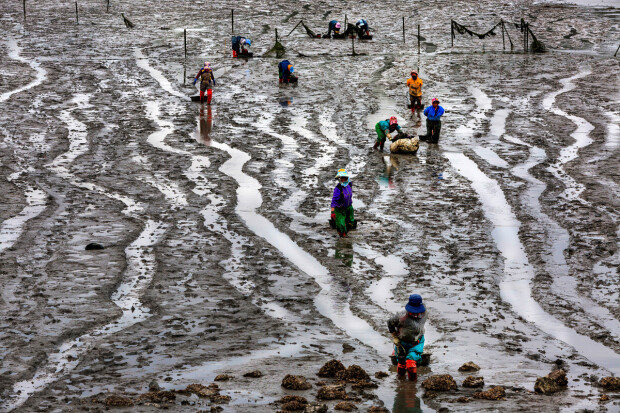
South Korea’s production of short-neck clams could drop by more than half by 2050 due to climate change, according to new research. A study warns that rising sea surface temperatures may sharply reduce the nation's clam harvest, mirroring last year’s 75 percent decline in the Gyeonggi coastal region.
According to the Korean Society of Climate Change Research on Monday, Jung Pil-gyu, a researcher at the National Pukyong University’s Resource and Environmental Economics Research Institute, analyzed projected changes in clam production and related economic losses under three climate scenarios: continued greenhouse gas emissions at current levels, gradual emissions reduction, and complete carbon neutrality by 2070.
The results indicate that if emissions continue at current levels, clam production between 2041 and 2050 is expected to decline by 52.0 percent compared to the average between 2000 and 2022. With gradual carbon reductions, the decline would be 37.9 percent, and under the carbon-neutral scenario, it would be 29.2 percent. The findings suggest that curbing emissions can mitigate the severity of production losses.
The anticipated decline is attributed to rising sea temperatures and reduced salinity, which stress the clams and lower their survival rates. Unlike fish, clams have limited mobility and are more vulnerable to sudden environmental shifts.
Economic losses from reduced clam harvests could exceed 46 billion won. Based on the 2013–2022 average market price of 3,015 won per kilogram, projected damages to the fishing industry could reach 46.07 billion won under current emissions levels and 25.88 billion won if carbon neutrality is achieved by 2070.
By region, South Jeolla Province is expected to be the most brutal hit. Under continued emissions, clam production there could fall by 95.6 percent by mid-century, virtually wiping out the industry. In contrast, South Chungcheong Province would see a more minor reduction of 32.6 percent under the same conditions, faring better than South Jeolla, North Jeolla, and South Gyeongsang.
The impact of extreme heat was already evident last year. During a 41-day high-temperature advisory that began on August 16 last year, clam catches in Gyeonggi’s coastal waters plummeted to just 35 tons, down 74.5 percent from the five-year average of 137 tons. From late August to early November, sea temperatures in the region were 2.1 to 3.0 degrees Celsius above average, reaching a maximum of 28.8 degrees in some areas. Over the past 55 years, the average surface water temperature in the West Sea has risen by 1.19 degrees.
“Mass clam die-offs due to prolonged heat are becoming more frequent,” Jung said. He emphasized the need for targeted local responses, such as developing heat-tolerant clam breeds and improving juvenile seed collection technologies. Local governments are also working to enhance farming conditions by breaking up seabed clumps and spreading sand to improve survival rates.
Hye-Ryung Choi herstory@donga.com








 About Dong-A Ilbo