

Lee Jae-myung’s party challenges judiciary with legislation
Lee Jae-myung’s party challenges judiciary with legislation
Posted May. 15, 2025 07:25,
Updated May. 15, 2025 07:25
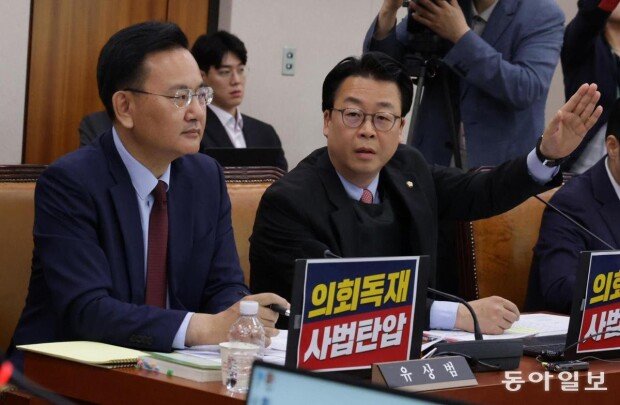
The Democratic Party of Korea launched an all-out offensive Wednesday against the nation’s judiciary, accusing it of interfering in the upcoming presidential election and moving swiftly to pass bills that would overhaul the courts.
During a hearing led by the National Assembly’s Legislation and Judiciary Committee, Democratic lawmakers denounced the Supreme Court’s recent remand of presidential candidate Lee Jae-myung’s case for retrial with an apparent intent to convict, calling it a “judicial coup.”
The party introduced a special prosecutor bill targeting Chief Justice Cho Hee-dae and proposed sweeping amendments to the Court Organization Act to expand the number of Supreme Court justices from 14 to as many as 30 or 100. It also passed a revision to the Public Official Election Act that would effectively shield Lee from prosecution by eliminating part of the false information provision.
With just 19 days left before the June 3 presidential election, the Democratic Party is intensifying its pressure on the judiciary to remove what it calls a “judicial risk” threatening its candidate. The People Power Party condemned the moves as “the beginning of Lee Jae-myung’s path to dictatorship.”
Despite the absence of all 12 Supreme Court justices and four other judges summoned to the hearing, the Democratic Party pressed ahead. Lawmakers argued that the top court’s unusually swift ruling in Lee’s election law case suggested an attempt to derail his candidacy.
In response to Chief Justice Cho’s refusal to attend the hearing, Democratic lawmakers vowed to pursue a full-scale national investigation. The special prosecutor bill was formally submitted to the Judiciary Committee’s first subcommittee despite strong objections from the PPP.
Floor Leader Park Chan-dae of the party issued a warning to the chief justice, saying, “If he ignores the will of the people, a special prosecutor or parliamentary investigation will be inevitable.”
The committee also advanced an amendment to the Constitutional Court Act that would allow constitutional challenges to Supreme Court decisions—a move viewed as further pressure on the judiciary.
Additionally, the committee passed another controversial amendment: a revision to the election law eliminating the “act” requirement from the crime of spreading false information. This would render Lee’s pending charge invalid due to the repeal of the relevant clause. The committee had previously passed a Democratic-led amendment to the Criminal Procedure Act that would pause any ongoing trial if Lee is elected.
The People Power Party accused the Democratic Party of attempting to dismantle judicial independence. “This is not judicial reform—it is judicial assassination,” said Shin Dong-wook, the ruling party’s chief spokesman.
이지운기자 easy@donga.com



![[단독]‘사채지옥’ 갇힌 20대 여성… 3년간 1.5억 뜯기고 성착취 영상까지](https://dimg.donga.com/c/138/175/90/1/wps/NEWS/IMAGE/2026/06/26/134186010.1.jpg)



 About Dong-A Ilbo