

Asiana Airlines introduces six A380 superjumbo jets
Asiana Airlines introduces six A380 superjumbo jets
Posted December. 26, 2016 07:05,
Updated December. 26, 2016 07:17
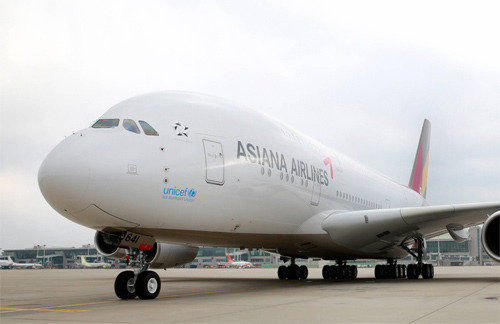
“We held a ceremony to commemorate the introduction of A380 No. 6 at the main tarmac at Incheon International Airport on Friday afternoon,” Asiana Airlines said on Sunday. “The newly introduced airplane will be deployed to the Incheon-Sydney route during the peak winter travel season.” The aircraft will fly between Incheon and Frankfurt, Germany beginning in March next year.
The A380 is the world’s largest passenger jet that is manufactured by Airbus Industries in Europe. Asiana’s A380 comes with 495 seats in total including 12 First Class seats (First Suite) and 66 Business Class seats (Business Smartium), and the superjumbo jet was first introduced by the Korean airliner in May 2014. The First Class seats are fitted with a 32-inch individual screen each, the world’s largest, and a twin sliding door at entrance to each seat, which is designed to protect the privacy of passengers. The Business Class seats feature 180-degree flat bed-type seat, and zigzag-shaped arrangement of seats, while the Economy Class Seats designed as "slim seats" offer 34 inches of leg room.
Asiana plans to continuously increase the efficiency and competitive edge in its long-distance flights including those for Los Angeles (twice daily), New York (once daily), and Frankfurt (once daily) by operating the six A380 superjumbo jets. The aircraft can not only carry a large number of passengers at once, but also help Asiana strengthen its image for premium quality service as the latest model of high-end passenger jet. “We will widely deploy the A380 on the Americas, Europe and Oceana routes, and further solidify our stature as a premium service airliner,” Asiana Airlines CEO Kim Soo-cheon said.
Asiana is handing over short-distance routes, in which budget carriers are engaged in fierce competition, to its subsidiary "Air Seoul," and instead is strengthening mid- to long-range flight routes. Asiana is set to introduce in phases 30 units of the A350 aircraft, a next-generation upper mid-size passenger, from next year, and 25 units of the A321-NEO aircraft from 2019. Once Asiana completes the introduction of these aircraft, which boast "eco-friendliness" buttressed by state-of-the-art technology, the air carrier is expected to complete its roadmap to lay the foundation for mid- to long-term growth.
Sung-Gyu Kim sunggyu@donga.com






 About Dong-A Ilbo