

Declassified files reveal tense nuclear talks
Declassified files reveal tense nuclear talks
Posted July. 01, 2026 08:30,
Updated July. 01, 2026 08:30
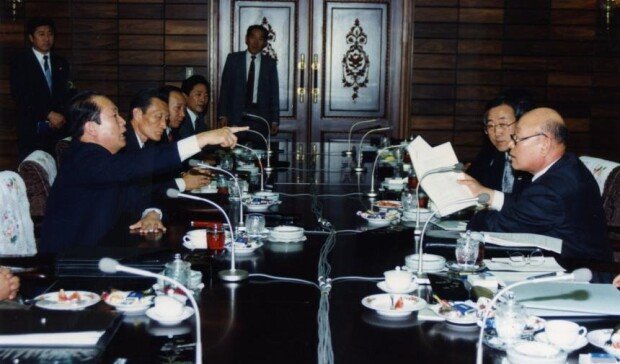
“Hey! Don’t slam the table!”
During North-South nuclear talks held in Panmunjom in March 1992, North Korean delegation chief Choi Woo-jin, then a rotating ambassador at the Foreign Ministry, struck the table and shouted the remark. Lee Dong-won, then vice minister of unification and later unification minister, fired back, saying, “How can someone who does not even know whether his country has nuclear weapons or not discuss nuclear issues?” The exchange quickly escalated, with both sides hurling insults such as “gangsters” and “robbers,” before the meeting ended without progress.
The Ministry of Unification on Tuesday released a 3,836-page trove of inter-Korean dialogue records, shedding light on the intensity of early nuclear negotiations. The documents capture repeated confrontations, profanity and personal insults, including remarks targeting appearance. The material covers talks from December 1991 to January 1993, including the lead-up to the 1991 Joint Declaration on the Denuclearization of the Korean Peninsula and the first rounds of follow-up nuclear discussions.
● North Korean delegate tears up Kim Il Sung photo
According to the records, the two sides held 32 rounds of talks over 13 months, frequently clashing as disputes deepened. Core disagreements centered on North Korea’s acceptance of nuclear inspections and the resumption of the South Korea-U.S. joint military exercise “Team Spirit.” As talks stalled, tensions repeatedly boiled over. Jeong Seung-hoon, former head of the Inter-Korean Dialogue Headquarters and a member of the review committee for the document release, said the early 1990s negotiations were “among the most intense and confrontational in inter-Korean history.”
At the 13th meeting of the South-North Joint Nuclear Control Committee in December 1992, tensions escalated when a North Korean delegate tore up a newspaper containing a photo of North Korean founder Kim Il Sung. Choi Woo-jin accused the South of “colluding with foreign forces” and demanded the cancellation of the Team Spirit exercise. Koh Koo-ryong, then head of the Institute of Foreign Affairs and National Security and later foreign minister, pushed back, asking, “Who is acting subservient to foreign powers?” He then produced a photo showing Kim Il Sung alongside Soviet leader Joseph Stalin, suggesting North Korea’s alignment with outside powers. An enraged Choi tore up the image, calling it a “provocation,” prompting further chaos as Koh protested, “Why are you tearing up the picture of the great leader?”
In another exchange in April of that year, Choi insulted Koh by calling him a “bald man making unreasonable demands,” a personal attack referencing his appearance.
● North Korea showed distrust of Roh Tae-woo administration
The documents also show North Korea closely monitored South Korea’s December 1992 presidential election and used it as leverage to slow negotiations. At the 12th meeting of the Joint Nuclear Control Committee, held eight days before the vote, North Korea expressed distrust, questioning whether a new administration would restart talks from scratch and pressing the South on its intentions. Analysts say Pyongyang appeared to be hedging, waiting to see the next government’s North Korea policy rather than reaching major agreements with the outgoing Roh Tae-woo administration, which was entering its lame-duck phase.
For the first time, draft proposals for mutual nuclear inspection rules were also made public. At the inaugural meeting of the Joint Nuclear Control Committee in March 1992, South Korea proposed surprise inspections of up to 40 facilities a year, while North Korea demanded five days’ advance notice and insisted inspection targets be agreed upon jointly, effectively rejecting intrusive verification measures.
이지윤 asap@donga.com


![[오늘의 운세/7월 3일]](https://dimg.donga.com/c/138/175/90/1/wps/NEWS/IMAGE/2026/07/03/134228901.1.jpg)


 About Dong-A Ilbo