

Scholar traces Japan's nationalist ideology
Scholar traces Japan's nationalist ideology
Posted June. 30, 2026 08:39,
Updated June. 30, 2026 08:39
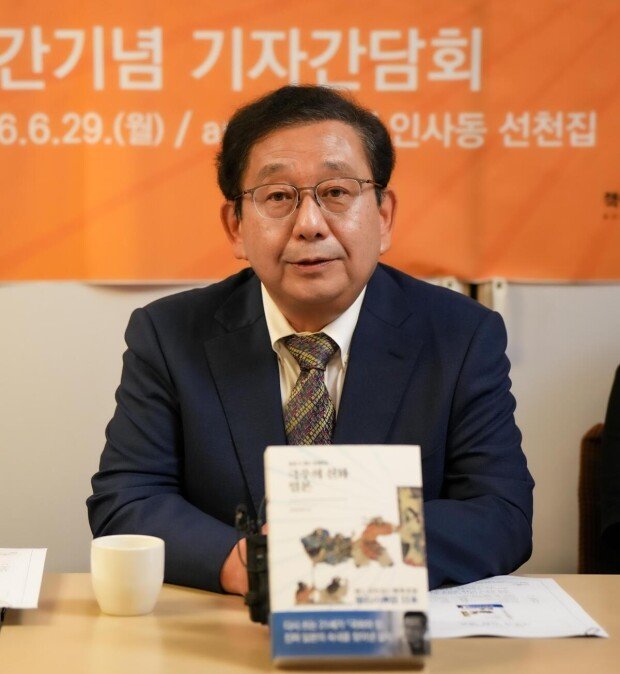
"At the heart of Japan's far-right ideology is the belief that Japan is Asia's preeminent nation," Hosaka said. "That idea dates back to the 17th century, when Neo-Confucian scholars under the Tokugawa shogunate argued that Japan, rather than China, was the true center of civilization. They also glorified the supposed conquest of the Korean Peninsula by Empress Jingu, a legend with no historical basis."
Yoshihisa Hosaka, a leading scholar of South Korea-Japan relations and distinguished professor in the Graduate School of Public Administration at Korea University, made the remarks Monday at a news conference marking the publication of his new book, The Myth of Japan's Far Right.
Hosaka argues that the Edo-period belief that Japan was "the world's true center" fostered a sense of national destiny that eventually fed imperial expansion and war. Because those ideas are deeply embedded in Japan's historical and cultural traditions, he warned, the country's far-right movement remains capable of regaining influence.
Born in Japan, Hosaka graduated from the University of Tokyo's Faculty of Engineering before moving to South Korea in 1988 to study relations between the two countries. He became a naturalized South Korean citizen in 2003. His latest book examines what he sees as the historical roots of Japan's "instinct for war" by tracing the evolution of its far-right ideology.
Hosaka said the foundations of Japan's ultranationalist thinking can also be found in the country's mythology. In one of Japan's founding legends, Empress Jingu invades the Korean Peninsula after receiving a revelation from Amaterasu Omikami, the supreme deity in Shinto, declaring that her descendants are destined to rule the land. Myths surrounding Emperor Jimmu and other early rulers similarly celebrate victory through conquest, he said. Even Amaterasu, best known as the sun goddess, has been portrayed as a deity of war in lesser-known interpretations of Japanese mythology.
"After State Shinto was institutionalized during the Meiji era, the emperor came to be revered as a living deity," Hosaka said. "The far right's ultimate goal is to dismantle the postwar order by revising the pacifist Constitution, restoring the emperor as head of state, reinstating emergency powers and rebuilding the military. In essence, it seeks to return Japan to its pre-1945 system."
Viewed through that lens, Hosaka said, comments by some Japanese broadcasters following Japanese Prime Minister Sanae Takaichi's inauguration as the country's first female prime minister were especially striking. They likened her ascent to the return of the sun goddess Amaterasu. "It could be a sign that mythology, politics, national symbols and military power are once again being woven into a single national narrative," he said.
"Even if the far right accounts for only about 2 percent of Japan's population, that still translates to more than 2 million people," Hosaka said. "Japanese society has generally been reluctant to confront such groups, allowing them to wield influence far beyond their numbers. The debate over imperial succession is one example. In many respects, Japan risks drifting back toward elements of its pre-1945 order."
Jong-Yeob JO jjj@donga.com








 About Dong-A Ilbo