

Chipmakers unveil nationwide production network
Chipmakers unveil nationwide production network
Posted June. 30, 2026 08:38,
Updated June. 30, 2026 08:38
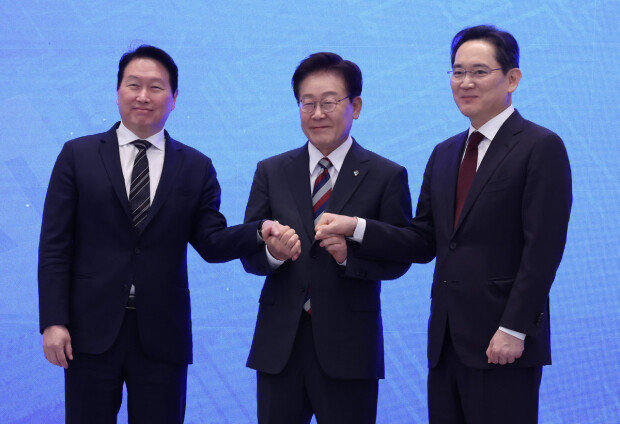
Samsung Electronics and SK hynix on Monday unveiled plans to build four advanced semiconductor fabrication plants in the newly designated Gwangju Metropolitan Special City in South Jeolla Province, a move that dramatically expands South Korea's chip manufacturing footprint beyond the Seoul metropolitan area. The plan was announced during the "National Briefing on South Korea's Three Mega-Projects for a Great Leap Forward" at the presidential office.
Excluding existing semiconductor clusters in Yongin and other capital-area sites, the initiative calls for nearly 1,000 trillion won ($730 billion) in fresh investment across the country's southwestern and central regions. The strategy is intended to meet surging demand for AI semiconductors while reducing the risks of concentrating production in the increasingly infrastructure-constrained capital region.
● Southwest to anchor 800 trillion won investment
The centerpiece of the initiative is a new manufacturing base in the southwest. Samsung Electronics and SK hynix will each invest 400 trillion won to build two cutting-edge memory chip fabrication plants in Gwangju Metropolitan Special City, bringing total investment to 800 trillion won.
It will be the first time large-scale front-end semiconductor fabrication facilities, where wafers are manufactured, have been built outside the Seoul metropolitan area. Until now, regional semiconductor investments have largely focused on materials, components and back-end packaging.
The shift comes as AI fuels an unprecedented increase in demand for memory chips while available infrastructure in the capital region grows increasingly stretched. According to market research firm Omdia, the global memory market is expected to expand from $200 billion in 2025 to $800 billion by 2030, quadrupling in just five years. Both company leaders said the expansion into the southwest reflects the realities of the market.
Lee Jae-yong said the AI revolution is reshaping the semiconductor industry faster than expected. "The market believes that even aggressive semiconductor investment may not be enough to keep pace with explosive demand," he said. "As we accelerate projects already planned for Yongin and other existing sites, we are also considering Gwangju as the location for a new fabrication plant, supported by the incentives expected there."
Chey Tae-won warned that memory chip supply is unlikely to keep up with demand. "Even if we accelerate investments of 600 trillion won in Yongin and 100 trillion won in Cheongju to expand memory production, supply shortages are expected to continue," he said. "To close that gap, we will invest about 400 trillion won in the southwestern region, where sufficient land, electricity and water are available, to build a new fabrication complex."
The companies also laid out a regional investment strategy spanning the semiconductor value chain. They will invest 81 trillion won to establish a large-scale packaging hub across Cheonan, Onyang and Cheongju, strengthening South Korea's competitiveness in high-bandwidth memory chips. The southeastern region, including Busan, and the Daegyeong region, centered on Gumi, will be developed into innovation hubs for semiconductor materials, parts and equipment.
The companies also plan to speed up projects already underway in the capital region. Samsung Electronics aims to shorten construction of its final Yongin fabrication plant by about seven years, while SK hynix plans to reduce the completion timeline for its Yongin industrial complex by roughly 12 years. Samsung will also build its fifth and sixth Pyeongtaek fabrication plants simultaneously, trimming the overall schedule by three to four years. Together, the projects are expected to double South Korea's memory chip production capacity within five years.
● Three-region semiconductor network takes shape
If the southwestern cluster proceeds as planned, South Korea will establish an integrated memory production network linking the Seoul metropolitan area, the central region and the southwest. The strategy combines faster expansion of existing production sites with the gradual development of new manufacturing bases, allowing the country to meet rapidly growing global demand for AI memory chips while strengthening supply chain resilience.
The government has pledged to accelerate power and water infrastructure for the Yongin cluster, reinforcing the capital region's position as the world's largest advanced memory manufacturing base. Samsung Electronics said it will invest 2,030 trillion won in its Yongin and Pyeongtaek semiconductor clusters, while SK hynix plans to invest 600 trillion won in Yongin.
The central region will serve as the country's packaging hub, linking production in the capital area and the southwest. Memory chips manufactured at the new Gwangju fabrication plants are expected to undergo packaging there before shipment.
Kwon Seok-jun, a chemical engineering professor at Sungkyunkwan University, said the investment plan comes at a critical point for the semiconductor industry. "As AI reshapes global manufacturing, expanding production capacity has become essential," he said. "Now that companies have committed to these investments, the government should provide durable support through measures such as special legislation that remains in force regardless of political change, helping reduce uncertainty for businesses."
이동훈 dhlee@donga.com




![[오늘의 운세/7월 2일]](https://dimg.donga.com/c/138/175/90/1/wps/NEWS/IMAGE/2026/07/02/134221102.1.jpg)


 About Dong-A Ilbo