

Time to deliver on reform promises
Time to deliver on reform promises
Posted June. 22, 2026 08:24,
Updated June. 22, 2026 08:24
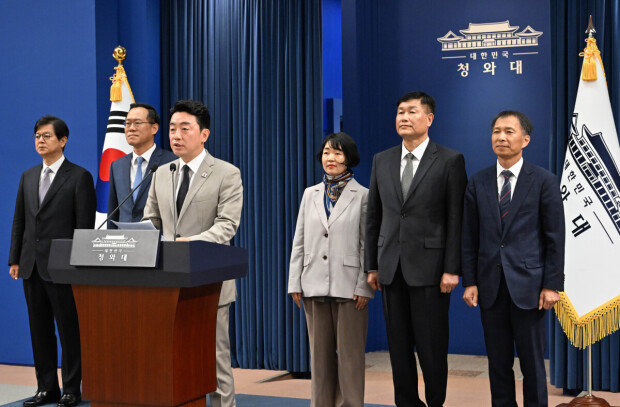
President Lee Jae-myung on June 21 replaced the senior presidential secretaries for public communications, civil affairs and social affairs, along with the second and third deputy directors of the National Security Office. The shake-up, which affects roughly half of the presidential office's senior staff, marks the start of a broader effort to retool the administration for its second year in office. The real test, however, will come with the upcoming Cabinet reshuffle, when Lee will need to show that his pragmatic governing philosophy can translate into strong personnel choices and effective leadership.
The newly appointed senior secretaries, Sung Ki-hong, Han Chan-sik and Kim Kyung-ja, are all younger than the officials they replaced. At the same time, Lee appears poised to retain his three closest aides: Chief of Staff Kang Hoon-sik, Policy Chief Kim Yong-beom and National Security Adviser Wi Sung-lac. Taken together, the appointments point to a strategy of continuity tempered by change. The administration appears intent on preserving stability while quickening the pace of governance and strengthening its communication with the public.
Changes at the presidential office and within the Cabinet offer an early indication of a president's governing priorities and commitment to renewal. If Lee's first year was largely devoted to breaking with the past and laying out a reform agenda, the next phase must focus on turning plans into results. That requires officials with experience, expertise and the ability to execute.
Many administrations have entered their second year promising renewal and insisting that change would begin at the top. Too often, those promises fell short. Too confident in their own judgment and too eager to drive reforms, they repeatedly turned to political loyalists and close associates while failing to broaden their talent pool. If Lee's government truly intends to move beyond ideology, factional interests and partisan confrontation, as it has pledged, its personnel choices should reflect that goal.
If Prime Minister nominee Han Sung-sook wins confirmation, a broader Cabinet reshuffle is likely to follow. The administration should be willing to look widely for the right people to advance its six major reform priorities: regulation, finance, the public sector, pensions, education and labor. At the same time, ethical standards cannot be treated as an afterthought. Appointing candidates who immediately raise questions about their qualifications or conduct would only undermine confidence in the government's reform agenda and consume valuable time.
The administration will move faster only if the prime minister and Cabinet ministers take the lead in shaping and implementing policy. The challenges are already clear. The war in the Middle East has added another layer of uncertainty to a difficult domestic and global environment. The government must bring inflation and housing prices under control while pressing ahead with reforms that raise incomes and create opportunities for young people and the middle class. Close coordination among the government, the ruling Democratic Party of Korea and the presidential office, as well as cooperation with the opposition People Power Party, will be indispensable. In the end, the administration will be judged not by its promises or intentions, but by results that people can see and feel.

![이름-주소 다 다른 유령회사들, 31세 男 한명이 굴리고 있었다[히어로콘텐츠/히든①-下]](https://dimg.donga.com/c/138/175/90/1/wps/NEWS/IMAGE/2026/06/22/134153535.1.jpg)


![[김승련 칼럼]장동혁, 지금이 사퇴할 최적기다](https://dimg.donga.com/c/138/175/90/1/wps/NEWS/IMAGE/2026/06/21/134153719.1.jpg)



 About Dong-A Ilbo