

Korean descendant roots for Korea and Mexico
Korean descendant roots for Korea and Mexico
Posted June. 22, 2026 08:23,
Updated June. 22, 2026 08:23
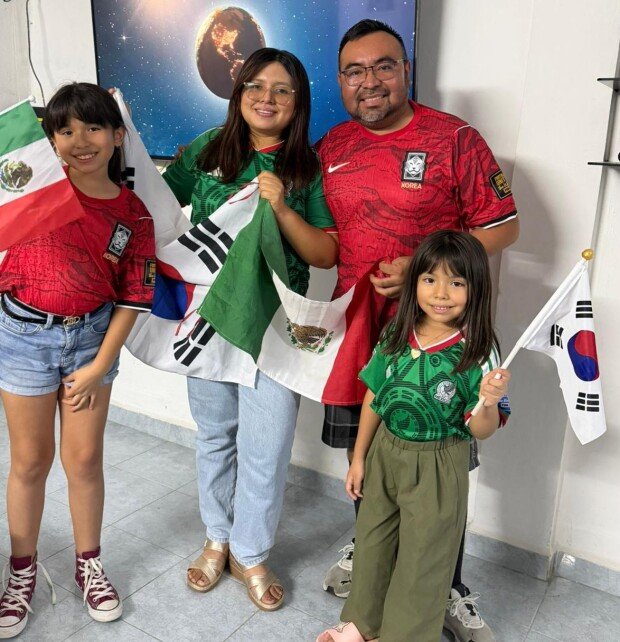
"I was happy when Mexico scored, but I couldn't celebrate too much because I was rooting for South Korea, too."
For Alfonso Manuel May Esquivel, 35, the World Cup match between South Korea and Mexico was more than just a game. Watching from his home in Mérida, Mexico, he found himself pulled in two directions.
Esquivel shared those mixed emotions after South Korea's Group A match against Mexico at the 2026 FIFA World Cup in Guadalajara on June 18.
He watched the match with about 20 family members and relatives, all gathered at his home in Yucatán state. Dressed in green Mexico jerseys and red South Korea national team shirts, they cheered for both sides while enjoying gimbap, bulgogi and soju prepared by Esquivel's mother and wife.
"I wanted both teams to come away with something positive," he said. "Whenever either side mounted a dangerous attack, I found myself worrying someone might get hurt."
Esquivel's family traces its roots to the Korean henequen migrants known as "Aenigyeong." His great-grandfather left Jemulpo Port in Incheon in 1905 and settled in Mérida, where he worked on a henequen plantation. More than 1,000 Koreans who traveled to Mexico at the time endured grueling workdays that often stretched beyond 12 hours. Many labored under harsh conditions and received little in return for their work.
Asked about the South Korea-Mexico matchup, Esquivel said he was pulling for both teams. "No matter how the group finishes, I hope South Korea and Mexico both advance and reach the round of 16," he said.
He also commented on an incident in which a Mexican man made a slant-eye gesture toward South Korean influencer Yoon Su-jin during South Korea's group-stage match against the Czech Republic.
"People in Mexico sometimes make that gesture jokingly, even when no offense is intended," he said. "As a Mexican of Korean descent, I sincerely apologize if people in South Korea were hurt or offended by it."
김화영 기자 run@donga.com

![이름-주소 다 다른 유령회사들, 31세 男 한명이 굴리고 있었다[히어로콘텐츠/히든①-下]](https://dimg.donga.com/c/138/175/90/1/wps/NEWS/IMAGE/2026/06/22/134153535.1.jpg)

![[김승련 칼럼]장동혁, 지금이 사퇴할 최적기다](https://dimg.donga.com/c/138/175/90/1/wps/NEWS/IMAGE/2026/06/21/134153719.1.jpg)


 About Dong-A Ilbo