

Calls grow for Britain’s EU return
Calls grow for Britain’s EU return
Posted June. 22, 2026 08:23,
Updated June. 22, 2026 08:23
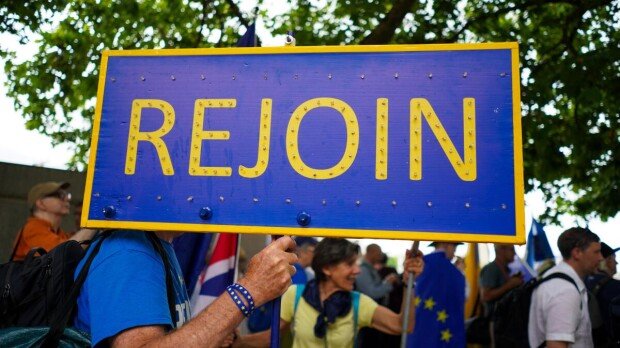
"Rejoin the European Union for trade and jobs."
Thousands of demonstrators marched through central London on June 20, calling for Britain to rejoin the European Union a decade after voters backed Brexit in the landmark June 23, 2016, referendum. Rather than delivering the freer and more competitive nation its supporters had promised, Brexit has been followed by years of sluggish growth, persistent inflation and mounting social pressures, leading a growing number of Britons to question whether leaving the bloc was the right decision.
The political fallout is also weighing heavily on British Prime Minister Keir Starmer, whose leadership is facing its toughest test since taking office in July 2024. The governing Labour Party suffered a crushing defeat in last month's local elections, while Starmer's approval ratings have continued to decline.
The pressure intensified after Andy Burnham, the mayor of Greater Manchester and a rival for the Labour leadership, won a parliamentary by-election in the Makerfield constituency on June 18. His return to Westminster has fueled speculation that Starmer's hold on power is weakening. The Telegraph reported that the prime minister could announce a timetable for his resignation as early as June 22.
● Economic woes revive debate over EU membership
According to commercial broadcaster ITV and other media outlets, about 1,500 demonstrators marched from Temple Station to Parliament Square near Westminster Abbey carrying blue EU flags adorned with the bloc's 12 gold stars. Many wore hats and T-shirts emblazoned with the slogan "Re:Union."
Claire Hall, one of the organizers of the demonstration, told ITV that Britain should fully rejoin the EU. "Food prices have soared, and the paperwork required to bring EU products into the country has become excessive," she said.
Jill Rutter, a senior fellow at the Institute for Government, offered a similar assessment during a recent briefing hosted by the Foreign Press Association. She said the debate over rejoining the EU has resurfaced because it has become increasingly clear that Brexit failed to deliver many of the benefits its supporters expected.
British voters approved Brexit in 2016 by a margin of 51.9% to 48.1%. Although opinion polls ahead of the referendum generally pointed to defeat, strong support from older conservative voters nostalgic for Britain's imperial past and working-class voters who felt marginalized by globalization produced an outcome that surprised many observers.
The referendum sparked deep divisions that have continued to shape British politics over the past decade. The economic consequences have also been significant. Britain lost unfettered access to the EU's vast market, saw the flow of low-cost labor from Eastern Europe decline sharply and found itself increasingly isolated in global trade. The COVID-19 pandemic and the war in Ukraine only added to inflationary pressures.
Nor did Brexit bring the reduction in immigration many supporters had hoped for. Workers from South Asia, the Middle East and Africa gradually filled many of the low-wage jobs once held by Eastern European migrants, leaving the anticipated anti-immigration effect largely unrealized. The disappointment even gave rise to a new term, "Bregret," a blend of Brexit and regret.
For years, discussion of rejoining the EU remained politically taboo amid fears that it would reignite old divisions. But as public opinion has shifted, calls to revisit Britain's relationship with the bloc have grown louder.
● Speculation mounts over Starmer's future
Starmer has struggled with weak approval ratings throughout his time in office as Britain grappled with high prices and sluggish economic growth. Following Labour's heavy losses in local elections, he has faced mounting pressure from within his own party to step aside.
Burnham's by-election victory has further intensified questions about Starmer's political future. In his victory speech, Burnham declared that this is a moment for change. "We have been given an opportunity to change the country's direction," he said. "We will open a new path for Britain."
The remarks underscored his ambitions to seek the nation's top job. Many political observers believe Starmer is likely to follow the precedent set by other British prime ministers and announce a resignation timetable rather than face an internal leadership contest while still in office. The Telegraph reported that Burnham's victory triggered a noticeable shift in sentiment among senior Cabinet ministers and prompted Starmer to reconsider his previously stated determination to remain in office.
Citing comments from a Labour lawmaker once regarded as a close ally of the prime minister, the newspaper also predicted that Starmer could unveil a resignation timetable as early as June 22.
장은지 기자 jej@donga.com

![팔순 노인 전세금까지 빨아먹은 ‘악마의 통장’[히어로콘텐츠/히든①-上]](https://dimg.donga.com/c/138/175/90/1/wps/NEWS/IMAGE/2026/06/22/134153615.1.jpg)
![“1000만원 줄 테니 나가달라”…집주인 제안, 받아도 될까 [집과법]](https://dimg.donga.com/c/138/175/90/1/wps/NEWS/IMAGE/2026/06/19/134130634.3.jpg)
![‘월급 50만원, 아파트는 4억’ 베트남…청년들 “그냥 평생 월세 살란다”[딥다이브]](https://dimg.donga.com/c/138/175/90/1/wps/NEWS/IMAGE/2026/06/19/134141662.1.png)




 About Dong-A Ilbo