

The ruling party must govern responsibly
The ruling party must govern responsibly
Posted June. 15, 2026 08:31,
Updated June. 15, 2026 08:31
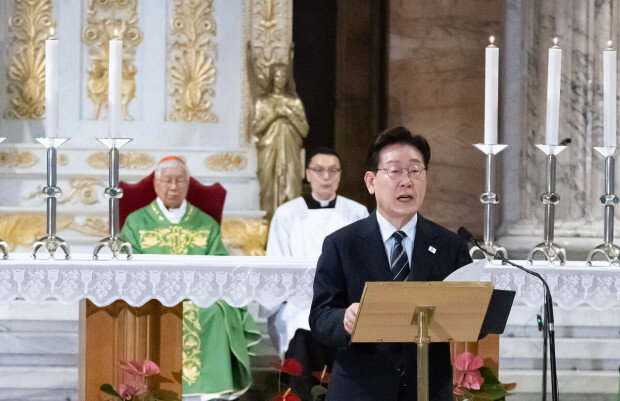
President Lee Jae-myung on Saturday urged the ruling party to place greater emphasis on "the language of responsibility" than on "the language of conviction." Writing on X during a trip to Europe, Lee said the governing party must address the public's everyday concerns and prove its effectiveness through tangible results. He also cautioned that "an idealist detached from reality becomes an ineffectual agitator focused on division rather than solutions." The remarks, made just five days after he said the Democratic Party of Korea must act differently as the party in power, were widely seen as another call for the party to embrace the responsibilities of governing.
Lee's comments came a day after Democratic Party Chairman Jung Chung-rae called for the complete abolition of prosecutors' supplementary investigative authority. The proposal, championed by the party's hard-line faction, has prompted concern even within the ruling camp, where some lawmakers warn that the consequences could ultimately be borne by the public. Justice Minister Chung Sung-ho also pushed back, questioning how victims' rights would be protected if the authority were scrapped entirely. In that context, Lee's remark that “the ruling party's passion should be directed toward the entire nation, not just our side” was widely viewed as a response to the debate.
This is not the first time Lee has reminded the Democratic Party of its responsibilities as the governing party. Three months ago, when hard-line lawmakers resisted the government's prosecution reform proposal and Jung failed to reconcile competing views within the party, Lee stressed that holding power does not mean being free to do as one pleases. Jung insisted at the time that the president's criticism was not directed at him, while the presidential office rejected that interpretation.
The recurring disconnect between Jung and the presidential office has fueled growing talk of a rift within the ruling camp. Disputes among lawmakers and supporters alike have repeatedly spilled into public view. With the party convention approaching in August, tensions are rising further. Jung has publicly remarked that administrations are temporary, while the presidential office has responded by accusing him of undermining the government. The fact that the ruling party leader has become a focal point of conflict with the administration barely a year into its term is troubling in itself.
Meanwhile, not a single party-government-presidential office coordination meeting has been held in the 10 days since the local elections. Yet there is no shortage of pressing issues demanding attention, including inflation, currency weakness, high interest rates, housing stability and employment challenges. The election results suggested that the Democratic Party can no longer count on support sustained largely by the shortcomings of a fractured People Power Party. As the ruling party enters its second year in office, what it needs most are balance, sound judgment and the ability to govern effectively. That will remain difficult so long as the party leadership stays mired in internal strife.








 About Dong-A Ilbo