

Lee warns ruling party against factionalism
Lee warns ruling party against factionalism
Posted June. 15, 2026 08:30,
Updated June. 15, 2026 08:30
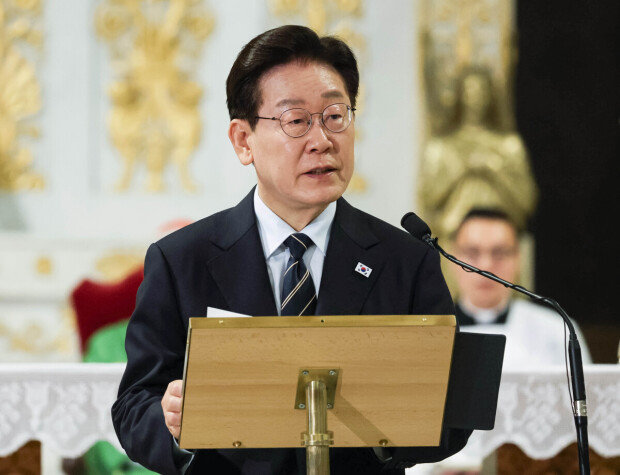
President Lee Jae-myung, currently touring Europe, said Saturday that an idealist detached from reality becomes an ineffectual agitator focused on division rather than solutions, adding that the ruling party’s commitment should be directed toward the entire nation, not merely its own political camp.
The remarks prompted speculation that Lee was sending a message to Democratic Party of Korea Chairman Jung Chung-rae, who has adopted a series of hard-line positions, including a proposal to abolish prosecutors’ supplementary investigative authority, while seeking another term as party leader.
In a post on X, titled “The Ruling Party, the Opposition and Political Responsibility,” Lee said the governing party should act as “a broad vessel” capable of easing tensions and minimizing backlash through dialogue and communication rather than confrontation and exclusion.
A ruling party, Lee said, must remain true to its convictions while placing greater weight on the language of responsibility than on the language of ideology.
“Having been entrusted with power by the people, it must devote its greatest passion to the public good rather than private interests, while maintaining the coolest sense of balance to reconcile ideals with reality,” he wrote. “It must overcome obstacles and challenges and take full responsibility for the outcome.”
Lee’s emphasis on “private interests” and “division,” coupled with his call for greater responsibility from the ruling party, led many within the presidential office and the governing camp to interpret the remarks as an indirect rebuke of Jung.
The interpretation gained momentum after Lee described the June 3 local election results as “a warning from the people to this administration” and publicly apologized as his approval ratings declined. Against that backdrop, some ruling-party officials believe Lee was criticizing Jung’s efforts to shore up support among the party’s hard-line base through proposals such as eliminating prosecutors’ supplementary investigative authority as he campaigns for reelection.
Tensions appear to have deepened after Jung said on June 10 that “the people are eternal, while administrations are short-lived.” The comment reportedly drew a strong reaction inside the presidential office. A senior ruling-party official said Sunday that some aides viewed the remark as “effectively a threat of impeachment against the president.”
The feud between lawmakers aligned with Lee and those backing Jung has increasingly spilled into public view.
Rep. Cho Gye-won, a member of the pro-Lee faction, wrote on Facebook on Sunday that Jung appeared to be disregarding the president’s message by reviving the issue of supplementary investigative authority and once again framing politics along factional lines.
“I would rather he be honest and openly declare that he disagrees with President Lee and intends to pursue his own faction-centered path,” Cho wrote.
Cho Seung-rae, the Democratic Party’s secretary-general and a close Jung ally, rejected that interpretation. He said Lee’s remarks should be understood as a broader call for the ruling party to demonstrate greater responsibility following the local elections.
“To reduce the president’s comments to a message aimed at a specific individual is to misrepresent his intentions,” Cho said.
Kyu-Jin Shin newjin@donga.com







 About Dong-A Ilbo