

Voters must look beyond partisan battles
Voters must look beyond partisan battles
Posted June. 03, 2026 08:32,
Updated June. 03, 2026 08:32
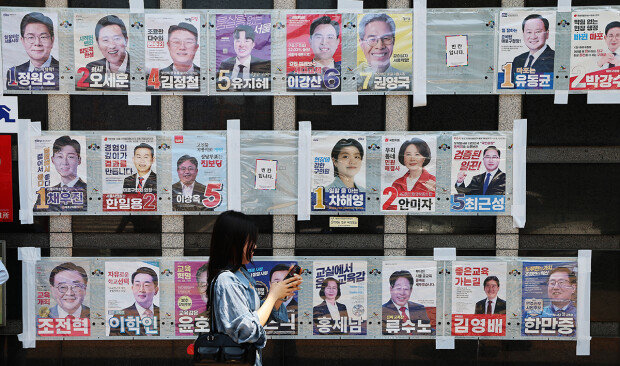
Voting is underway Wednesday in South Korea's June 3 local elections, with voters selecting 4,227 officials ranging from provincial governors and mayors to local council members and superintendents of education. By-elections for 14 National Assembly seats are also being held. About 10.5 million of the country's 44.65 million eligible voters cast ballots during the two-day early voting period, leaving roughly 34.15 million voters to make their decisions on Election Day.
The outcome will provide an important measure of public sentiment toward the governing party's policy agenda and the opposition's future direction. Yet the broader political implications should not overshadow the primary purpose of local elections: choosing capable leaders to serve local communities. Local governments and councils wield substantial influence over issues that directly affect daily life, including housing, public safety, transportation, welfare and education, while also determining how public funds are allocated. Before heading to the polls, voters should consider whether incumbent officials have exercised those responsibilities effectively and whether challengers are offering stronger and more practical alternatives.
The importance of that decision is underscored by the vast sums of public money at stake. Local government leaders, including governors and mayors, are responsible for managing a combined budget of about 481 trillion won this year. The nation's 17 metropolitan and provincial education offices account for another 96 trillion won. Together, those budgets amount to nearly 80 percent of the central government's spending. Given the steady rise in public expenditures, the local government heads and education superintendents elected this year will oversee more than 2,300 trillion won over the next four years. Voters should therefore take a hard look at whether candidates entrusted with such resources are proposing realistic policies or simply offering expensive promises at taxpayers' expense.
The future of local communities is inseparable from the competitiveness of the broader economy. Developing industries tailored to regional strengths, creating quality jobs and building the capacity for sustained growth are no longer goals that can be deferred. Voters should carefully evaluate which candidates have presented concrete plans and credible funding sources to secure their region's economic future.
This campaign has done little to break from the familiar pattern of partisan rivalry, negative attacks and disputes over unverified allegations, often pushing policy discussions into the background. That makes it all the more important for voters to distinguish between candidates who resort to personal attacks to mask a lack of qualifications and those who rely on glossy campaign promises to conceal weak policy visions. The greater the voter participation, the more difficult it will be for either victors or defeated candidates to ignore the message delivered by the electorate.

![[속보]트럼프 “이란과 14일 합의 서명”…혁명수비대 “절대 없을 것”](https://dimg.donga.com/c/138/175/90/1/wps/NEWS/IMAGE/2026/06/14/134105551.1.jpg)





 About Dong-A Ilbo