

Chip boom powers South Korea exports
Chip boom powers South Korea exports
Posted June. 02, 2026 08:23,
Updated June. 02, 2026 08:23
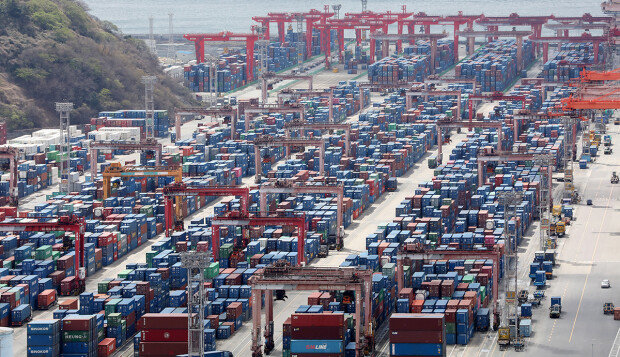
South Korea’s exports hit a record $87.75 billion in May, shrugging off headwinds from conflict in the Middle East and elevated oil prices. Monthly shipments have stayed above $80 billion for three straight months. If the trend continues, the country is on track for an annual record of roughly $1 trillion and could break into the world’s top five exporters.
Semiconductors led the gains. Chip exports reached a record $37.2 billion, up 169.4% from a year earlier. The increase was driven by stronger artificial intelligence investment from U.S. tech companies including Google and Meta, along with rising memory chip prices, extending what is widely described as a semiconductor supercycle. Computer exports also surged 290.7%, reflecting robust demand for information technology products.
The Korea Institute for Industrial Economics and Trade projects exports will reach $924.4 billion this year, just one year after South Korea crossed the $700 billion mark. If achieved, the country would overtake Hong Kong, Japan and Italy to rank among the world’s five largest exporters. Should exports exceed $1 trillion, South Korea could also surpass the Netherlands, which ranked fourth globally last year at $964.1 billion, much of it driven by re-exports.
The strong headline figures mask a growing concentration in semiconductors. The sector’s share of exports rose from 24% a year earlier to 42.3%. By contrast, exports of automobiles fell in May due to fewer working days, supply chain disruptions, logistics uncertainty linked to Middle East conflict and U.S. tariffs. Home appliances and steel also declined. Petroleum product export values increased on higher oil prices, but volumes fell.
Semiconductors remain a highly cyclical industry, often characterized by sharp swings between expansion and downturn. Companies tend to ramp up capacity during upturns, only to face steep price declines when demand weakens. More recently, demand has been driven less by consumer electronics such as PCs and smartphones and more by artificial intelligence investment from major tech firms. The industry is also shifting toward a more contract-based, order-driven model, which could lengthen the current upcycle. Even so, risks remain that higher interest rates or weaker demand could quickly dampen big tech spending, pulling down both semiconductor exports and overall trade.
Removing the so-called semiconductor effect exposes a more fragile export structure. Heavy reliance on a single industry accounting for nearly half of total exports leaves the economy vulnerable to shocks. Efforts to diversify exports toward small and mid-sized firms, as well as materials, parts and equipment industries, continue. So do efforts to expand markets beyond the United States and China into Southeast Asia, India and Latin America. Even during strong cycles, the need to prepare for downturn risk remains clear.








 About Dong-A Ilbo